NASA Media Archive
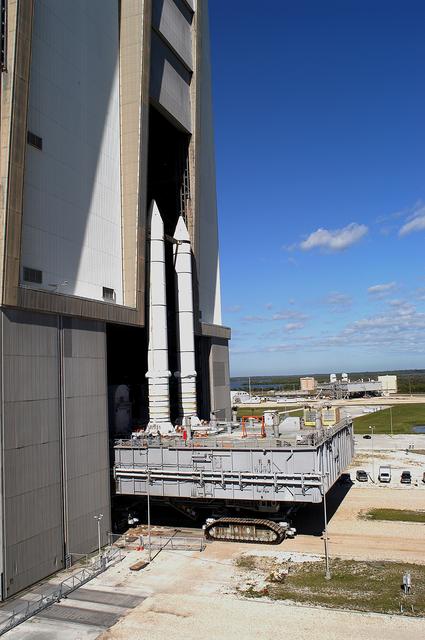
KENNEDY SPACE CENTER, FLA. - Mobile Launcher Platform (MLP) number 3 and a set of twin solid rocket boosters, atop the crawler-transporter, crawl out of the Vehicle Assembly Building (VAB) in support of the second engineering analysis vibration test on the crawler and MLP. In the background is another MLP. The crawler is moving at various speeds up to 1 mph in an effort to achieve vibration data gathering goals as it leaves the VAB, travels toward Launch Pad 39A and then returns. The boosters are braced at the top for stability. The primary purpose of these rollout tests is to gather data to develop future maintenance requirements on the transport equipment and the flight hardware. Various parts of the MLP and crawler transporter have been instrumented with vibration data collection equipment.
KSC-03pd3151
KSC | 2003-11-21
Details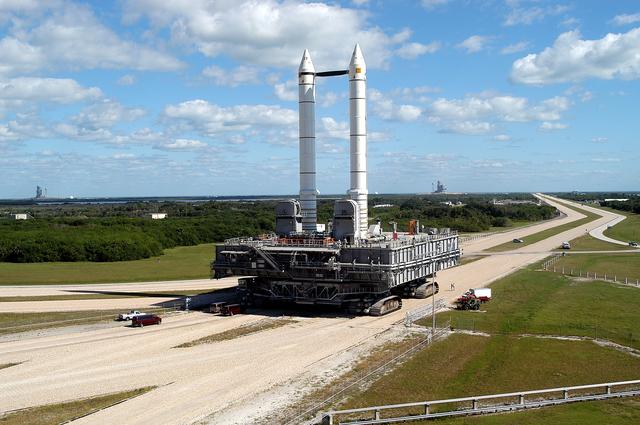
KENNEDY SPACE CENTER, FLA. - Mobile Launcher Platform (MLP) number 3 and a set of twin solid rocket boosters, atop the crawler-transporter, inch along the crawlerway in support of the second engineering analysis vibration test on the crawler and MLP. The crawler is moving at various speeds up to 1 mph in an effort to achieve vibration data gathering goals as it leaves the VAB, travels toward Launch Pad 39A (on the horizon at right; Pad 39B is at far left), and then returns. The boosters are braced at the top for stability. The primary purpose of these rollout tests is to gather data to develop future maintenance requirements on the transport equipment and the flight hardware. Various parts of the MLP and crawler transporter have been instrumented with vibration data collection equipment.
KSC-03pd3155
KSC | 2003-11-21
Details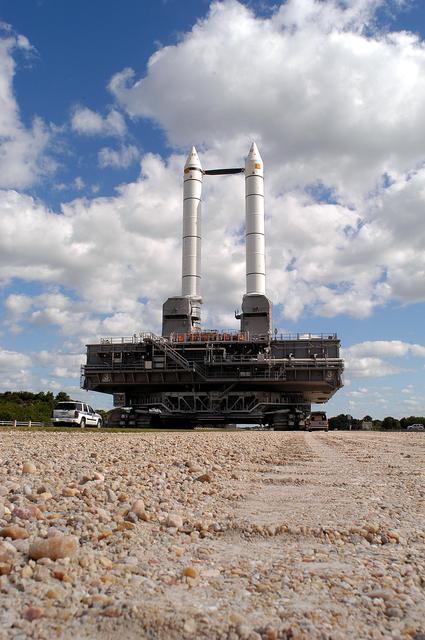
KENNEDY SPACE CENTER, FLA. - Mobile Launcher Platform (MLP) number 3 and a set of twin solid rocket boosters, atop the crawler-transporter, inch along the crawlerway in support of the second engineering analysis vibration test on the crawler and MLP. The view reveals the river gravel surface that is 4 inches thick on the straightaway sections and 8 inches thick on curves. The crawler is moving at various speeds up to 1 mph in an effort to achieve vibration data gathering goals as it leaves the VAB, travels toward Launch Pad 39A and then returns. The boosters are braced at the top for stability. The primary purpose of these rollout tests is to gather data to develop future maintenance requirements on the transport equipment and the flight hardware. Various parts of the MLP and crawler transporter have been instrumented with vibration data collection equipment.
KSC-03pd3156
KSC | 2003-11-21
Details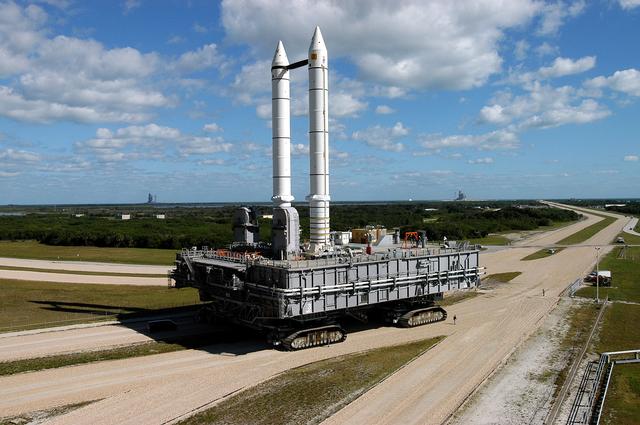
KENNEDY SPACE CENTER, FLA. - Mobile Launcher Platform (MLP) number 3 and a set of twin solid rocket boosters bolted to it, atop the crawler-transporter, crawl to the intersection in the crawlerway in support of the second engineering analysis vibration test on the crawler and MLP. In the background are Launch Pads 39A (right) and 39B (left). The crawler is moving at various speeds up to 1 mph in an effort to achieve vibration data gathering goals as it leaves the VAB, travels toward Launch Pad 39A and then returns. The boosters are braced at the top for stability. The primary purpose of these rollout tests is to gather data to develop future maintenance requirements on the transport equipment and the flight hardware. Various parts of the MLP and crawler transporter have been instrumented with vibration data collection equipment.
KSC-03pd3159
KSC | 2003-11-21
Details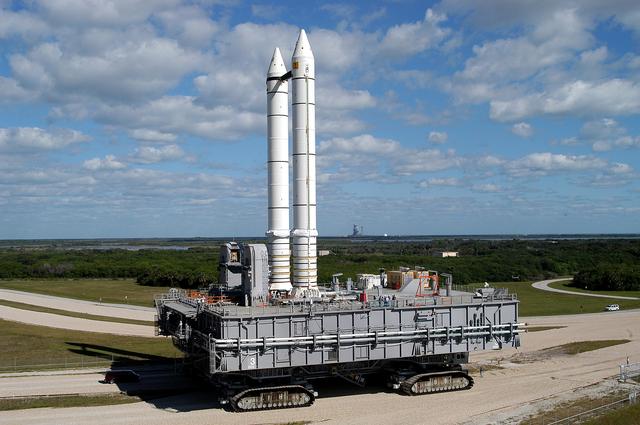
KENNEDY SPACE CENTER, FLA. - Mobile Launcher Platform (MLP) number 3 and a set of twin solid rocket boosters, atop the crawler-transporter, inch along the crawlerway in support of the second engineering analysis vibration test on the crawler and MLP. The crawler is moving at various speeds up to 1 mph in an effort to achieve vibration data gathering goals as it leaves the VAB, travels toward Launch Pad 39A (on the horizon) and then returns. The boosters are braced at the top for stability. The primary purpose of these rollout tests is to gather data to develop future maintenance requirements on the transport equipment and the flight hardware. Various parts of the MLP and crawler transporter have been instrumented with vibration data collection equipment.
KSC-03pd3153
KSC | 2003-11-21
Details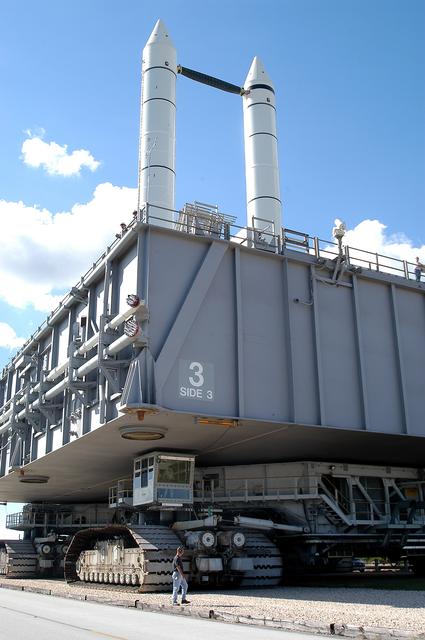
KENNEDY SPACE CENTER, FLA. - A Kennedy Space Center technician monitors the performance of a crawler-transporter as it moves Mobile Launcher Platform (MLP) number 3, with a set of twin solid rocket boosters bolted atop, to the intersection in the crawlerway during the second engineering analysis vibration test on the crawler and MLP. The crawler is moving at various speeds up to 1 mph in an effort to achieve vibration data gathering goals as it leaves the VAB, travels toward Launch Pad 39A, and then returns. The boosters are braced at the top for stability. The primary purpose of these rollout tests is to gather data to develop future maintenance requirements on the transport equipment and the flight hardware. Various parts of the MLP and crawler transporter have been instrumented with vibration data collection equipment.
KSC-03pd3162
KSC | 2003-11-21
Details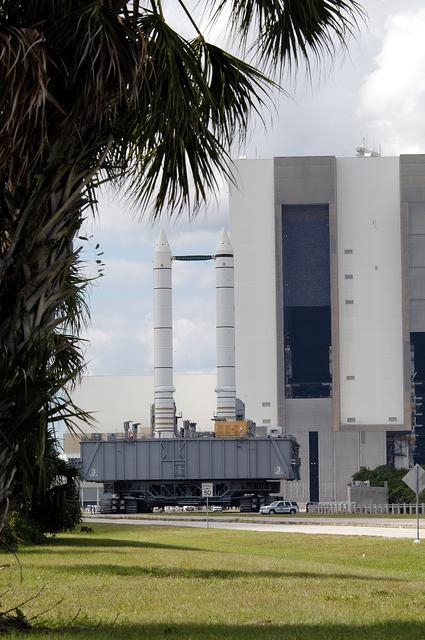
KENNEDY SPACE CENTER, FLA. - Mobile Launcher Platform (MLP) number 3 and a set of twin solid rocket boosters, atop the crawler-transporter, crawls away from the Vehicle Assembly Building in support of the second engineering analysis vibration test on the crawler and MLP. The crawler is moving at various speeds up to 1 mph in an effort to achieve vibration data gathering goals as it leaves the VAB, travels toward Launch Pad 39A and then returns. The boosters are braced at the top for stability. The primary purpose of these rollout tests is to gather data to develop future maintenance requirements on the transport equipment and the flight hardware. Various parts of the MLP and crawler transporter have been instrumented with vibration data collection equipment.
KSC-03pd3157
KSC | 2003-11-21
Details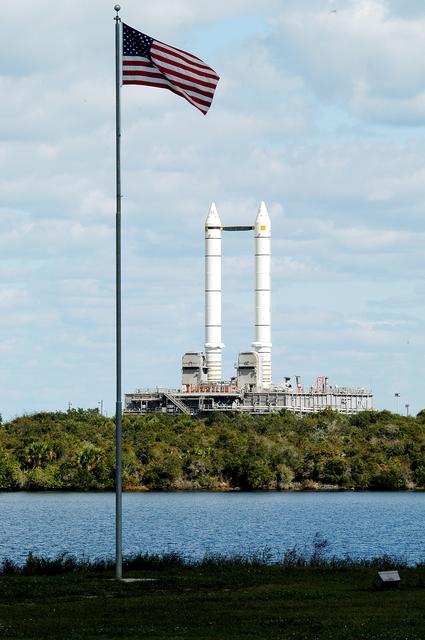
KENNEDY SPACE CENTER, FLA. - Mobile Launcher Platform (MLP) number 3 and a set of twin solid rocket boosters bolted to it, atop the crawler-transporter, inches along the crawlerway in support of the second engineering analysis vibration test on the crawler and MLP. The MLP is viewed from the KSC News Center across the turn basin. The crawler is moving at various speeds up to 1 mph in an effort to achieve vibration data gathering goals as it leaves the VAB, travels toward Launch Pad 39A and then returns. The boosters are braced at the top for stability. The primary purpose of these rollout tests is to gather data to develop future maintenance requirements on the transport equipment and the flight hardware. Various parts of the MLP and crawler transporter have been instrumented with vibration data collection equipment.
KSC-03pd3158
KSC | 2003-11-21
Details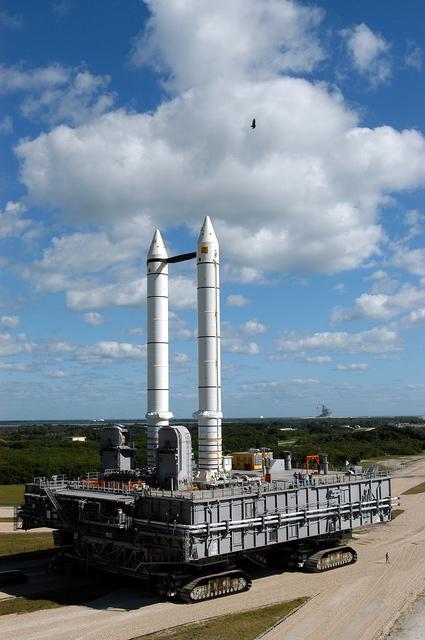
KENNEDY SPACE CENTER, FLA. - A high-flying bird takes a closer look at the Mobile Launcher Platform (MLP) number 3 with twin solid rocket boosters bolted to it as it crawls toward Launch Pad 39A, in the background. The crawler is moving along the crawlerway at various speeds up to 1 mph in an effort to achieve vibration data gathering goals as it travels toward Launch Pad 39A and then returns. The boosters are braced at the top for stability. The primary purpose of these rollout tests is to gather data to develop future maintenance requirements on the transport equipment and the flight hardware. Various parts of the MLP and crawler transporter have been instrumented with vibration data collection equipment.
KSC-03pd3160
KSC | 2003-11-21
Details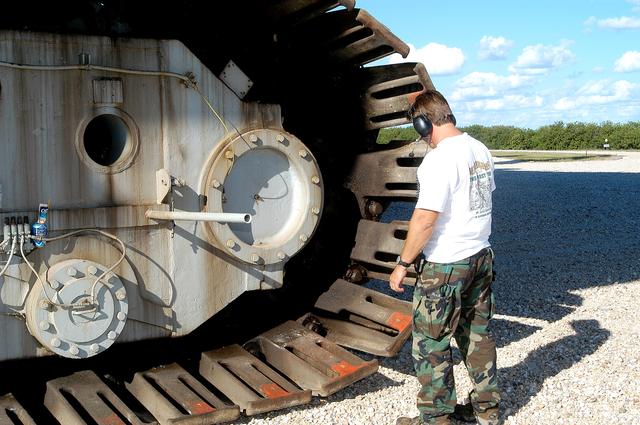
KENNEDY SPACE CENTER, FLA. - A Kennedy Space Center technician inspects the shoes on one of eight tracks of a crawler-transporter (CT). The CT is moving Mobile Launcher Platform (MLP) number 3 with a set of twin solid rocket boosters bolted on top to the intersection in the crawlerway in support of the second engineering analysis vibration test on the crawler and MLP. The crawler is moving at various speeds up to 1 mph in an effort to achieve vibration data gathering goals as it leaves the VAB, travels toward Launch Pad 39A and then returns. The boosters are braced at the top for stability. The primary purpose of these rollout tests is to gather data to develop future maintenance requirements on the transport equipment and the flight hardware. Various parts of the MLP and crawler transporter have been instrumented with vibration data collection equipment.
KSC-03pd3165
KSC | 2003-11-21
Details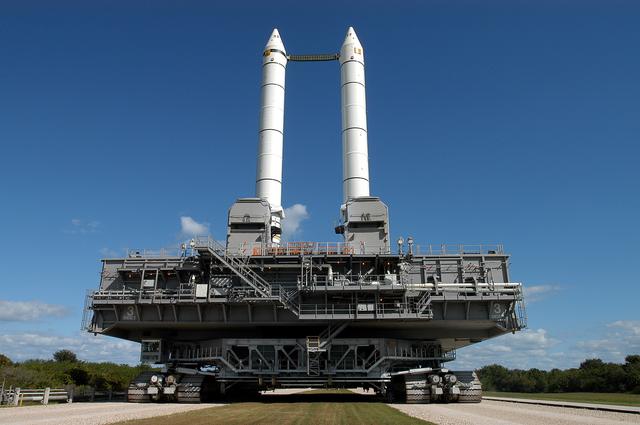
KENNEDY SPACE CENTER, FLA. - Like candles embedded in a sculptured “cake,” the Mobile Launcher Platform (MLP) number 3 with twin solid rocket boosters bolted to it inches along the crawlerway at various speeds up to 1 mph in an effort to achieve vibration data gathering goals. The boosters are braced at the top for stability. The primary purpose of these rollout tests is to gather data to develop future maintenance requirements on the transport equipment and the flight hardware. Various parts of the MLP and crawler transporter have been instrumented with vibration data collection equipment.
KSC-03pd3161
KSC | 2003-11-21
Details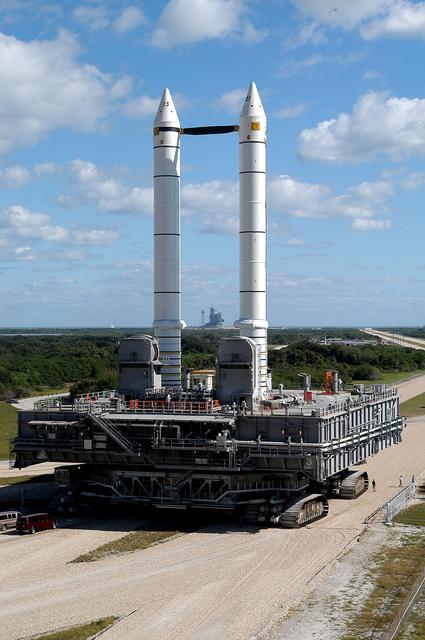
KENNEDY SPACE CENTER, FLA. - Mobile Launcher Platform (MLP) number 3 and a set of twin solid rocket boosters, atop the crawler-transporter, inch along the crawlerway in support of the second engineering analysis vibration test on the crawler and MLP. The crawler is moving at various speeds up to 1 mph in an effort to achieve vibration data gathering goals as it leaves the VAB, travels toward Launch Pad 39A (framed between the boosters), and then returns. The boosters are braced at the top for stability. The primary purpose of these rollout tests is to gather data to develop future maintenance requirements on the transport equipment and the flight hardware. Various parts of the MLP and crawler transporter have been instrumented with vibration data collection equipment.
KSC-03pd3154
KSC | 2003-11-21
Details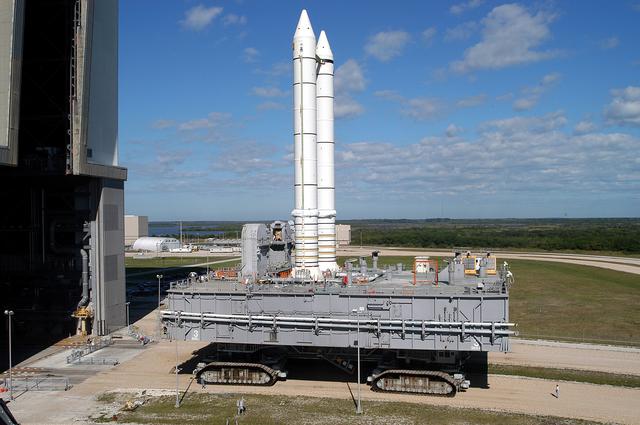
KENNEDY SPACE CENTER, FLA. - Mobile Launcher Platform (MLP) number 3 and a set of twin solid rocket boosters, atop the crawler-transporter, inch away from the Vehicle Assembly Building (VAB) in support of the second engineering analysis vibration test on the crawler and MLP. The crawler is moving at various speeds up to 1 mph in an effort to achieve vibration data gathering goals as it leaves the VAB, travels toward Launch Pad 39A and then returns. The boosters are braced at the top for stability. The primary purpose of these rollout tests is to gather data to develop future maintenance requirements on the transport equipment and the flight hardware. Various parts of the MLP and crawler transporter have been instrumented with vibration data collection equipment.
KSC-03pd3152
KSC | 2003-11-21
Details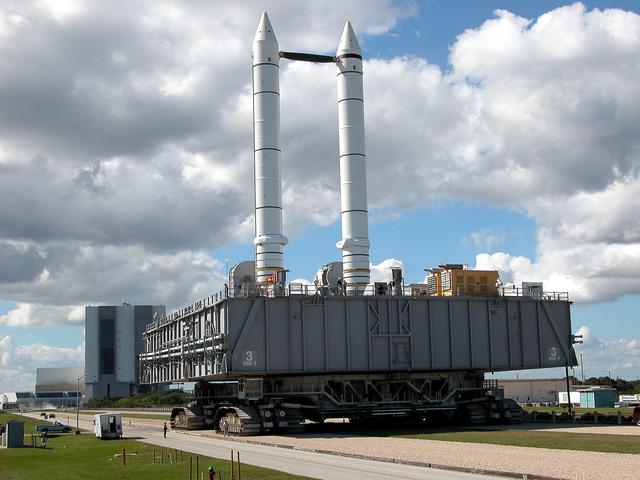
KENNEDY SPACE CENTER, FLA. - A crawler-transporter carrying Mobile Launcher Platform (MLP) number 3, with a set of twin solid rocket boosters bolted atop, crawls to the intersection in the crawlerway in support of the second engineering analysis vibration test on the crawler and MLP. From this perspective, the Launch Control Center (left) and the 525-foot-tall Vehicle Assembly Building (right) in the background appear dwarfed by the 184-foot-tall boosters. The crawler is moving at various speeds up to 1 mph in an effort to achieve vibration data gathering goals as it leaves the VAB, travels toward Launch Pad 39A and then returns. The boosters are braced at the top for stability. The primary purpose of these rollout tests is to gather data to develop future maintenance requirements on the transport equipment and the flight hardware. Various parts of the MLP and crawler transporter have been instrumented with vibration data collection equipment.
KSC-03pd3167
KSC | 2003-11-21
Details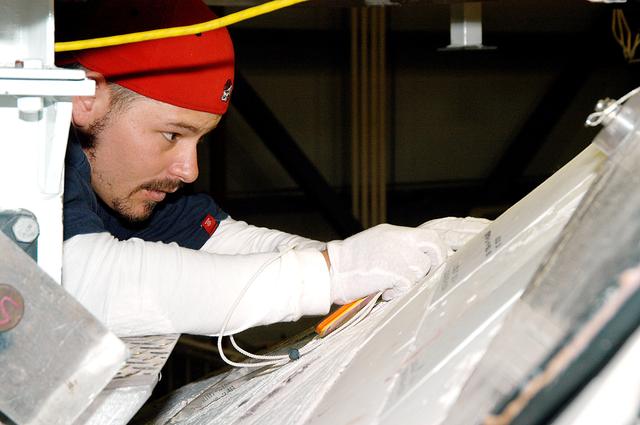
KENNEDY SPACE CENTER, FLA. - In the Orbiter Processing Facility, United Space Alliance technician Chris Moore performs gap tests on the tiles of the nose of orbiter Atlantis as part of return-to-flight activities. Atlantis is scheduled for mission STS-114, a return-to-flight test mission to the International Space Station.
KSC-03pd3150
KSC | 2003-11-20
Details
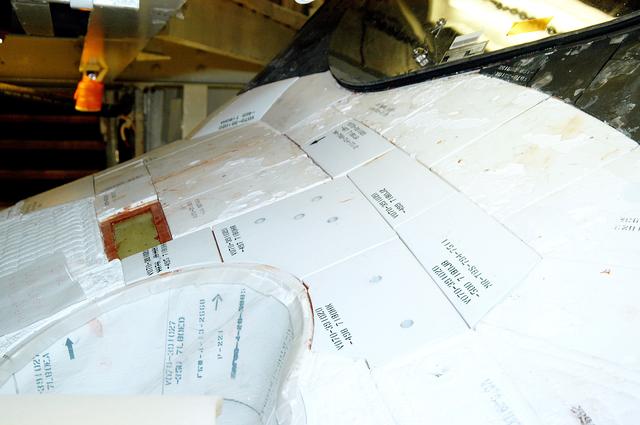
KENNEDY SPACE CENTER, FLA. - This view shows the tiles below the windshield on the orbiter Atlantis. A gap test is being performed on the tiles as part of return-to-flight activities. Atlantis is scheduled for mission STS-114, a return-to-flight test mission to the International Space Station.
KSC-03pd3149
KSC | 2003-11-20
Details
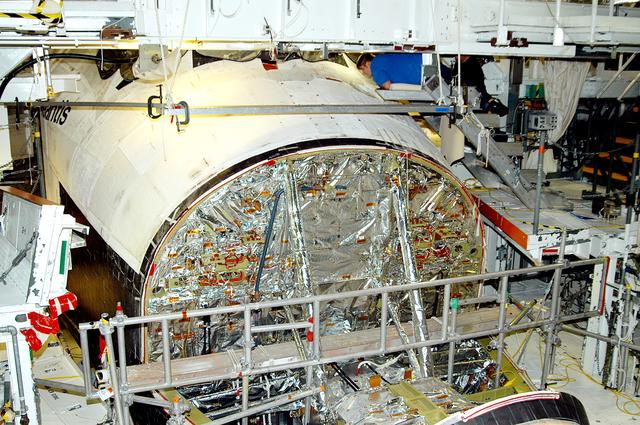
KENNEDY SPACE CENTER, FLA. - In the Orbiter Processing Facility, United Space Alliance technician Jamie Haynes checks the tiles on the nose of orbiter Atlantis as part of return-to-flight activities. Atlantis is scheduled for mission STS-114, a return-to-flight test mission to the International Space Station.
KSC-03pd3147
KSC | 2003-11-20
Details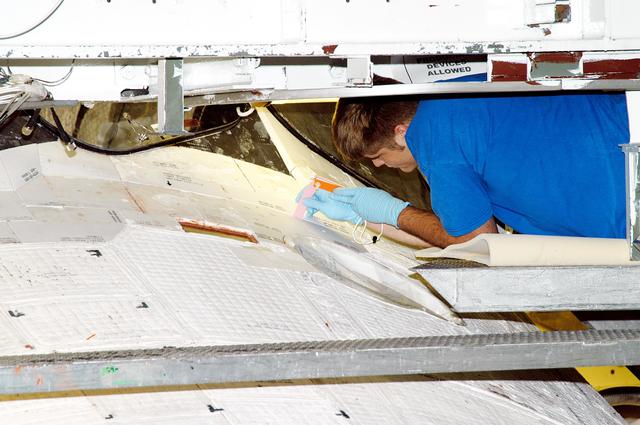
KENNEDY SPACE CENTER, FLA. - In the Orbiter Processing Facility, United Space Alliance technician Jamie Haynes does a gap test on the tiles of the nose of orbiter Atlantis as part of return-to-flight activities. Atlantis is scheduled for mission STS-114, a return-to-flight test mission to the International Space Station.
KSC-03pd3148
KSC | 2003-11-20
Details

Where on Earth...? MISR Mystery Image Quiz 16:<br .>Maldives in the Indian Ocean and Tuamotu, French Polynesia
PIA04345
JPL | 2003-11-19
Details
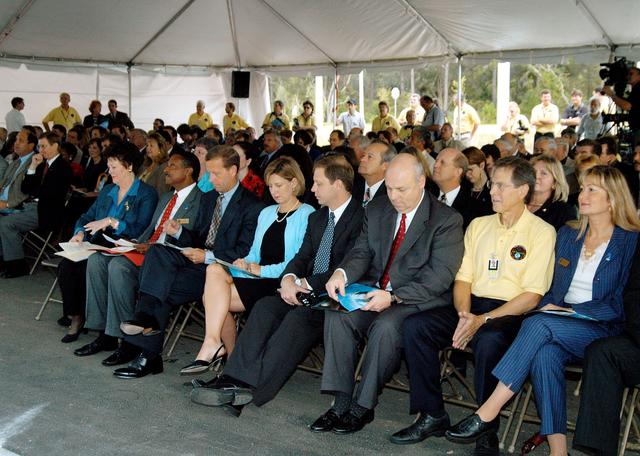
KENNEDY SPACE CENTER, FLA. - Dignitaries, invited guests, space center employees, and the media gather for a dedication and ribbon-cutting ceremony for the Space Life Sciences Lab hosted by NASA-Kennedy Space Center and the state of Florida at the new lab. Completed in August, the facility encompasses more than 100,000 square feet and was formerly known as the Space Experiment Research and Processing Laboratory or SERPL. The state, through the Florida Space Authority, built the research lab which is host to NASA, NASA’s Life Sciences Services contractor Dynamac Corp., Bionetics Corp., and researchers from the University of Florida. Dynamac Corp. leases the facility. The Florida Space Research Institute is responsible for gaining additional tenants from outside the NASA community.
KSC-03pd3132
KSC | 2003-11-19
Details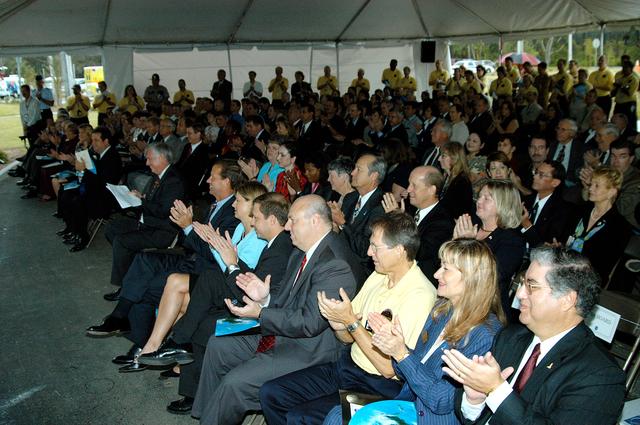
KENNEDY SPACE CENTER, FLA. - Dignitaries, invited guests, space center employees, and the media show their appreciation for the speakers at a dedication and ribbon-cutting ceremony for the Space Life Sciences Lab hosted by NASA-Kennedy Space Center and the state of Florida at the new lab. Completed in August, the facility encompasses more than 100,000 square feet and was formerly known as the Space Experiment Research and Processing Laboratory or SERPL. The state, through the Florida Space Authority, built the research lab which is host to NASA, NASA’s Life Sciences Services contractor Dynamac Corp., Bionetics Corp., and researchers from the University of Florida. Dynamac Corp. leases the facility. The Florida Space Research Institute is responsible for gaining additional tenants from outside the NASA community.
KSC-03pd3138
KSC | 2003-11-19
Details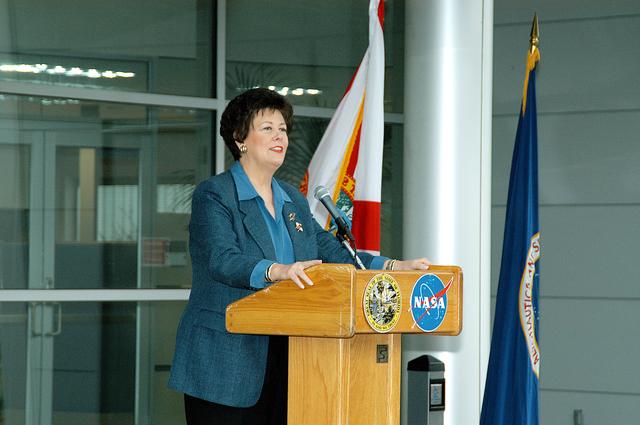
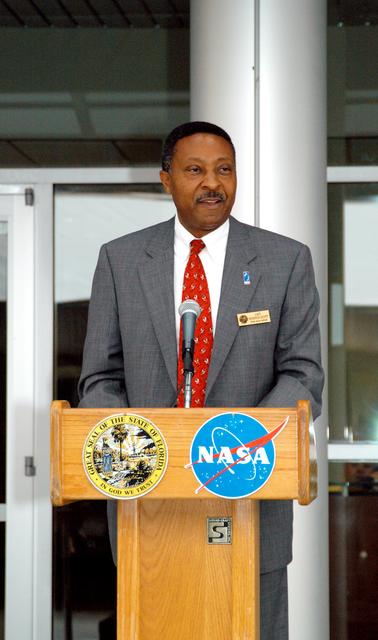
KENNEDY SPACE CENTER, FLA. - Capt. Winston Scott, executive director of the Florida Space Authority, speaks at a dedication and ribbon-cutting ceremony for the Space Life Sciences Lab hosted by NASA-Kennedy Space Center and the state of Florida at the new lab. Completed in August, the facility encompasses more than 100,000 square feet and was formerly known as the Space Experiment Research and Processing Laboratory or SERPL. The state, through the Florida Space Authority, built the research lab which is host to NASA, NASA’s Life Sciences Services contractor Dynamac Corp., Bionetics Corp., and researchers from the University of Florida. Dynamac Corp. leases the facility. The Florida Space Research Institute is responsible for gaining additional tenants from outside the NASA community.
KSC-03pd3136
KSC | 2003-11-19
Details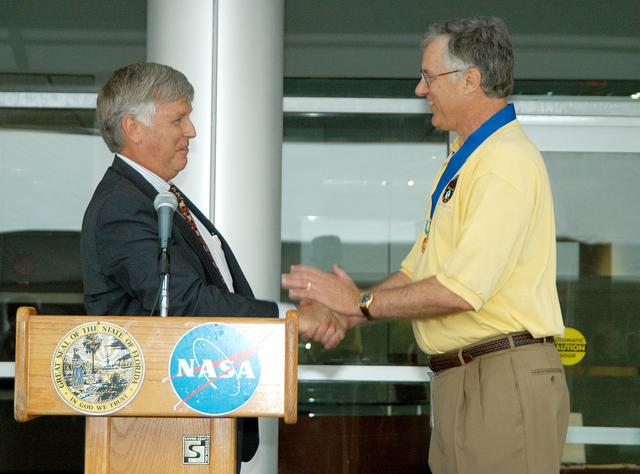
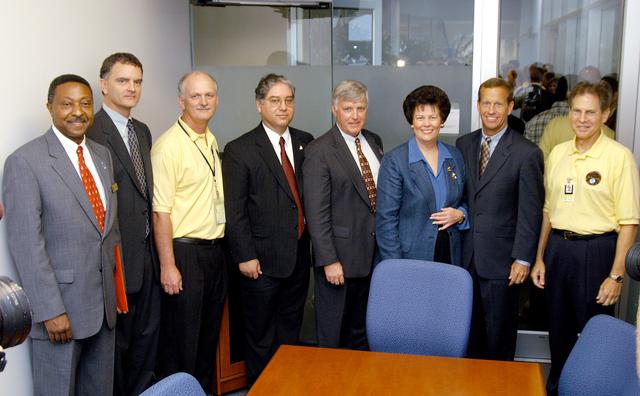
KENNEDY SPACE CENTER, FLA. - Officials of the NASA-Kennedy Space Center and the state of Florida pose for a group portrait at a dedication and ribbon-cutting ceremony for the Space Life Sciences Lab at the new lab. From left are Capt. Winston Scott, executive director of the Florida Space Authority; Dr. Robert J. Ferl, director of Space Agriculture Biotechnology Research and Education (SABRE), University of Florida; Charlie Quincy, chief of the Biological Sciences Office, Kennedy Space Center; Jose Perez-Morales, NASA Project Manager for the Space Life Sciences Lab; Jim Kennedy, director of the Kennedy Space Center; The Honorable Toni Jennings, lieutenant governor of the state of Florida; Frank T. Brogan, president of the Florida Atlantic University; and Dr. Samuel Durrance, executive director of the Florida Space Research Institute. Completed in August, the facility encompasses more than 100,000 square feet and was formerly known as the Space Experiment Research and Processing Laboratory or SERPL. The state, through the Florida Space Authority, built the research lab which is host to NASA, NASA’s Life Sciences Services contractor Dynamac Corp., Bionetics Corp., and researchers from the University of Florida. Dynamac Corp. leases the facility. The Florida Space Research Institute is responsible for gaining additional tenants from outside the NASA community.
KSC-03pd3145
KSC | 2003-11-19
Details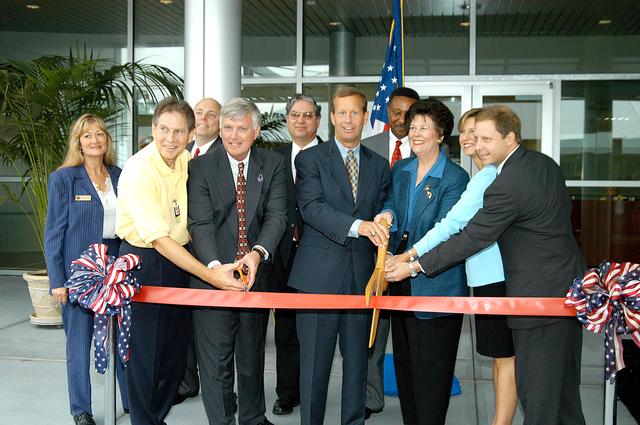
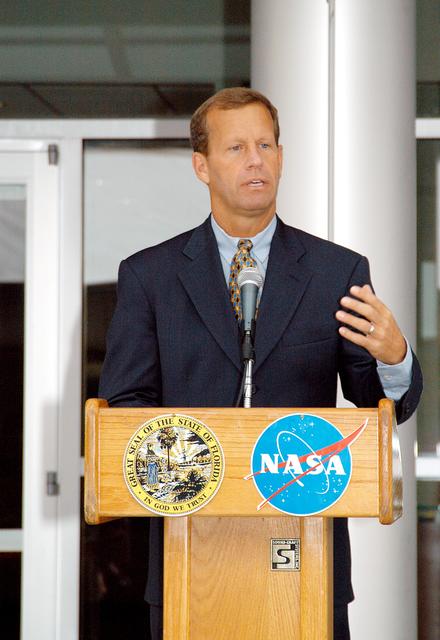
KENNEDY SPACE CENTER, FLA. - Frank T. Brogan, president of the Florida Atlantic University, speaks at a dedication and ribbon-cutting ceremony for the Space Life Sciences Lab hosted by NASA-Kennedy Space Center and the state of Florida at the new lab. Completed in August, the facility encompasses more than 100,000 square feet and was formerly known as the Space Experiment Research and Processing Laboratory or SERPL. The state, through the Florida Space Authority, built the research lab which is host to NASA, NASA’s Life Sciences Services contractor Dynamac Corp., Bionetics Corp., and researchers from the University of Florida. Dynamac Corp. leases the facility. The Florida Space Research Institute is responsible for gaining additional tenants from outside the NASA community.
KSC-03pd3137
KSC | 2003-11-19
Details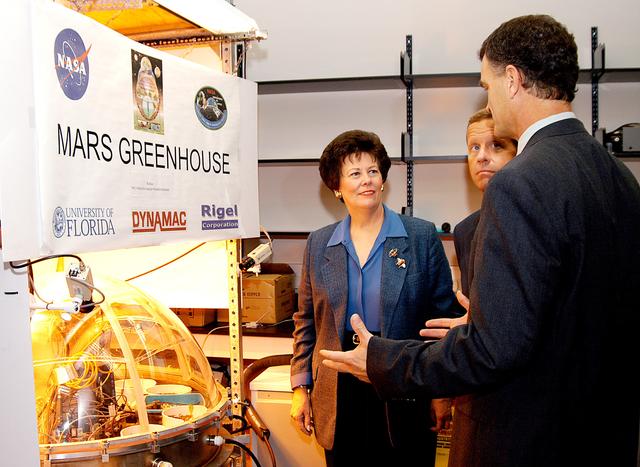
KENNEDY SPACE CENTER, FLA. - The Honorable Toni Jennings (left), lieutenant governor of the state of Florida, and Frank T. Brogan, president of Florida Atlantic University, receive a briefing on the research that will be conducted in the Space Life Sciences Lab from Dr. Robert J. Ferl (right), director of Space Agriculture Biotechnology Research and Education (SABRE), University of Florida. Jennings and Brogan are speaking at a dedication and ribbon-cutting ceremony for the lab hosted by NASA-Kennedy Space Center and the state of Florida at the new lab. Completed in August, the facility encompasses more than 100,000 square feet and was formerly known as the Space Experiment Research and Processing Laboratory or SERPL. The state, through the Florida Space Authority, built the research lab which is host to NASA, NASA’s Life Sciences Services contractor Dynamac Corp., Bionetics Corp., and researchers from the University of Florida. Dynamac Corp. leases the facility. The Florida Space Research Institute is responsible for gaining additional tenants from outside the NASA community.
KSC-03pd3146
KSC | 2003-11-19
Details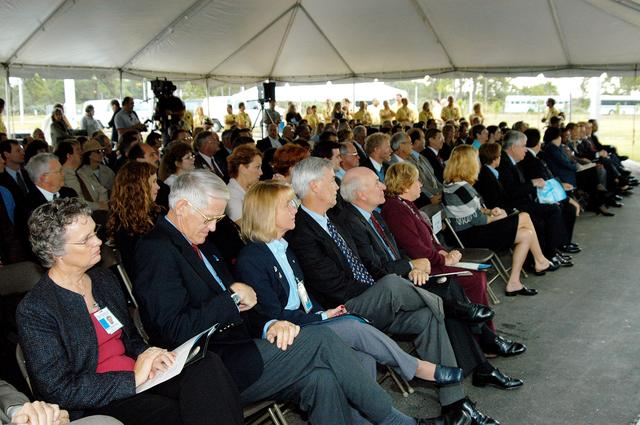
KENNEDY SPACE CENTER, FLA. - Dignitaries, invited guests, space center employees, and the media gather for a dedication and ribbon-cutting ceremony for the Space Life Sciences Lab hosted by NASA-Kennedy Space Center and the state of Florida at the new lab. Completed in August, the facility encompasses more than 100,000 square feet and was formerly known as the Space Experiment Research and Processing Laboratory or SERPL. The state, through the Florida Space Authority, built the research lab which is host to NASA, NASA’s Life Sciences Services contractor Dynamac Corp., Bionetics Corp., and researchers from the University of Florida. Dynamac Corp. leases the facility. The Florida Space Research Institute is responsible for gaining additional tenants from outside the NASA community.
KSC-03pd3134
KSC | 2003-11-19
Details