NASA Media Archive
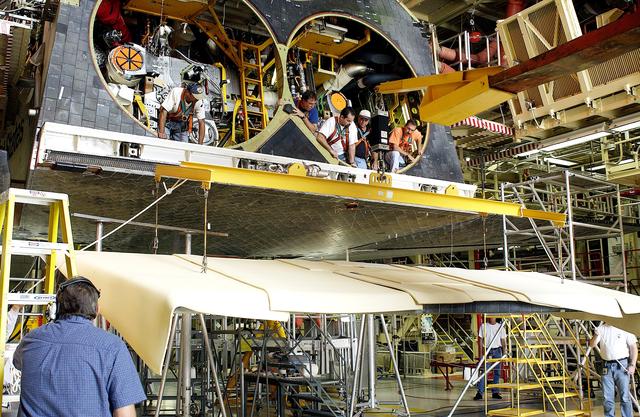
KENNEDY SPACE CENTER, FLA. - In the Orbiter Processing Facility, workers look down from spaces allotted for the main engines as the rear body flap is lifted for installation on the orbiter Discovery. The body flap, which is temporarily under protective covering, attaches below the main engines.
KSC-03pd2704
KSC | 2003-09-23
Details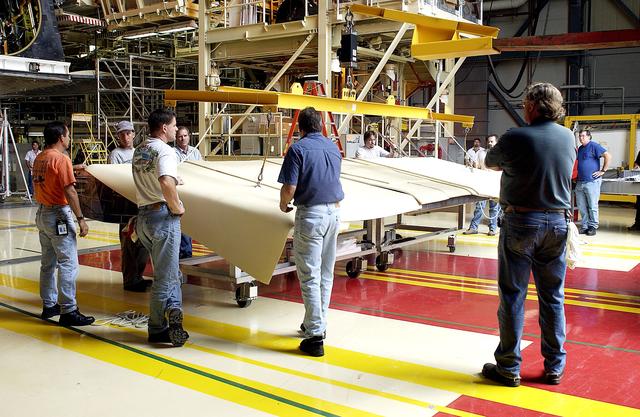
KENNEDY SPACE CENTER, FLA. - Workers in the Orbiter Processing Facility get ready to lift and install the rear body flap on orbiter Discovery. The body flap, which is temporarily under protective covering, attaches below the main engines.
KSC-03pd2701
KSC | 2003-09-23
Details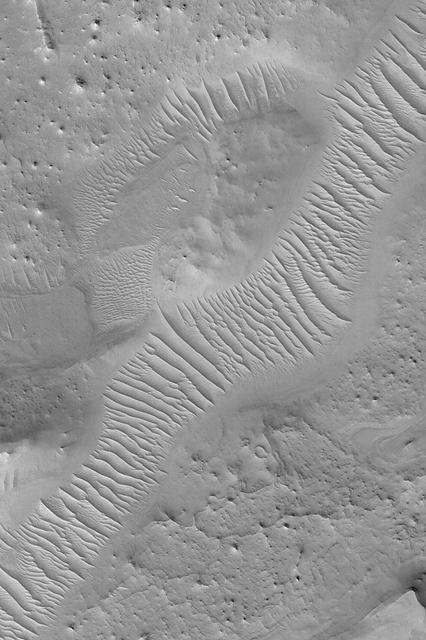
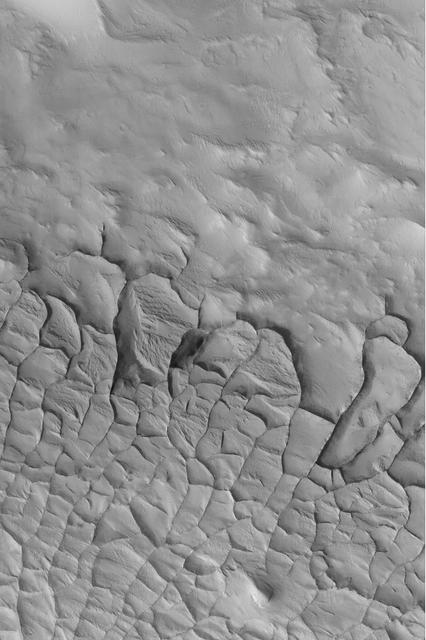

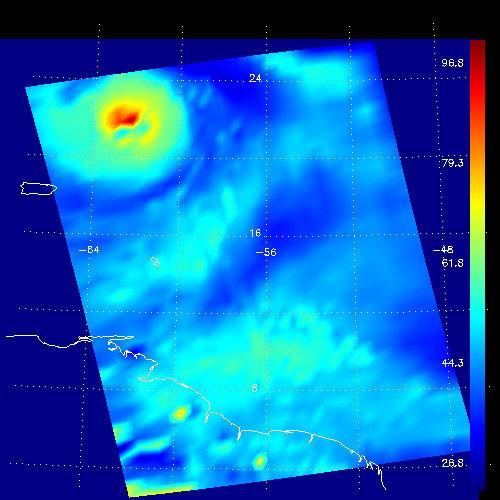
Hurricane Isabel, Amount of Atmospheric Water Vapor Observed By AIRS
PIA00430
JPL | 2003-09-20
Details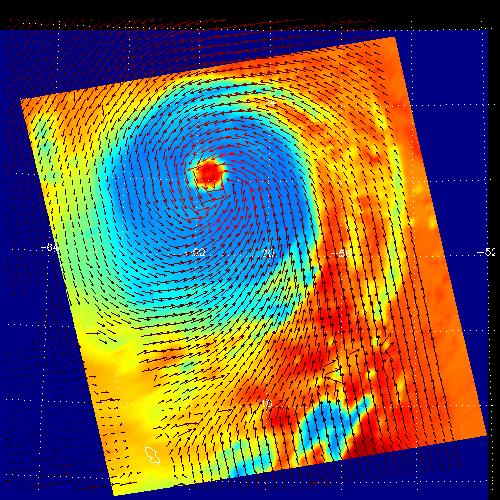
Hurricane Isabel, AIRS Infrared and SeaWinds Scatterometer Data Combined
PIA00429
JPL | 2003-09-20
Details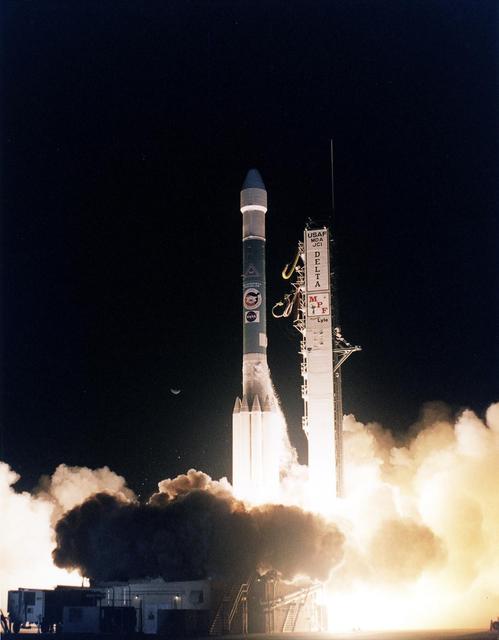


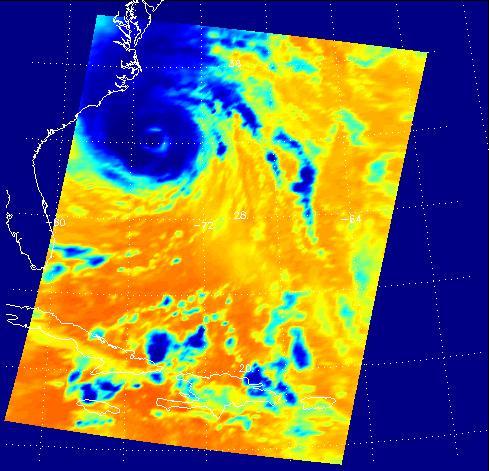
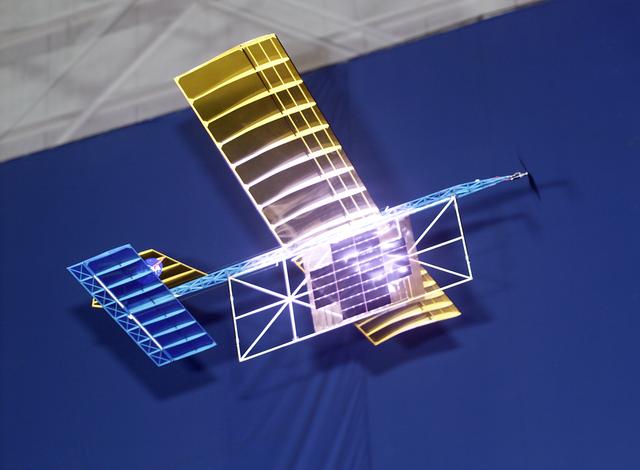
With a laser beam centered on its panel of photovoltaic cells, a model plane makes the first flight of an aircraft powered by a laser beam inside a building at NASA Marshall.
ED03-0249-18
AFRC | 2003-09-18
Details
VANDENBERG AFB, CALIF. - Viewed from inside, the second stage of the Delta II launch vehicle for the Gravity Probe B experiment is lifted up the mobile service tower on Space Launch Complex 2, Vandenberg Air Force Base, Calif. Behind it is the first stage of the Delta II. The Gravity Probe B will launch a payload of four gyroscopes into low-Earth polar orbit to test two extraordinary predictions of Albert Einstein’s general theory of relativity: the geodetic effect (how space and time are warped by the presence of the Earth) and frame dragging (how Earth’s rotation drags space and time around with it). Once in orbit, for 18 months each gyroscope’s spin axis will be monitored as it travels through local spacetime, observing and measuring these effects. The experiment was developed by Stanford University, Lockheed Martin and NASA’s Marshall Space Flight Center. The targeted launch date is Dec. 6, 2003.
KSC-03pd2886
KSC | 2003-09-18
Details

VANDENBERG AFB, CALIF. - The second stage of the Delta II launch vehicle for the Gravity Probe B experiment is lifted up the mobile service tower on Space Launch Complex 2, Vandenberg Air Force Base, Calif. The Gravity Probe B will launch a payload of four gyroscopes into low-Earth polar orbit to test two extraordinary predictions of Albert Einstein’s general theory of relativity: the geodetic effect (how space and time are warped by the presence of the Earth) and frame dragging (how Earth’s rotation drags space and time around with it). Once in orbit, for 18 months each gyroscope’s spin axis will be monitored as it travels through local spacetime, observing and measuring these effects. The experiment was developed by Stanford University, Lockheed Martin and NASA’s Marshall Space Flight Center. The targeted launch date is Dec. 6, 2003.
KSC-03pd2884
KSC | 2003-09-18
Details
VANDENBERG AFB, CALIF. - Viewed from inside, the second stage of the Delta II launch vehicle for the Gravity Probe B experiment is lifted up the mobile service tower on Space Launch Complex 2, Vandenberg Air Force Base, Calif. The Gravity Probe B will launch a payload of four gyroscopes into low-Earth polar orbit to test two extraordinary predictions of Albert Einstein’s general theory of relativity: the geodetic effect (how space and time are warped by the presence of the Earth) and frame dragging (how Earth’s rotation drags space and time around with it). Once in orbit, for 18 months each gyroscope’s spin axis will be monitored as it travels through local spacetime, observing and measuring these effects. The experiment was developed by Stanford University, Lockheed Martin and NASA’s Marshall Space Flight Center. The targeted launch date is Dec. 6, 2003.
KSC-03pd2885
KSC | 2003-09-18
Details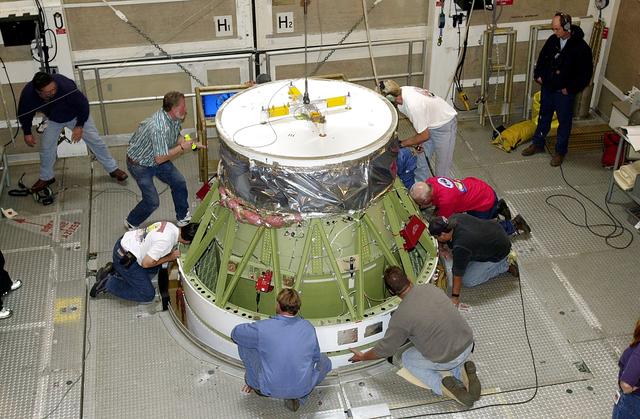
VANDENBERG AFB, CALIF. - Workers on the mobile service tower at Space Launch Complex 2, Vandenberg Air Force Base, Calif., check the Delta II rocket’s second stage as it is mated with the first stage. The Delta II is the launch vehicle for the Gravity Probe B experiment, developed by Stanford University, Lockheed Martin and NASA’s Marshall Space Flight Center. The Gravity Probe B will launch a payload of four gyroscopes into low-Earth polar orbit to test two extraordinary predictions of Albert Einstein’s general theory of relativity: the geodetic effect (how space and time are warped by the presence of the Earth) and frame dragging (how Earth’s rotation drags space and time around with it). Once in orbit, for 18 months each gyroscope’s spin axis will be monitored as it travels through local spacetime, observing and measuring these effects. The targeted launch date is Dec. 6, 2003.
KSC-03pd2889
KSC | 2003-09-18
Details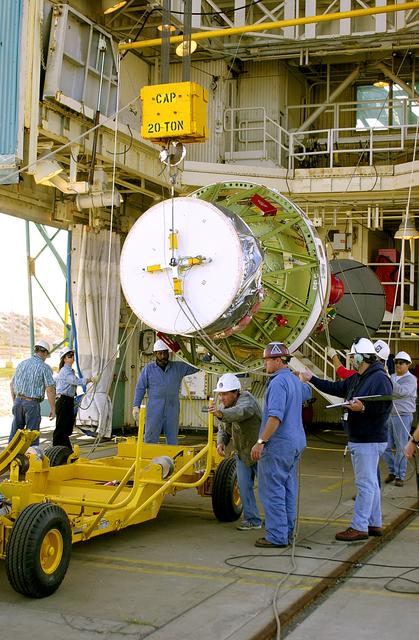
VANDENBERG AFB, CALIF. - The second stage of the Delta II launch vehicle for the Gravity Probe B experiment is lifted off the transporter after its arrival on Space Launch Complex 2, Vandenberg Air Force Base, Calif. The Gravity Probe B will launch a payload of four gyroscopes into low-Earth polar orbit to test two extraordinary predictions of Albert Einstein’s general theory of relativity: the geodetic effect (how space and time are warped by the presence of the Earth) and frame dragging (how Earth’s rotation drags space and time around with it). Once in orbit, for 18 months each gyroscope’s spin axis will be monitored as it travels through local spacetime, observing and measuring these effects. The experiment was developed by Stanford University, Lockheed Martin and NASA’s Marshall Space Flight Center. The targeted launch date is Dec. 6, 2003.
KSC-03pd2883
KSC | 2003-09-18
Details

VANDENBERG AFB, CALIF. - The second stage of the Delta II launch vehicle for the Gravity Probe B experiment is moved into the mobile service tower on Space Launch Complex 2, Vandenberg Air Force Base, Calif. Behind it can be seen the first stage of the Delta II. The Gravity Probe B will launch a payload of four gyroscopes into low-Earth polar orbit to test two extraordinary predictions of Albert Einstein’s general theory of relativity: the geodetic effect (how space and time are warped by the presence of the Earth) and frame dragging (how Earth’s rotation drags space and time around with it). Once in orbit, for 18 months each gyroscope’s spin axis will be monitored as it travels through local spacetime, observing and measuring these effects. The experiment was developed by Stanford University, Lockheed Martin and NASA’s Marshall Space Flight Center. The targeted launch date is Dec. 6, 2003.
KSC-03pd2887
KSC | 2003-09-18
Details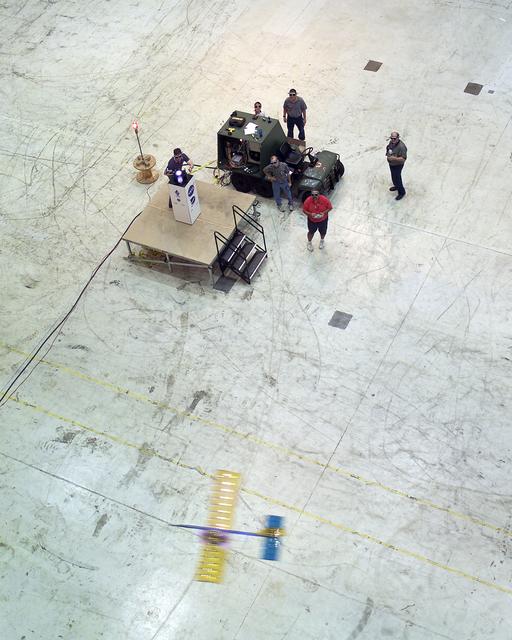
Powered by a laser beam directed at it from a pedestal, a model plane makes the first flight of an aircraft powered by laser energy inside a building at NASA Marshall.
ED03-0249-20
AFRC | 2003-09-18
Details


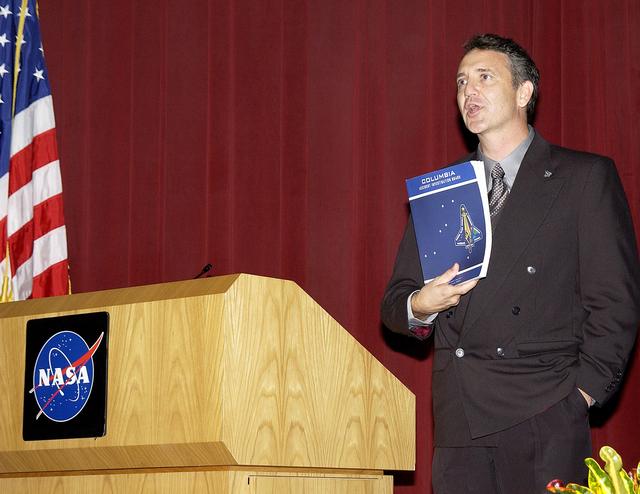
KENNEDY SPACE CENTER, FLA. - Tim Wilson, assistant chief engineer for Shuttle, speaks to employees during Center Director Jim Kennedy’s first all-hands meeting for employees. Also on the agenda was Dr. Woodrow Whitlow Jr., KSC deputy director, and Bill Pickavance, vice president and deputy program manager, Florida operations, United Space Alliance. Representatives from the Shuttle program and contractor team were on hand to discuss the Columbia Accident Investigation Board report and where KSC stands in its progress toward return to flight.
KSC-03pd2696
KSC | 2003-09-17
Details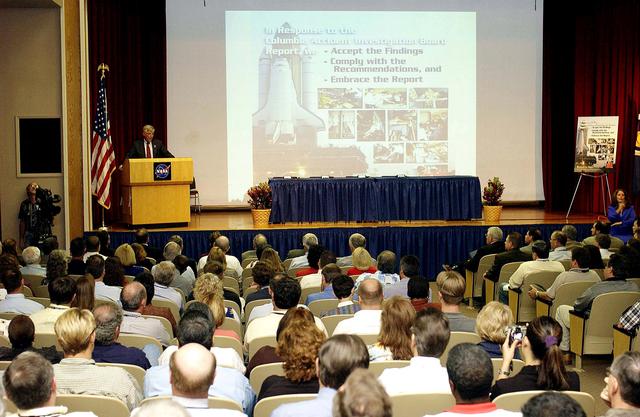
KENNEDY SPACE CENTER, FLA. - Center Director Jim Kennedy talks to employees during his first all-hands meeting. Making presentations were Dr. Woodrow Whitlow Jr., KSC deputy director; Tim Wilson, assistant chief engineer for Shuttle; and Bill Pickavance, vice president and deputy program manager, Florida operations, United Space Alliance. Representatives from the Shuttle program and contractor team were on hand to discuss the Columbia Accident Investigation Board report and where KSC stands in its progress toward return to flight.
KSC-03pd2693
KSC | 2003-09-17
Details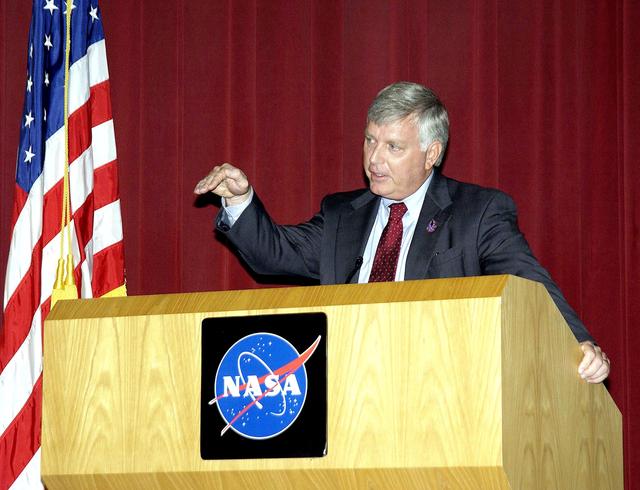
KENNEDY SPACE CENTER, FLA. - Center Director Jim Kennedy talks to employees during his first all-hands meeting. Making presentations were Dr. Woodrow Whitlow Jr., KSC deputy director;Tim Wilson, assistant chief engineer for Shuttle; and Bill Pickavance, vice president and deputy program manager, Florida operations, United Space Alliance.. Representatives from the Shuttle program and contractor team were on hand to discuss the Columbia Accident Investigation Board report and where KSC stands in its progress toward return to flight.
KSC-03pd2690
KSC | 2003-09-17
Details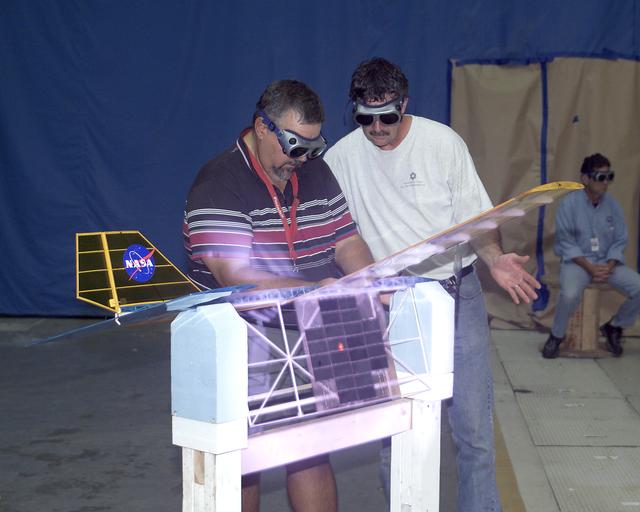
With a laser beam centered on its solar panel, a model aircraft is checked out by technician Tony Frakowiak and researcher Tim Blackwell before its power-beamed demonstration flight.
ED03-0249-07
AFRC | 2003-09-17
Details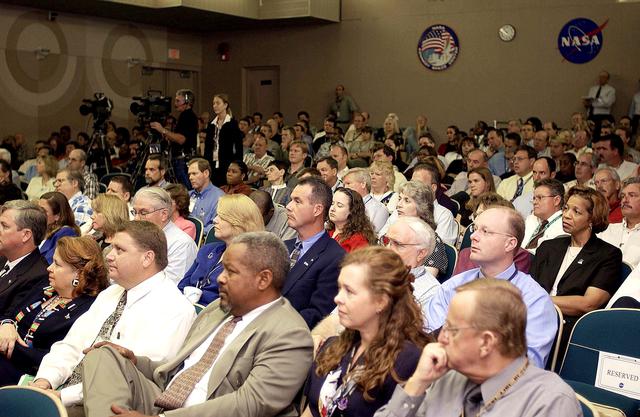
KENNEDY SPACE CENTER, FLA. - Employees in the Training Auditorium listen to Center Director Jim Kennedy’s first all-hands meeting for employees. Making presentations were Dr. Woodrow Whitlow Jr., KSC deputy director; Tim Wilson, assistant chief engineer for Shuttle; and Bill Pickavance, vice president and deputy program manager, Florida operations, United Space Alliance. Representatives from the Shuttle program and contractor team were on hand to discuss the Columbia Accident Investigation Board report and where KSC stands in its progress toward return to flight.
KSC-03pd2700
KSC | 2003-09-17
Details