NASA Media Archive
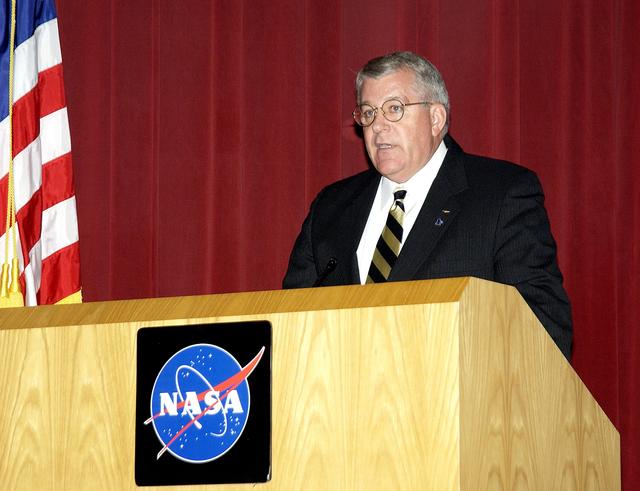
KENNEDY SPACE CENTER, FLA. - Bill Pickavance, vice president and deputy program manager, Florida operations, United Space Alliance, speaks to employees during Center Director Jim Kennedy’s first all-hands meeting for employees. Also on the agenda was Dr. Woodrow Whitlow Jr., KSC deputy director, and Tim Wilson, assistant chief engineer for Shuttle. Representatives from the Shuttle program and contractor team were on hand to discuss the Columbia Accident Investigation Board report and where KSC stands in its progress toward return to flight.
KSC-03pd2697
KSC | 2003-09-17
Details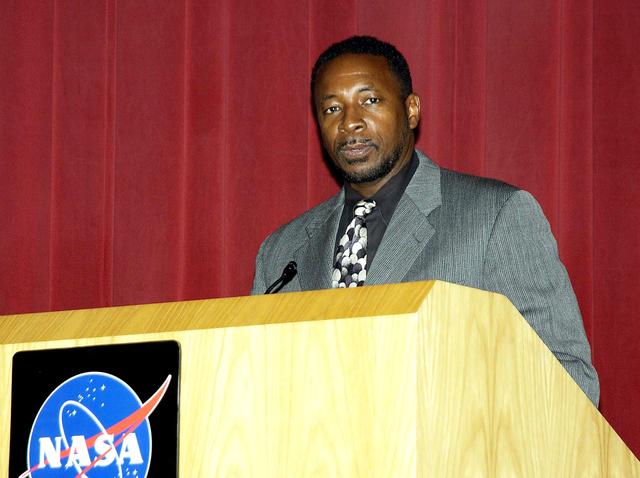
KENNEDY SPACE CENTER, FLA. - Dr. Woodrow Whitlow Jr., KSC deputy director, speaks to employees during Center Director Jim Kennedy’s first all-hands meeting for employees. Also on the agenda was Tim Wilson, assistant chief engineer for Shuttle, and Bill Pickavance, vice president and deputy program manager, Florida operations, United Space Alliance.. Representatives from the Shuttle program and contractor team were on hand to discuss the Columbia Accident Investigation Board report and where KSC stands in its progress toward return to flight.
KSC-03pd2695
KSC | 2003-09-17
Details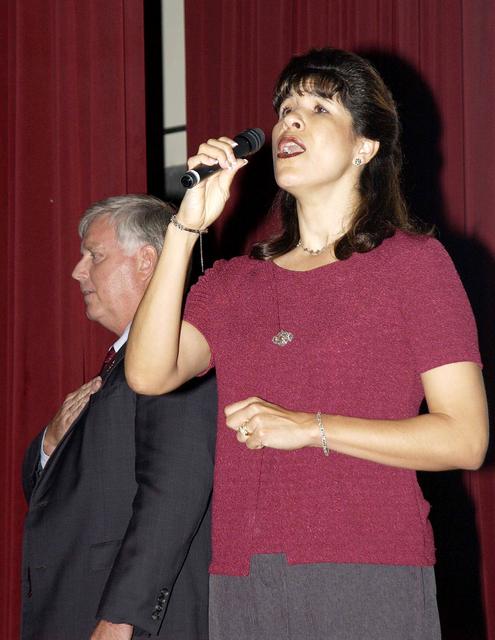
KENNEDY SPACE CENTER, FLA. - Suzy Cunningham sings the national anthem to kick off Center Director Jim Kennedy’s first all-hands meeting conducted for employees. She is senior spaceport manager, NASA/Air Force Spaceport Planning and Customer Service Office. Making presentations were Dr. Woodrow Whitlow Jr., KSC deputy director; Tim Wilson, assistant chief engineer for Shuttle; and Bill Pickavance, vice president and deputy program manager, Florida operations, United Space Alliance. Representatives from the Shuttle program and contractor team were on hand to discuss the Columbia Accident Investigation Board report and where KSC stands in its progress toward return to flight.
KSC-03pd2691
KSC | 2003-09-17
Details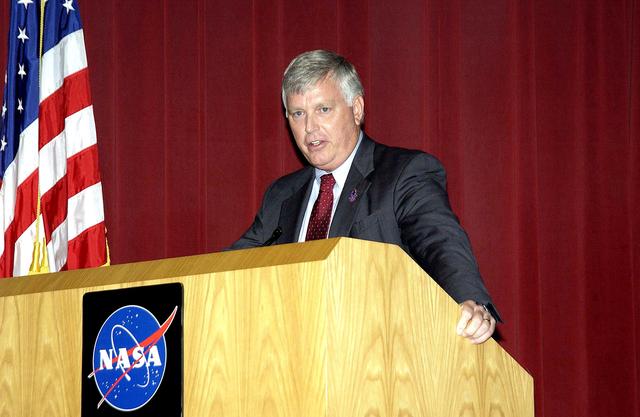
KENNEDY SPACE CENTER, FLA. - Center Director Jim Kennedy talks to employees during his first all-hands meeting. Making presentations were Dr. Woodrow Whitlow Jr., KSC deputy director,; Tim Wilson, assistant chief engineer for Shuttle; and Bill Pickavance, vice president and deputy program manager, Florida operations, United Space Alliance. Representatives from the Shuttle program and contractor team were on hand to discuss the Columbia Accident Investigation Board report and where KSC stands in its progress toward return to flight.
KSC-03pd2689
KSC | 2003-09-17
Details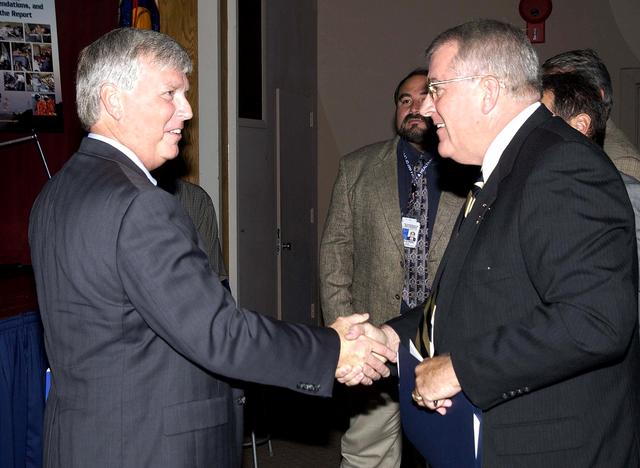
KENNEDY SPACE CENTER, FLA. - Center Director Jim Kennedy (left) welcomes Bill Pickavance to the podium during the CD’s first all-hands meeting with employees. Pickavance is vice president and deputy program manager, Florida operations, United Space Alliance. Also, making presentations were Dr. Woodrow Whitlow Jr., KSC deputy director, and Tim Wilson, assistant chief engineer for Shuttle. Representatives from the Shuttle program and contractor team were on hand to discuss the Columbia Accident Investigation Board report and where KSC stands in its progress toward return to flight.
KSC-03pd2688
KSC | 2003-09-17
Details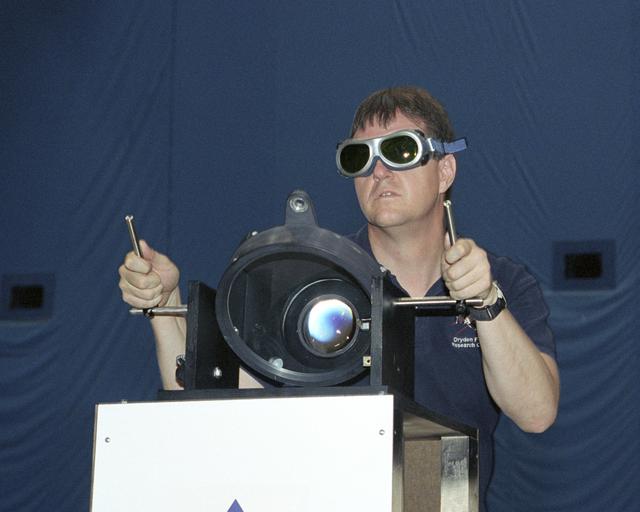
NASA Dryden's Dave Bushman aims the optics of a laser device at a panel on a model aircraft during the first flight demonstration of an aircraft powered by laser light.
EC03-0249-36
AFRC | 2003-09-17
Details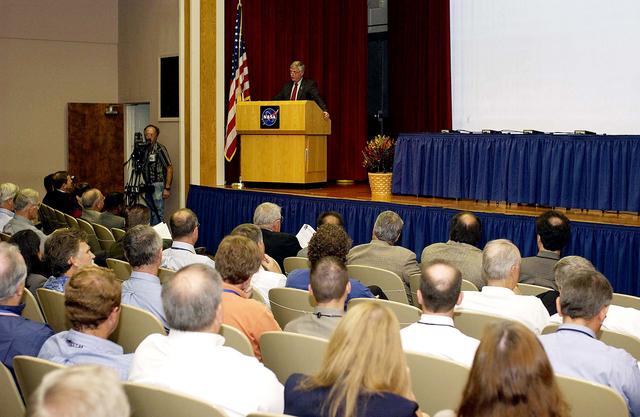
KENNEDY SPACE CENTER, FLA. - Center Director Jim Kennedy talks to employees during his first all-hands meeting. Making presentations were Dr. Woodrow Whitlow Jr., KSC deputy director; Tim Wilson, assistant chief engineer for Shuttle; and Bill Pickavance, vice president and deputy program manager, Florida operations, United Space Alliance.. Representatives from the Shuttle program and contractor team were on hand to discuss the Columbia Accident Investigation Board report and where KSC stands in its progress toward return to flight.
KSC-03pd2692
KSC | 2003-09-17
Details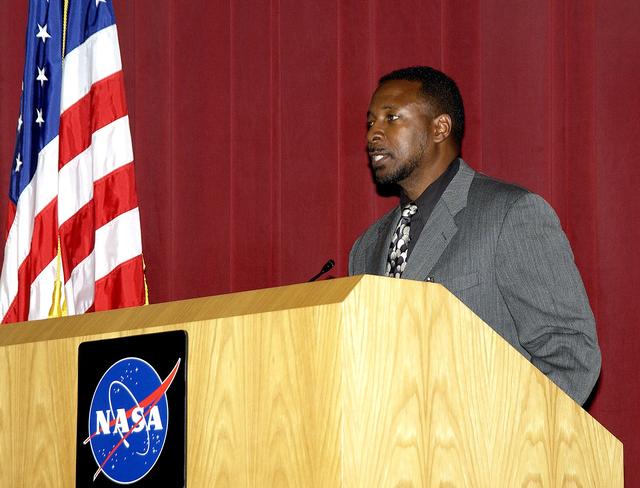
KENNEDY SPACE CENTER, FLA. - Dr. Woodrow Whitlow Jr., KSC deputy director, speaks to employees during Center Director Jim Kennedy’s first all-hands meeting for employees. Also on the agenda was Tim Wilson, assistant chief engineer for Shuttle, and Bill Pickavance, vice president and deputy program manager, Florida operations, United Space Alliance.. Representatives from the Shuttle program and contractor team were on hand to discuss the Columbia Accident Investigation Board report and where KSC stands in its progress toward return to flight.
KSC-03pd2694
KSC | 2003-09-17
Details

KENNEDY SPACE CENTER, FLA. - Representatives from the Shuttle program and contractor team are part of Center Director Jim Kennedy’s first all-hands meeting for employees. From left are Kennedy, Bill Pickavance, Mike Wetmore and Bert Garrido. They were on hand to discuss the Columbia Accident Investigation Board report and where KSC stands in its progress toward return to flight.
KSC-03pd2699
KSC | 2003-09-17
Details
KENNEDY SPACE CENTER, FLA. - Representatives from the Shuttle program and contractor team are part of Center Director Jim Kennedy’s first all-hands meeting for employees. From left are Kennedy, Bill Pickavance, Mike Wetmore and Bert Garrido. They were on hand to discuss the Columbia Accident Investigation Board report and where KSC stands in its progress toward return to flight.
KSC-03pd2698
KSC | 2003-09-17
Details

VANDENBERG AFB, CALIF. - The interstage of the Delta II launch vehicle for the Gravity Probe B experiment is lifted up the mobile service tower on Space Launch Complex 2, Vandenberg Air Force Base, Calif. It will enclose the second stage. The Gravity Probe B will launch a payload of four gyroscopes into low-Earth polar orbit to test two extraordinary predictions of Albert Einstein’s general theory of relativity: the geodetic effect (how space and time are warped by the presence of the Earth) and frame dragging (how Earth’s rotation drags space and time around with it). Once in orbit, for 18 months each gyroscope’s spin axis will be monitored as it travels through local spacetime, observing and measuring these effects. The experiment was developed by Stanford University, Lockheed Martin and NASA’s Marshall Space Flight Center. The targeted launch date is Dec. 6, 2003.
KSC-03pd2874
KSC | 2003-09-16
Details
VANDENBERG AFB, CALIF. - The interstage of the Delta II launch vehicle for the Gravity Probe B experiment is moved into the mobile service tower on Space Launch Complex 2, Vandenberg Air Force Base, Calif., where it will be mated with the second stage. The Gravity Probe B will launch a payload of four gyroscopes into low-Earth polar orbit to test two extraordinary predictions of Albert Einstein’s general theory of relativity: the geodetic effect (how space and time are warped by the presence of the Earth) and frame dragging (how Earth’s rotation drags space and time around with it). Once in orbit, for 18 months each gyroscope’s spin axis will be monitored as it travels through local spacetime, observing and measuring these effects. The experiment was developed by Stanford University, Lockheed Martin and NASA’s Marshall Space Flight Center. The targeted launch date is Dec. 6, 2003.
KSC-03pd2875
KSC | 2003-09-16
Details
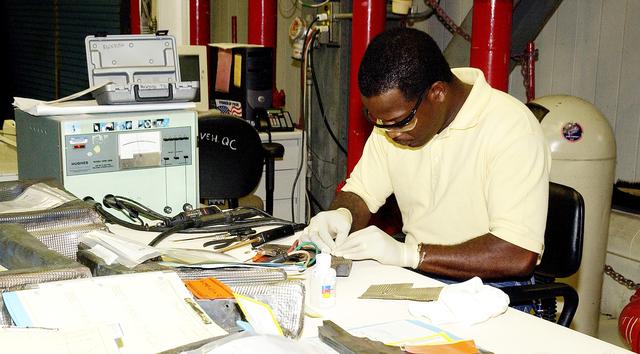
KENNEDY SPACE CENTER, FLA. - United Space Alliance employee Anthony Simmons prepares to electroweld a crack found on an insulator inside a Reinforced Carbon Carbon panel. The gray carbon composite RCC panels are attached to the leading edge of the wing of the orbiters to withstand the aerodynamic forces experienced during launch and reentry, which can reach as high as 800 pounds per square foot. The operating range of RCC is from minus 250º F to about 3,000º F, the temperature produced by friction with the atmosphere during reentry.
KSC-03pd2671
KSC | 2003-09-16
Details
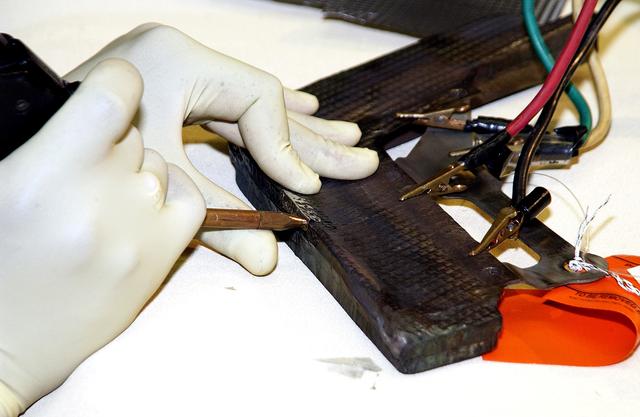
KENNEDY SPACE CENTER, FLA. - United Space Alliance employee Anthony Simmons electrowelds a crack formed in the insulator inside a Reinforced Carbon Carbon panel. The gray carbon composite RCC panels are attached to the leading edge of the wing of the orbiters to withstand the aerodynamic forces experienced during launch and reentry, which can reach as high as 800 pounds per square foot. The operating range of RCC is from minus 250º F to about 3,000º F, the temperature produced by friction with the atmosphere during reentry.
KSC-03pd2668
KSC | 2003-09-16
Details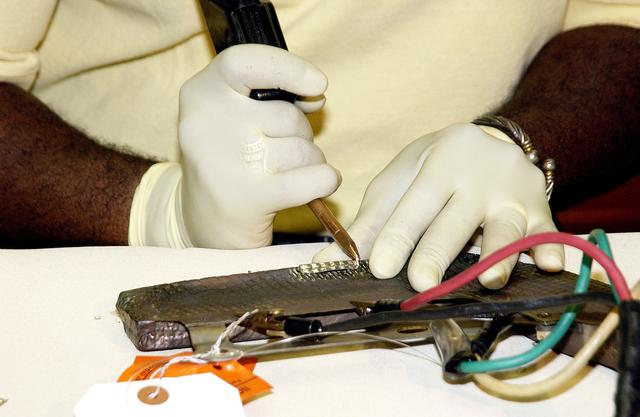
KENNEDY SPACE CENTER, FLA. - United Space Alliance employee Anthony Simmons electrowelds a crack formed in the insulator inside a Reinforced Carbon Carbon panel. The gray carbon composite RCC panels are attached to the leading edge of the wing of the orbiters to withstand the aerodynamic forces experienced during launch and reentry, which can reach as high as 800 pounds per square foot. The operating range of RCC is from minus 250º F to about 3,000º F, the temperature produced by friction with the atmosphere during reentry.
KSC-03pd2667
KSC | 2003-09-16
Details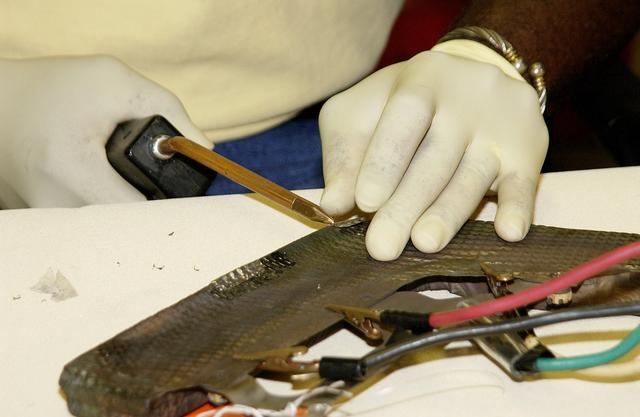
KENNEDY SPACE CENTER, FLA. - United Space Alliance employee Anthony Simmons continues electrowelding on an insulator inside a Reinforced Carbon Carbon panel. The gray carbon composite RCC panels are attached to the leading edge of the wing of the orbiters to withstand the aerodynamic forces experienced during launch and reentry, which can reach as high as 800 pounds per square foot. The operating range of RCC is from minus 250º F to about 3,000º F, the temperature produced by friction with the atmosphere during reentry.
KSC-03pd2672
KSC | 2003-09-16
Details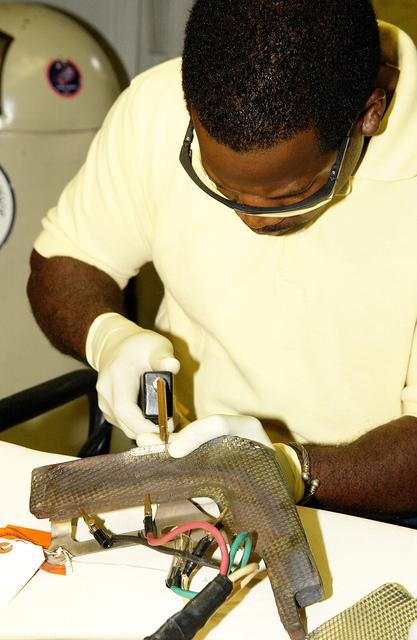
KENNEDY SPACE CENTER, FLA. - United Space Alliance employee Anthony Simmons continues electrowelding on an insulator inside a Reinforced Carbon Carbon panel. The gray carbon composite RCC panels are attached to the leading edge of the wing of the orbiters to withstand the aerodynamic forces experienced during launch and reentry, which can reach as high as 800 pounds per square foot. The operating range of RCC is from minus 250º F to about 3,000º F, the temperature produced by friction with the atmosphere during reentry.
KSC-03pd2670
KSC | 2003-09-16
Details
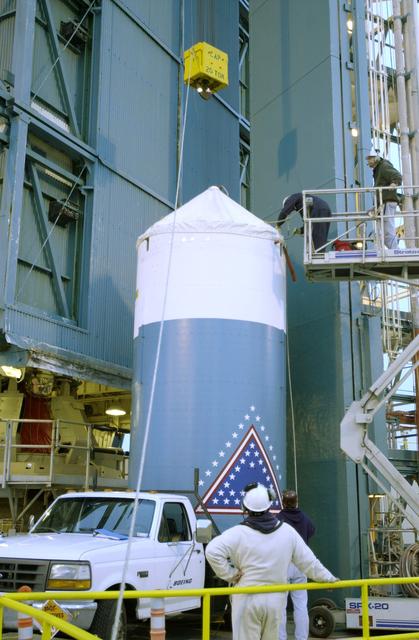
VANDENBERG AFB, CALIF. - The interstage of the Delta II launch vehicle for the Gravity Probe B experiment is prepared for lifting up the mobile service tower on Space Launch Complex 2, Vandenberg Air Force Base, Calif. It will enclose the second stage. The Gravity Probe B will launch a payload of four gyroscopes into low-Earth polar orbit to test two extraordinary predictions of Albert Einstein’s general theory of relativity: the geodetic effect (how space and time are warped by the presence of the Earth) and frame dragging (how Earth’s rotation drags space and time around with it). Once in orbit, for 18 months each gyroscope’s spin axis will be monitored as it travels through local spacetime, observing and measuring these effects. The experiment was developed by Stanford University, Lockheed Martin and NASA’s Marshall Space Flight Center. The targeted launch date is Dec. 6, 2003.
KSC-03pd2873
KSC | 2003-09-16
Details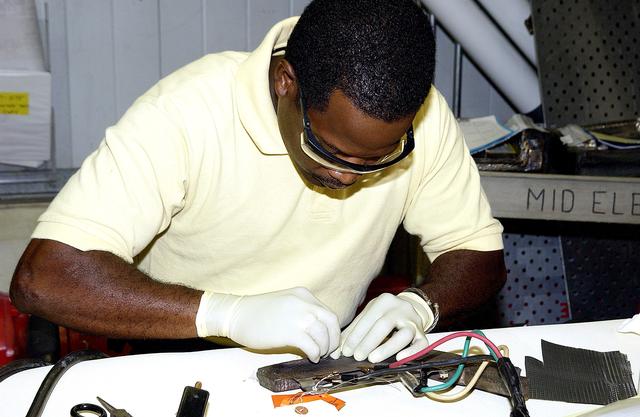
KENNEDY SPACE CENTER, FLA. - United Space Alliance employee Anthony Simmons prepares to electroweld a crack formed in the insulator inside a Reinforced Carbon Carbon panel. The gray carbon composite RCC panels are attached to the leading edge of the wing of the orbiters to withstand the aerodynamic forces experienced during launch and reentry, which can reach as high as 800 pounds per square foot. The operating range of RCC is from minus 250º F to about 3,000º F, the temperature produced by friction with the atmosphere during reentry.
KSC-03pd2666
KSC | 2003-09-16
Details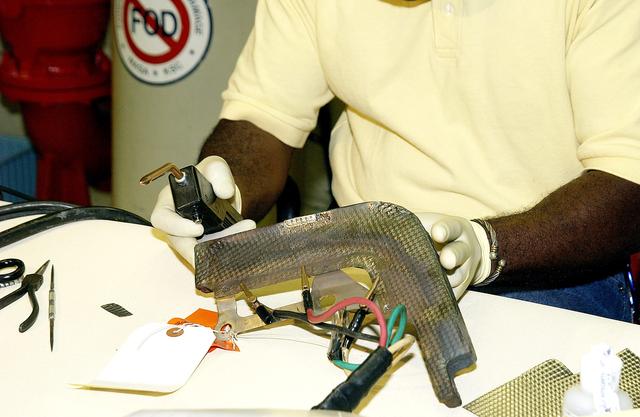
KENNEDY SPACE CENTER, FLA. - United Space Alliance employee Anthony Simmons checks the electroweld he performed on an insulator inside a Reinforced Carbon Carbon panel. The gray carbon composite RCC panels are attached to the leading edge of the wing of the orbiters to withstand the aerodynamic forces experienced during launch and reentry, which can reach as high as 800 pounds per square foot. The operating range of RCC is from minus 250º F to about 3,000º F, the temperature produced by friction with the atmosphere during reentry.
KSC-03pd2669
KSC | 2003-09-16
Details


KENNEDY SPACE CENTER, FLA. - Workers place some of the Columbia debris moved from the Columbia Debris Hangar in its permanent storage site in the Vehicle Assembly Building. More than 83,000 pieces of debris were shipped to KSC during search and recovery efforts in East Texas. That represents about 38 percent of the dry weight of Columbia, equaling almost 85,000 pounds.
KSC-03pd2622
KSC | 2003-09-15
Details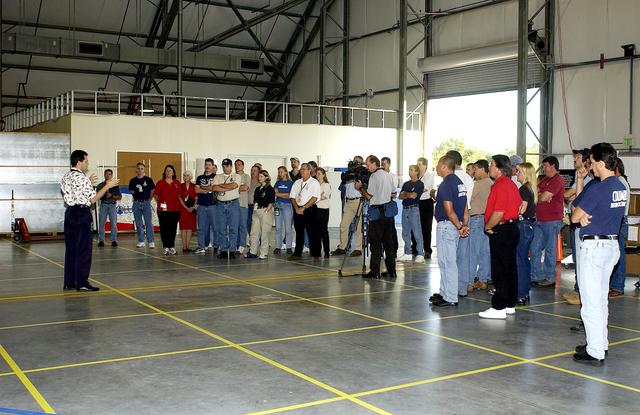
KENNEDY SPACE CENTER, FLA. - Scott Thurston, NASA vehicle flow manager, speaks to members of the Columbia Reconstruction Team during transfer of debris from the Columbia Debris Hangar to its permanent storage site in the Vehicle Assembly Building. More than 83,000 pieces of debris were shipped to KSC during search and recovery efforts in East Texas. That represents about 38 percent of the dry weight of Columbia, equaling almost 85,000 pounds.
KSC-03pd2608
KSC | 2003-09-15
Details
VANDENBERG AFB, CALIF. - The first stage of the Delta II launch vehicle for the Gravity Probe B experiment is lifted up the mobile service tower on Space Launch Complex 2, Vandenberg Air Force Base, Calif. The Gravity Probe B will launch a payload of four gyroscopes into low-Earth polar orbit to test two extraordinary predictions of Albert Einstein’s general theory of relativity: the geodetic effect (how space and time are warped by the presence of the Earth) and frame dragging (how Earth’s rotation drags space and time around with it). Once in orbit, for 18 months each gyroscope’s spin axis will be monitored as it travels through local spacetime, observing and measuring these effects. The experiment was developed by Stanford University, Lockheed Martin and NASA’s Marshall Space Flight Center. The targeted launch date is Dec. 6, 2003.
KSC-03pd2872
KSC | 2003-09-15
Details
KENNEDY SPACE CENTER, FLA. - A flatbed truck carrying pieces of Columbia debris arrives in the transfer aisle of the Vehicle Assembly Building. The debris is being transferred to the VAB for permanent storage. More than 83,000 pieces of debris were shipped to KSC during search and recovery efforts in East Texas. That represents about 38 percent of the dry weight of Columbia, equaling almost 85,000 pounds.
KSC-03pd2615
KSC | 2003-09-15
Details
VANDENBERG AFB, CALIF. - The first stage of the Delta II launch vehicle for the Gravity Probe B experiment is ready to be lifted up the mobile service tower on Space Launch Complex 2, Vandenberg Air Force Base, Calif. The Gravity Probe B will launch a payload of four gyroscopes into low-Earth polar orbit to test two extraordinary predictions of Albert Einstein’s general theory of relativity: the geodetic effect (how space and time are warped by the presence of the Earth) and frame dragging (how Earth’s rotation drags space and time around with it). Once in orbit, for 18 months each gyroscope’s spin axis will be monitored as it travels through local spacetime, observing and measuring these effects. The experiment was developed by Stanford University, Lockheed Martin and NASA’s Marshall Space Flight Center. The targeted launch date is Dec. 6, 2003.
KSC-03pd2871
KSC | 2003-09-15
Details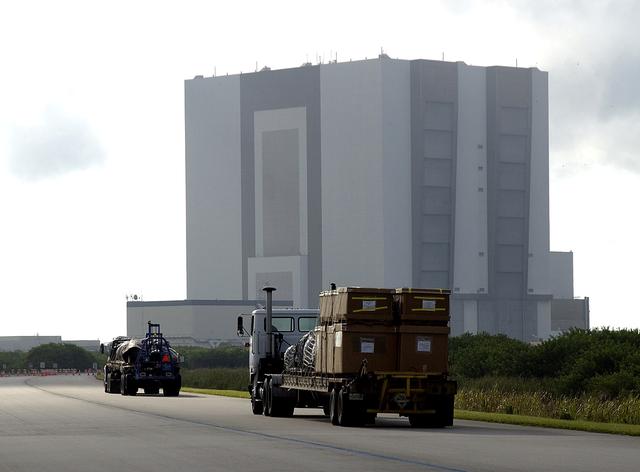
KENNEDY SPACE CENTER, FLA. - Flatbed trucks carrying some of the debris of Space Shuttle Columbia approach the Vehicle Assembly Building (VAB). The debris is being transferred from the Columbia Debris Hangar to the VAB for permanent storage. More than 83,000 pieces of debris were shipped to KSC during search and recovery efforts in East Texas. That represents about 38 percent of the dry weight of Columbia, equaling almost 85,000 pounds.
KSC-03pd2613
KSC | 2003-09-15
Details
VANDENBERG AFB, CALIF. - The first stage of the Delta II launch vehicle for the Gravity Probe B experiment arrives at Space Launch Complex 2, Vandenberg Air Force Base, Calif. The Gravity Probe B will launch a payload of four gyroscopes into low-Earth polar orbit to test two extraordinary predictions of Albert Einstein’s general theory of relativity: the geodetic effect (how space and time are warped by the presence of the Earth) and frame dragging (how Earth’s rotation drags space and time around with it). Once in orbit, for 18 months each gyroscope’s spin axis will be monitored as it travels through local spacetime, observing and measuring these effects. The experiment was developed by Stanford University, Lockheed Martin and NASA’s Marshall Space Flight Center. The targeted launch date is Dec. 6, 2003.
KSC-03pd2869
KSC | 2003-09-15
Details


VANDENBERG AFB, CALIF. - The first stage of the Delta II launch vehicle for the Gravity Probe B experiment is raised to a vertical position at Space Launch Complex 2, Vandenberg Air Force Base, Calif. The Gravity Probe B will launch a payload of four gyroscopes into low-Earth polar orbit to test two extraordinary predictions of Albert Einstein’s general theory of relativity: the geodetic effect (how space and time are warped by the presence of the Earth) and frame dragging (how Earth’s rotation drags space and time around with it). Once in orbit, for 18 months each gyroscope’s spin axis will be monitored as it travels through local spacetime, observing and measuring these effects. The experiment was developed by Stanford University, Lockheed Martin and NASA’s Marshall Space Flight Center. The targeted launch date is Dec. 6, 2003.
KSC-03pd2870
KSC | 2003-09-15
Details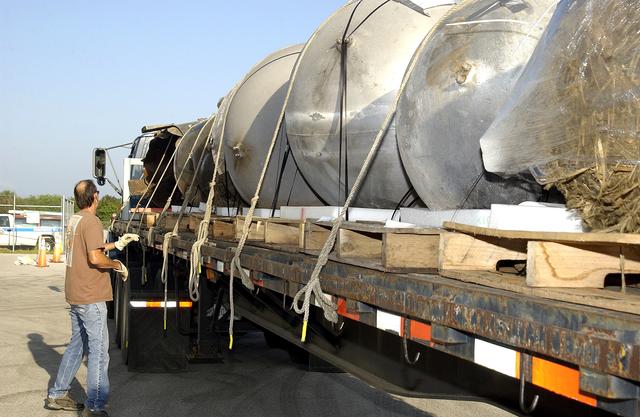
KENNEDY SPACE CENTER, FLA. - At the Columbia Debris Hangar, some of the debris of Space Shuttle Columbia is secured onto a flatbed truck for transfer to the Vehicle Assembly Building for permanent storage. More than 83,000 pieces of debris were shipped to KSC during search and recovery efforts in East Texas. That represents about 38 percent of the dry weight of Columbia, equaling almost 85,000 pounds.
KSC-03pd2611
KSC | 2003-09-15
Details