NASA Media Archive
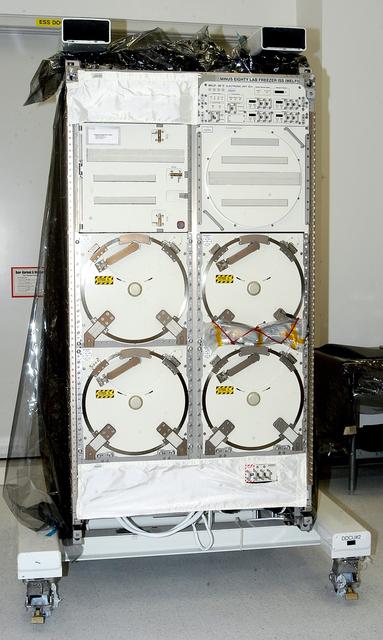
KENNEDY SPACE CENTER, FLA. - The Minus Eighty Lab Freezer for ISS (MELFI), provided as Laboratory Support Equipment by the European Space Agency for the International Space Station, is seen in the Space Station Processing Facility. The lab will provide cooling and storage for reagents, samples and perishable materials in four insulated containers called dewars with independently selectable temperatures of -80°C, -26°C, and +4°C. It also will be used to transport samples to and from the station. The MELFI is planned for launch on the ULF-1 mission.
KSC-03pd2600
KSC | 2003-09-08
Details

KENNEDY SPACE CENTER, FLA. - After removing its cover, technicians look over the Minus Eighty Lab Freezer for ISS (MELFI), provided as Laboratory Support Equipment by the European Space Agency for the International Space Station. The lab will provide cooling and storage for reagents, samples and perishable materials in four insulated containers called dewars with independently selectable temperatures of -80°C, -26°C, and +4°C. It also will be used to transport samples to and from the station. The MELFI is planned for launch on the ULF-1 mission.
KSC-03pd2599
KSC | 2003-09-08
Details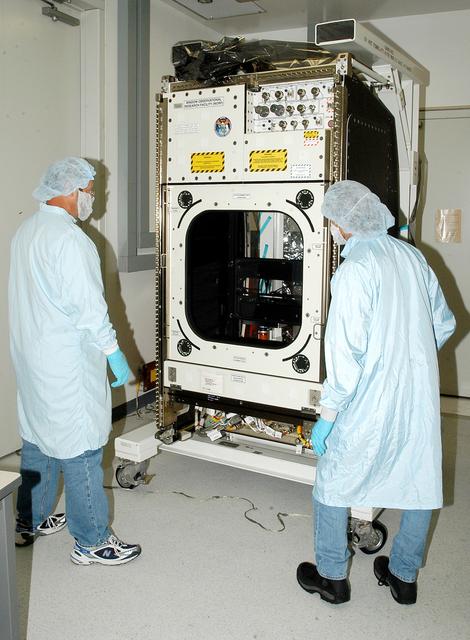
KENNEDY SPACE CENTER, FLA. - Workers in the Space Station Processing Facility check out the Window Observational Research Facility (WORF), designed and built by the Boeing Co. at NASA’s Marshall Space Flight Center in Huntsville, Ala. WORF will be delivered to the International Space Station and placed in the rack position in front of the Destiny lab window, providing locations for attaching cameras, multi-spectral scanners and other instruments. WORF will support a variety of scientific and commercial experiments in areas of Earth systems and processes, global ecological changes in Earth’s biosphere, lithosphere, hydrosphere and climate system, Earth resources, natural hazards, and education. After installation, it will become a permanent focal point for Earth Science research aboard the space station.
KSC-03pd2596
KSC | 2003-09-08
Details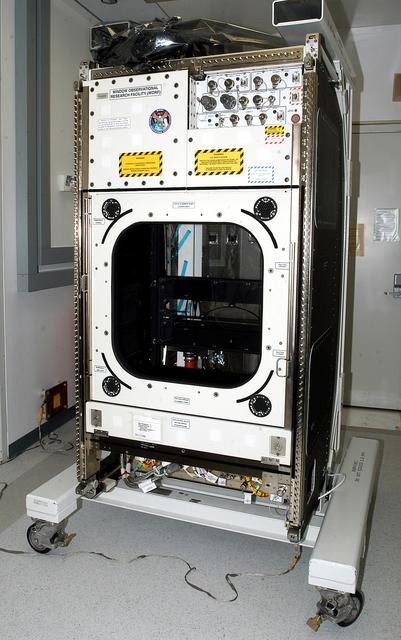
KENNEDY SPACE CENTER, FLA. - The Window Observational Research Facility (WORF), seen in the Space Station Processing Facility, was designed and built by the Boeing Co. at NASA’s Marshall Space Flight Center in Huntsville, Ala. WORF will be delivered to the International Space Station and placed in the rack position in front of the Destiny lab window, providing locations for attaching cameras, multi-spectral scanners and other instruments. WORF will support a variety of scientific and commercial experiments in areas of Earth systems and processes, global ecological changes in Earth’s biosphere, lithosphere, hydrosphere and climate system, Earth resources, natural hazards, and education. After installation, it will become a permanent focal point for Earth Science research aboard the space station.
KSC-03pd2597
KSC | 2003-09-08
Details
KENNEDY SPACE CENTER, FLA. - In the Orbiter Processing Facility, United Space Alliance worker Mike Hyatt looks over a Reinforced Carbon Carbon (RCC) panel that will be attached to the leading edge of the wing of the orbiter Atlantis. The gray carbon composite RCC panels have sufficient strength to withstand the aerodynamic forces experienced during launch and reentry, which can reach as high as 800 pounds per square foot. The operating range of RCC is from minus 250º F to about 3,000º F, the temperature produced by friction with the atmosphere during reentry.
KSC-03pd2601
KSC | 2003-09-08
Details
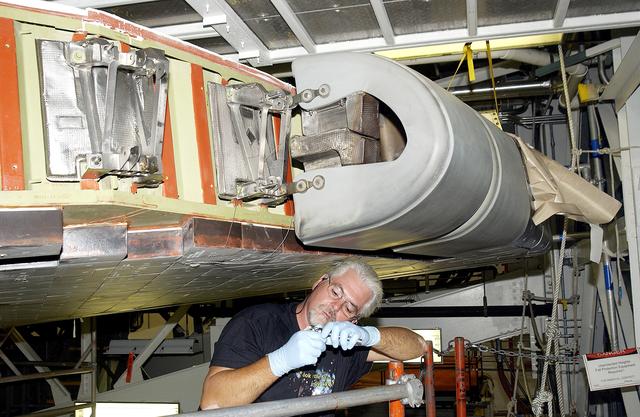
KENNEDY SPACE CENTER, FLA. - Billy Witt, a midbody shop mechanic with United Space Alliance, checks a part used for installation of a Reinforced Carbon Carbon (RCC) panel to the leading edge of the wing of an orbiter. Above him is an RCC panel just installed on Atlantis. The gray carbon composite RCC panels have sufficient strength to withstand the aerodynamic forces experienced during launch and reentry, which can reach as high as 800 pounds per square foot. The operating range of RCC is from minus 250º F to about 3,000º F, the temperature produced by friction with the atmosphere during reentry.
KSC-03pd2606
KSC | 2003-09-08
Details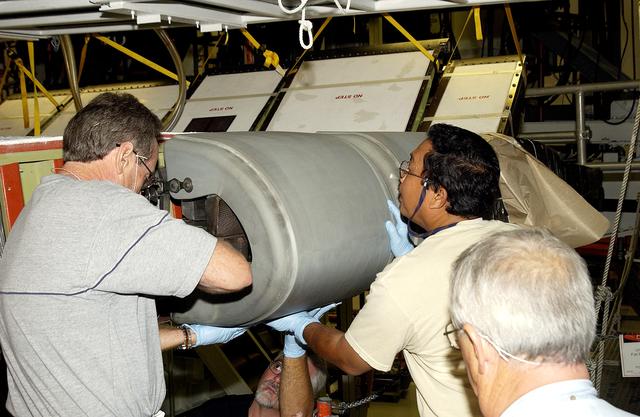
KENNEDY SPACE CENTER, FLA. - In the Orbiter Processing Facility, United Space Alliance workers Mike Hyatt (left), Saul Ngy (center) and Jerry Belt (right) prepare to install a Reinforced Carbon Carbon (RCC) panel to the leading edge of the wing of the orbiter Atlantis. The gray carbon composite RCC panels have sufficient strength to withstand the aerodynamic forces experienced during launch and reentry, which can reach as high as 800 pounds per square foot. The operating range of RCC is from minus 250º F to about 3,000º F, the temperature produced by friction with the atmosphere during reentry.
KSC-03pd2602
KSC | 2003-09-08
Details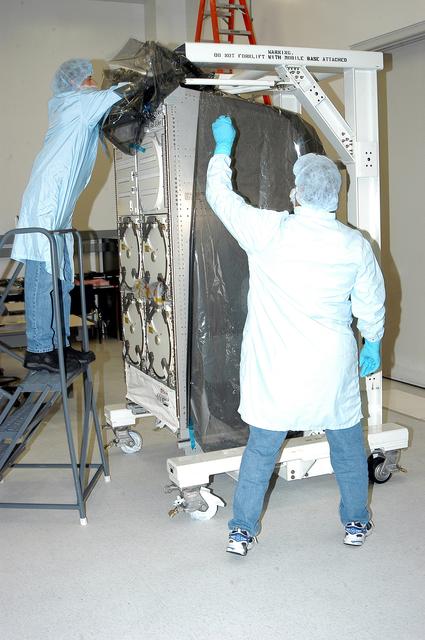
KENNEDY SPACE CENTER, FLA. - In the Space Station Processing Facility, technicians remove the cover from the Minus Eighty Lab Freezer for ISS(MELFI) provided as Laboratory Support Equipment by the European Space Agency for the International Space Station. The lab will provide cooling and storage for reagents, samples and perishable materials in four insulated containers called dewars with independently selectable temperatures of -80°C, -26°C, and +4°C. It also will be used to transport samples to and from the station. The MELFI is planned for launch on the ULF-1 mission.
KSC-03pd2598
KSC | 2003-09-08
Details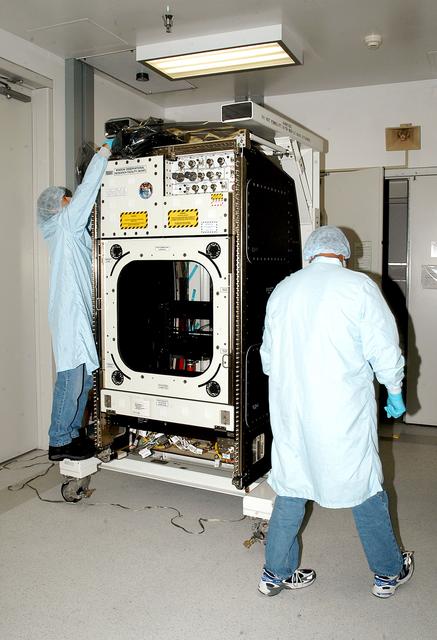
KENNEDY SPACE CENTER, FLA. - Workers in the Space Station Processing Facility check out the Window Observational Research Facility (WORF), designed and built by the Boeing Co. at NASA’s Marshall Space Flight Center in Huntsville, Ala. WORF will be delivered to the International Space Station and placed in the rack position in front of the Destiny lab window, providing locations for attaching cameras, multi-spectral scanners and other instruments. WORF will support a variety of scientific and commercial experiments in areas of Earth systems and processes, global ecological changes in Earth’s biosphere, lithosphere, hydrosphere and climate system, Earth resources, natural hazards, and education. After installation, it will become a permanent focal point for Earth Science research aboard the space station.
KSC-03pd2595
KSC | 2003-09-08
Details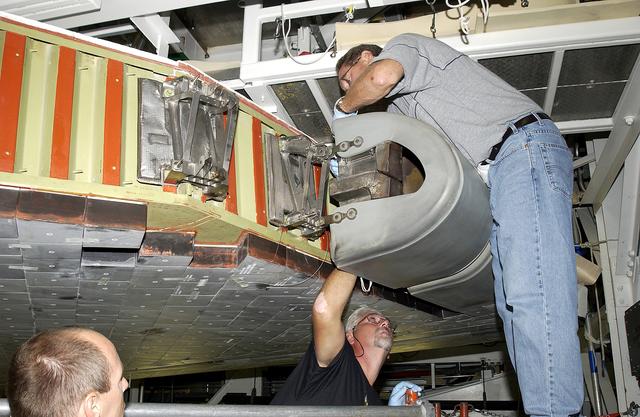
KENNEDY SPACE CENTER, FLA. - In the Orbiter Processing Facility, United Space Alliance worker Mike Hyatt (above) finishes installing a Reinforced Carbon Carbon (RCC) panel to the leading edge of the wing of the orbiter Atlantis. The gray carbon composite RCC panels have sufficient strength to withstand the aerodynamic forces experienced during launch and reentry, which can reach as high as 800 pounds per square foot. The operating range of RCC is from minus 250º F to about 3,000º F, the temperature produced by friction with the atmosphere during reentry.
KSC-03pd2605
KSC | 2003-09-08
Details