NASA Media Archive
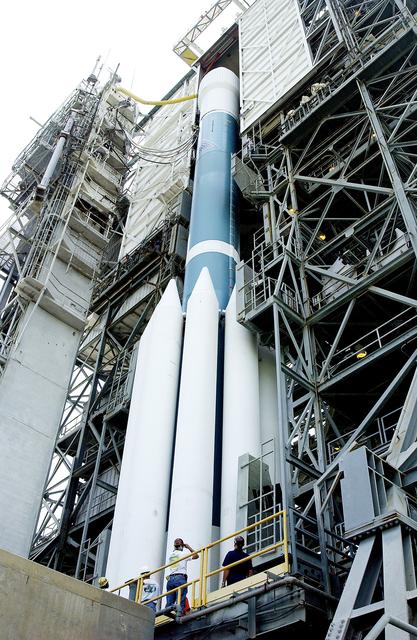
KENNEDY SPACE CENTER, FLA. - The Mobile Service Tower is rolled back at Space Launch Complex 17B, Cape Canaveral Air Force Station, to reveal the Delta II Heavy launch vehicle ready for launch of the Mars Exploration Rover-B (MER-B) mission, with the rover "Opportunity" aboard. The second of twin rovers being sent to Mars, it is equipped with a robotic arm, a drilling tool, three spectrometers, and four pairs of cameras that allow it to have a human-like, 3D view of the terrain. Each rover could travel as far as 100 meters in one day to act as Mars scientists' eyes and hands, exploring an environment where humans are not yet able to go. MER-B is scheduled to launch on June 28 at one of two available times, 11:56:16 p.m. EDT or 12:37:59 a.m. EDT on June 29.
KSC-03pd2054
KSC | 2003-06-28
Details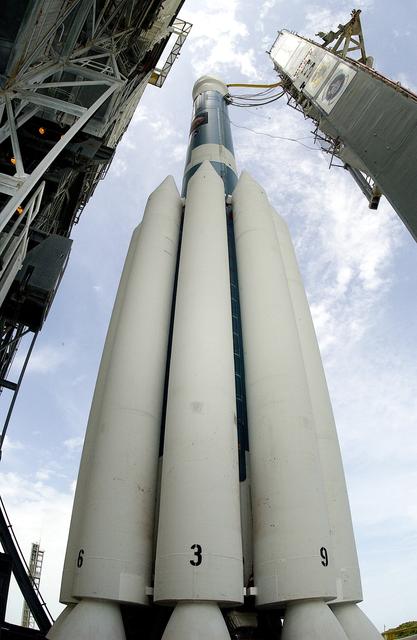
KENNEDY SPACE CENTER, FLA. - The Mobile Service Tower is rolled back at Space Launch Complex 17B, Cape Canaveral Air Force Station, to reveal the Delta II Heavy launch vehicle ready for launch of the Mars Exploration Rover-B (MER-B) mission, with the rover "Opportunity" aboard. The second of twin rovers being sent to Mars, it is equipped with a robotic arm, a drilling tool, three spectrometers, and four pairs of cameras that allow it to have a human-like, 3D view of the terrain. Each rover could travel as far as 100 meters in one day to act as Mars scientists' eyes and hands, exploring an environment where humans are not yet able to go. MER-B is scheduled to launch on June 28 at one of two available times, 11:56:16 p.m. EDT or 12:37:59 a.m. EDT on June 29.
KSC-03pd2055
KSC | 2003-06-28
Details

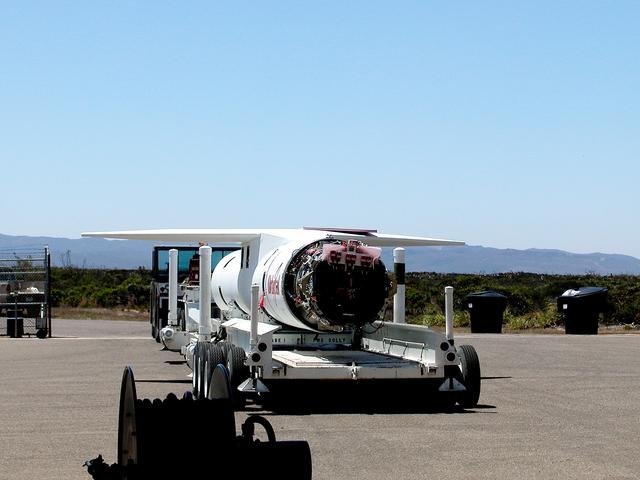
KENNEDY SPACE CENTER, FLA. - The Pegasus launch vehicle is moved back to its hangar at Vandenberg Air Force Base, Calif. The Pegasus will carry the SciSat-1 spacecraft in a 400-mile-high polar orbit to investigate processes that control the distribution of ozone in the upper atmosphere. The scientific mission of SciSat-1 is to measure and understand the chemical processes that control the distribution of ozone in the Earth’s atmosphere, particularly at high altitudes. The data from the satellite will provide Canadian and international scientists with improved measurements relating to global ozone processes and help policymakers assess existing environmental policy and develop protective measures for improving the health of our atmosphere, preventing further ozone depletion. The mission is designed to last two years.
KSC-03pd2116
KSC | 2003-06-27
Details
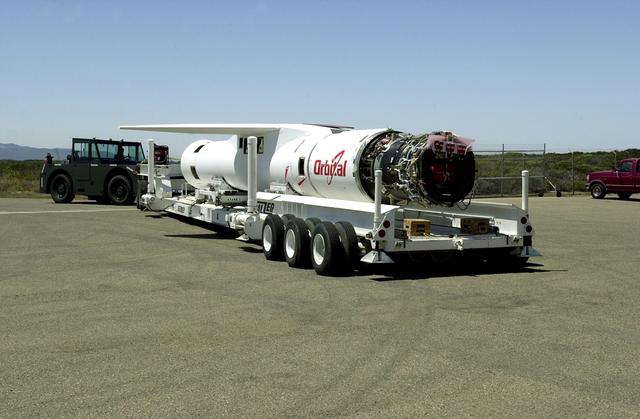
KENNEDY SPACE CENTER, FLA. - The Pegasus launch vehicle is moved back to its hangar at Vandenberg Air Force Base, Calif. The Pegasus will carry the SciSat-1 spacecraft in a 400-mile-high polar orbit to investigate processes that control the distribution of ozone in the upper atmosphere. The scientific mission of SciSat-1 is to measure and understand the chemical processes that control the distribution of ozone in the Earth’s atmosphere, particularly at high altitudes. The data from the satellite will provide Canadian and international scientists with improved measurements relating to global ozone processes and help policymakers assess existing environmental policy and develop protective measures for improving the health of our atmosphere, preventing further ozone depletion. The mission is designed to last two years.
KSC-03pd2117
KSC | 2003-06-27
Details
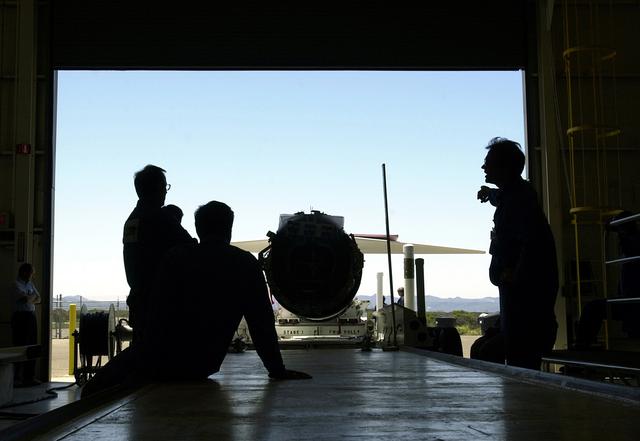
KENNEDY SPACE CENTER, FLA. - Inside the hangar at Vandenberg Air Force Base, Calif., workers wait for the Pegasus launch vehicle to be moved inside. The Pegasus will carry the SciSat-1 spacecraft in a 400-mile-high polar orbit to investigate processes that control the distribution of ozone in the upper atmosphere. The scientific mission of SciSat-1 is to measure and understand the chemical processes that control the distribution of ozone in the Earth’s atmosphere, particularly at high altitudes. The data from the satellite will provide Canadian and international scientists with improved measurements relating to global ozone processes and help policymakers assess existing environmental policy and develop protective measures for improving the health of our atmosphere, preventing further ozone depletion. The mission is designed to last two years.
KSC-03pd2121
KSC | 2003-06-27
Details
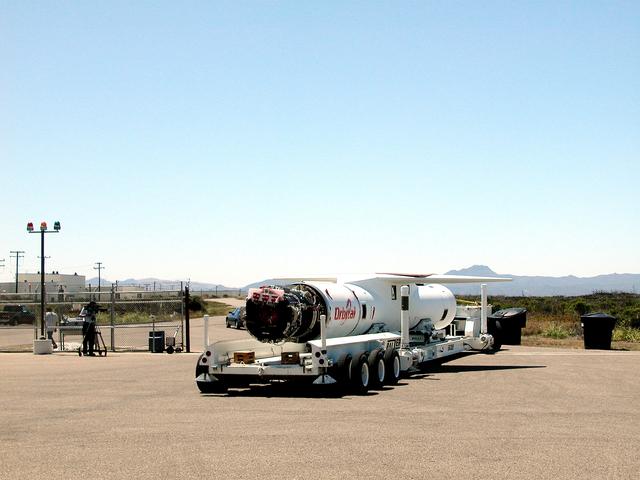
KENNEDY SPACE CENTER, FLA. - At Vandenberg Air Force Base, Calif., the Pegasus launch vehicle is moved toward its hangar. The Pegasus will carry the SciSat-1 spacecraft in a 400-mile-high polar orbit to investigate processes that control the distribution of ozone in the upper atmosphere. The scientific mission of SciSat-1 is to measure and understand the chemical processes that control the distribution of ozone in the Earth’s atmosphere, particularly at high altitudes. The data from the satellite will provide Canadian and international scientists with improved measurements relating to global ozone processes and help policymakers assess existing environmental policy and develop protective measures for improving the health of our atmosphere, preventing further ozone depletion. The mission is designed to last two years.
KSC-03pd2120
KSC | 2003-06-27
Details
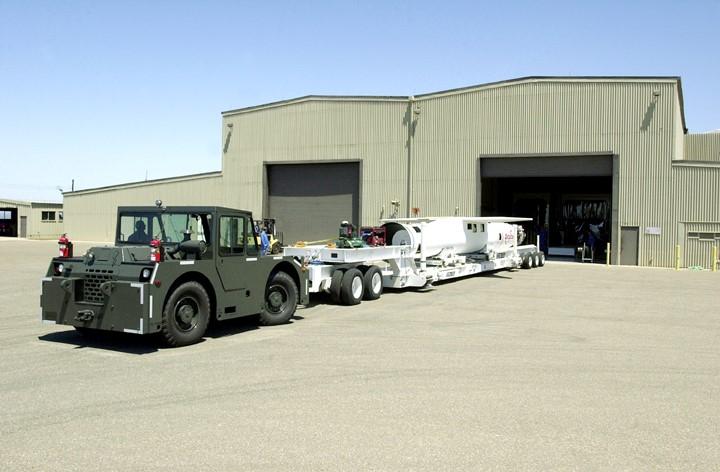
KENNEDY SPACE CENTER, FLA. - At Vandenberg Air Force Base, Calif., the Pegasus launch vehicle is moved into its hangar. The Pegasus will carry the SciSat-1 spacecraft in a 400-mile-high polar orbit to investigate processes that control the distribution of ozone in the upper atmosphere. The scientific mission of SciSat-1 is to measure and understand the chemical processes that control the distribution of ozone in the Earth’s atmosphere, particularly at high altitudes. The data from the satellite will provide Canadian and international scientists with improved measurements relating to global ozone processes and help policymakers assess existing environmental policy and develop protective measures for improving the health of our atmosphere, preventing further ozone depletion. The mission is designed to last two years.
KSC-03pd2115
KSC | 2003-06-27
Details
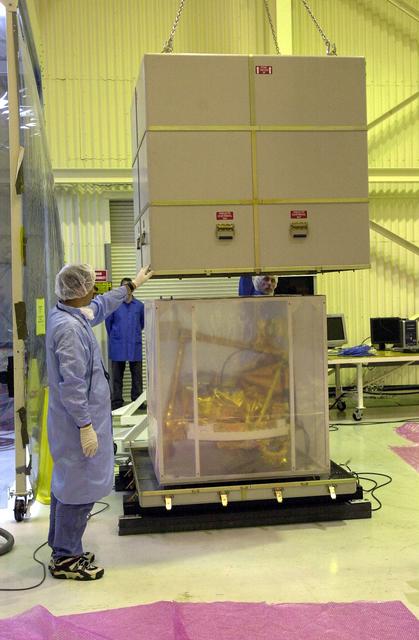
KENNEDY SPACE CENTER, FLA. - The SciSat-1 spacecraft is uncrated at Vandenberg Air Force Base, Calif. SciSat-1 weighs approximately 330 pounds and will be placed in a 400-mile-high polar orbit to investigate processes that control the distribution of ozone in the upper atmosphere. The scientific mission of SciSat-1 is to measure and understand the chemical processes that control the distribution of ozone in the Earth’s atmosphere, particularly at high altitudes. The data from the satellite will provide Canadian and international scientists with improved measurements relating to global ozone processes and help policymakers assess existing environmental policy and develop protective measures for improving the health of our atmosphere, preventing further ozone depletion. The mission is designed to last two years.
KSC-03pd2109
KSC | 2003-06-26
Details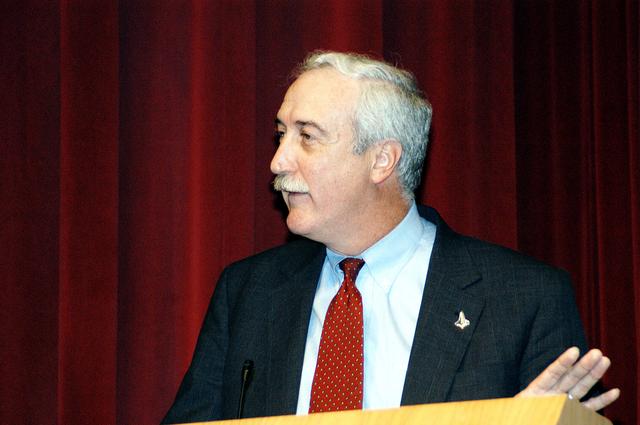
KENNEDY SPACE CENTER, FLA. - NASA Administrator Sean O'Keefe addresses a group of KSC employees assembled in the KSC Training Auditorium. The occasion is the announcement of James W. Kennedy as the next director of the NASA Kennedy Space Center (KSC) in Florida. Kennedy has served as KSC's deputy director since November 2002. He will succeed KSC Director Roy D. Bridges, who was appointed on June 13 to lead NASA's Langley Research Center, Hampton, Va.
KSC-03pd2031
KSC | 2003-06-26
Details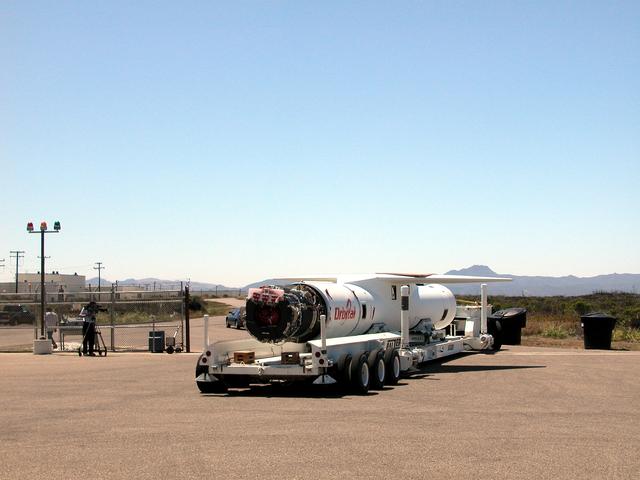
VANDENBERG AIR FORCE BASE, CALIF. - At Vandenberg Air Force Base, Calif., the Pegasus launch vehicle is moved toward its hangar. The Pegasus will carry the SciSat-1 spacecraft in a 400-mile-high polar orbit to investigate processes that control the distribution of ozone in the upper atmosphere. The data from the satellite will provide Canadian and international scientists with improved measurements relating to global ozone processes and help policymakers assess existing environmental policy and develop protective measures for improving the health of our atmosphere, preventing further ozone depletion. The mission is designed to last two years.
KSC-03pd2921
KSC | 2003-06-26
Details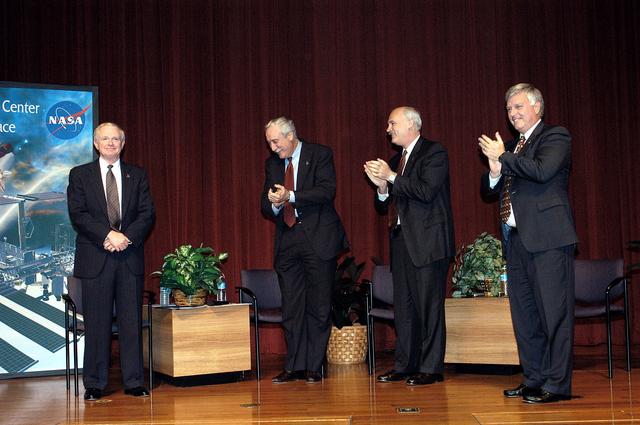
KENNEDY SPACE CENTER, FLA. - KSC Center Director Roy D. Bridges receives the applause of NASA officials and a group of KSC employees assembled in the KSC Training Auditorium. From left are Bridges, NASA Administrator Sean O'Keefe, NASA Associate Administrator of Space Flight William F. Readdy, and KSC Deputy Director James W. Kennedy. The occasion is the announcement of Kennedy as the next director of the NASA Kennedy Space Center (KSC) in Florida. Kennedy has served as KSC's deputy director since November 2002. He will succeed Bridges, who was appointed on June 13 to lead NASA's Langley Research Center, Hampton, Va.
KSC-03pd2038
KSC | 2003-06-26
Details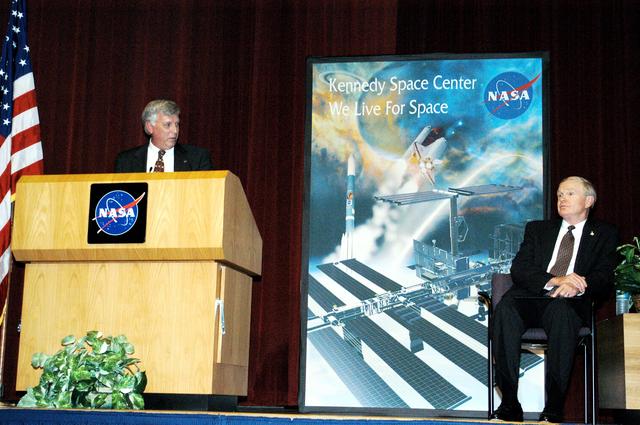
KENNEDY SPACE CENTER, FLA. - KSC Deputy Director James W. Kennedy addresses a group of KSC employees assembled in the KSC Training Auditorium, as KSC Director Roy D. Bridges looks on (right). The occasion is the announcement of Kennedy as the next director of the NASA Kennedy Space Center (KSC) in Florida. Kennedy has served as KSC's deputy director since November 2002. He will succeed Bridges, who was appointed on June 13 to lead NASA's Langley Research Center, Hampton, Va.
KSC-03pd2043
KSC | 2003-06-26
Details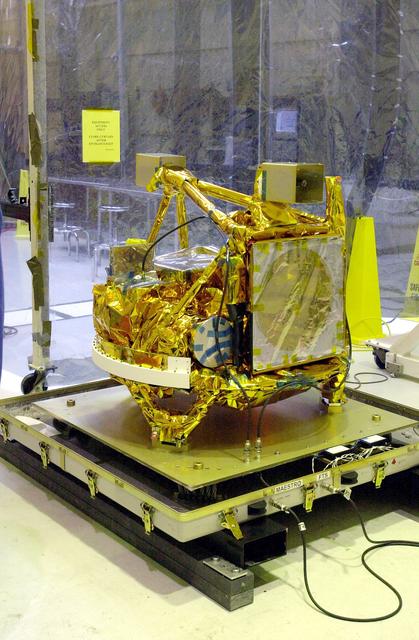
VANDENBERG AIR FORCE BASE, CALIF. - The SciSat-1 spacecraft is revealed at Vandenberg Air Force Base, Calif. Sci-Sat, which will undergo instrument checkout and spacecraft functional testing, weighs approximately 330 pounds and after launch will be placed in a 400-mile-high polar orbit to investigate processes that control the distribution of ozone in the upper atmosphere. The data from the satellite will provide Canadian and international scientists with improved measurements relating to global ozone processes and help policymakers assess existing environmental policy and develop protective measures for improving the health of our atmosphere, preventing further ozone depletion. The mission is designed to last two years.
KSC-03pd2919
KSC | 2003-06-26
Details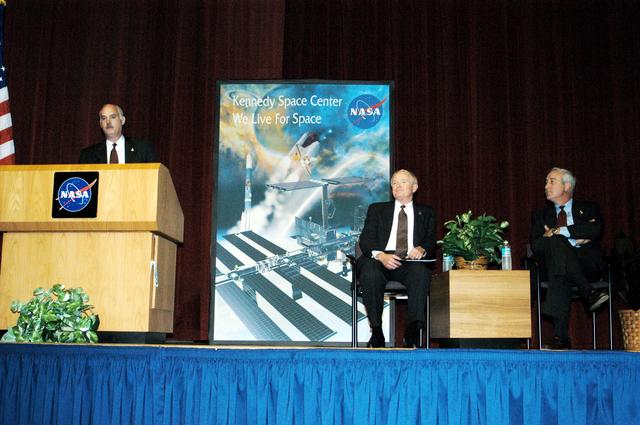
KENNEDY SPACE CENTER, FLA. - NASA Associate Administrator for Space Flight William F. Readdy addresses a group of KSC employees assembled in the KSC Training Auditorium. From left are Readdy, KSC Center Director Roy D. Bridges, and NASA Administrator Sean O'Keefe. The occasion is the announcement of James W. Kennedy as the next director of the NASA Kennedy Space Center (KSC) in Florida. Kennedy has served as KSC's deputy director since November 2002. He will succeed Bridges, who was appointed on June 13 to lead NASA's Langley Research Center, Hampton, Va.
KSC-03pd2040
KSC | 2003-06-26
Details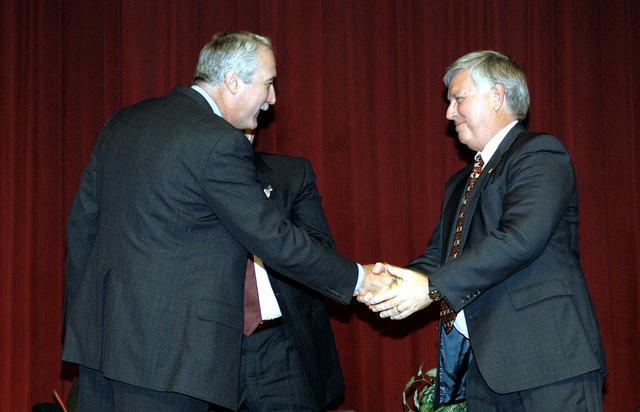
KENNEDY SPACE CENTER, FLA. - NASA Administrator Sean O'Keefe (left) congratulates James W. Kennedy (right) before a group of KSC employees assembled in the KSC Training Auditorium. The occasion is the announcement of Kennedy as the next director of the NASA Kennedy Space Center (KSC) in Florida. Kennedy has served as KSC's deputy director since November 2002. He will succeed KSC Director Roy D. Bridges, who was appointed on June 13 to lead NASA's Langley Research Center, Hampton, Va.
KSC-03pd2037
KSC | 2003-06-26
Details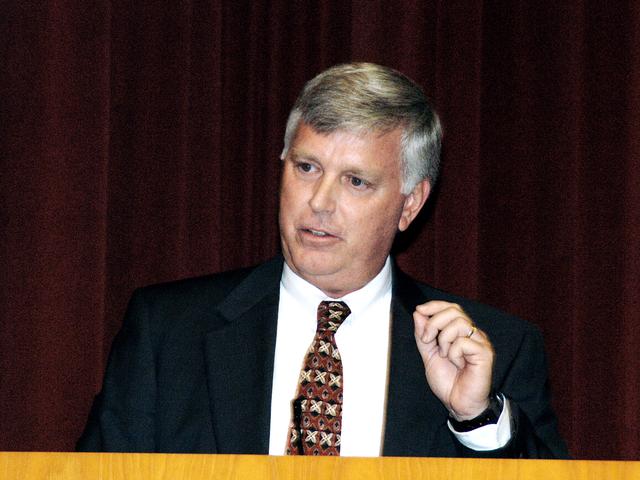
KENNEDY SPACE CENTER, FLA. - KSC Deputy Director James W. Kennedy addresses a group of KSC employees assembled in the KSC Training Auditorium. The occasion is the announcement of Kennedy as the next director of the NASA Kennedy Space Center (KSC) in Florida. He has served as KSC's deputy director since November 2002. He will succeed KSC Director Roy D. Bridges, who was appointed on June 13 to lead NASA's Langley Research Center, Hampton, Va.
KSC-03pd2042
KSC | 2003-06-26
Details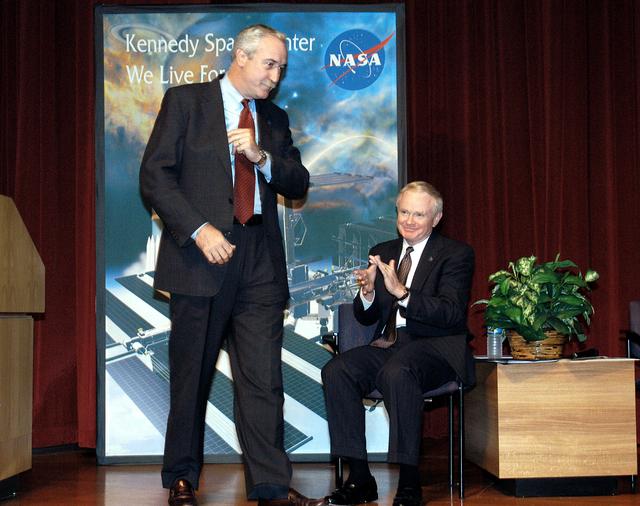
KENNEDY SPACE CENTER, FLA. - NASA Administrator Sean O'Keefe (left) receives the applause of KSC Director Roy D. Bridges (right) and a group of KSC employees assembled in the KSC Training Auditorium. The occasion is the announcement of James W. Kennedy as the next director of the NASA Kennedy Space Center (KSC) in Florida. Kennedy has served as KSC's deputy director since November 2002. He will succeed Bridges, who was appointed on June 13 to lead NASA's Langley Research Center, Hampton, Va.
KSC-03pd2036
KSC | 2003-06-26
Details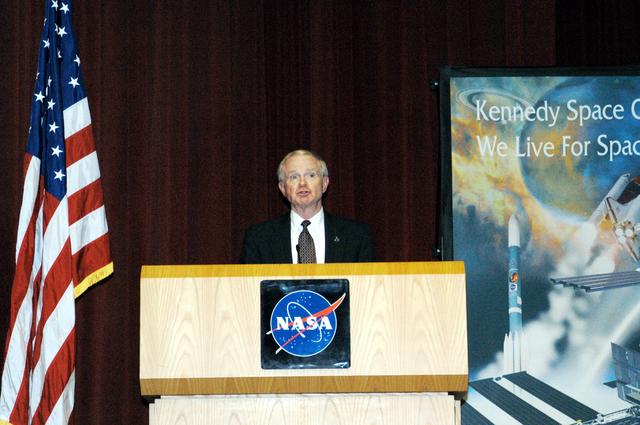
KENNEDY SPACE CENTER, FLA. - KSC Director Roy D. Bridges addresses a group of KSC employees assembled in the KSC Training Auditorium. The occasion is the announcement of James W. Kennedy as the next director of the NASA Kennedy Space Center (KSC) in Florida. Kennedy has served as KSC's deputy director since November 2002. He will succeed Bridges, who was appointed on June 13 to lead NASA's Langley Research Center, Hampton, Va.
KSC-03pd2039
KSC | 2003-06-26
Details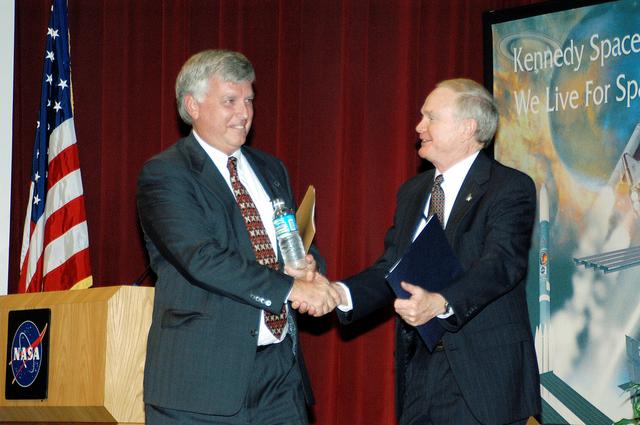
KENNEDY SPACE CENTER, FLA. - KSC Deputy Director James W. Kennedy (left) and KSC Director Roy D. Bridges shake hands before a group of KSC employees assembled in the KSC Training Auditorium. The occasion is the announcement of Kennedy as the next director of the NASA Kennedy Space Center (KSC) in Florida. Kennedy has served as KSC's deputy director since November 2002. He will succeed Bridges, who was appointed on June 13 to lead NASA's Langley Research Center, Hampton, Va.
KSC-03pd2047
KSC | 2003-06-26
Details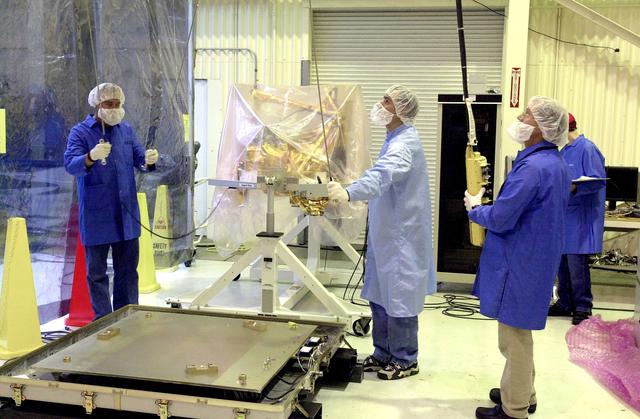
VANDENBERG AIR FORCE BASE, CALIF. - Outside the clean room at Vandenberg Air Force Base, Calif., the SciSat-1 spacecraft (background) has been removed from the shipping container mounting base (lower left) and placed on the handling fixture. Sci-Sat, which will undergo instrument checkout and spacecraft functional testing, weighs approximately 330 pounds and after launch will be placed in a 400-mile-high polar orbit to investigate processes that control the distribution of ozone in the upper atmosphere. The data from the satellite will provide Canadian and international scientists with improved measurements relating to global ozone processes and help policymakers assess existing environmental policy and develop protective measures for improving the health of our atmosphere, preventing further ozone depletion. The mission is designed to last two years.
KSC-03pd2920
KSC | 2003-06-26
Details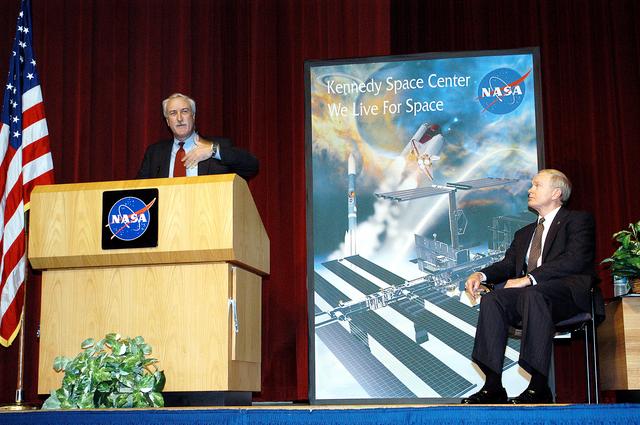
KENNEDY SPACE CENTER, FLA. - NASA Administrator Sean O'Keefe addresses a group of KSC employees assembled in the KSC Training Auditorium. KSC Director Roy D. Bridges (right) also spoke. The occasion is the announcement of James W. Kennedy as the next director of the NASA Kennedy Space Center (KSC) in Florida. Kennedy has served as KSC's deputy director since November 2002. He will succeed Bridges, who was appointed on June 13 to lead NASA's Langley Research Center, Hampton, Va.
KSC-03pd2035
KSC | 2003-06-26
Details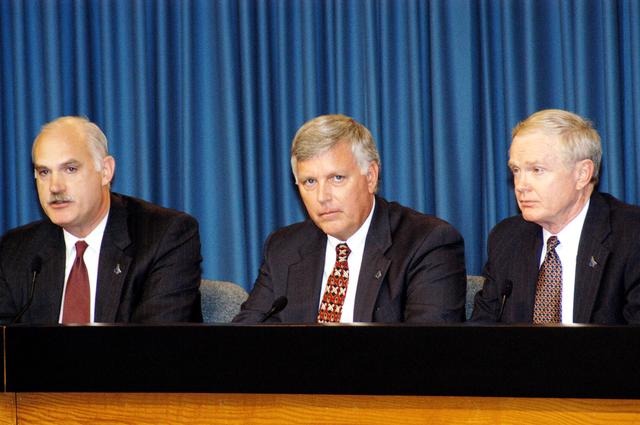
KENNEDY SPACE CENTER, FLA. - NASA officials participate in a press conference in KSC's Press Site Auditorium. From left are NASA Associate Administrator for Space Flight William F. Readdy, KSC Deputy Director James W. Kennedy, and KSC Director Roy D. Bridges. The press conference followed the official announcement of Kennedy as the next director of the NASA Kennedy Space Center (KSC) in Florida. Kennedy has served as KSC's deputy director since November 2002. He will succeed Bridges, who was appointed on June 13 to lead NASA's Langley Research Center, Hampton, Va.
KSC-03pd2051
KSC | 2003-06-26
Details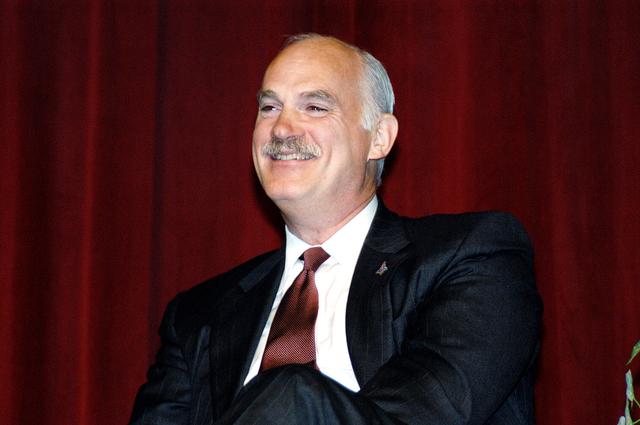
KENNEDY SPACE CENTER, FLA. - NASA Associate Administrator for Space Flight William F. Readdy addresses a group of KSC employees assembled in the KSC Training Auditorium. The occasion is the announcement of James W. Kennedy as the next director of the NASA Kennedy Space Center (KSC) in Florida. Kennedy has served as KSC's deputy director since November 2002. He will succeed KSC Director Roy D. Bridges, who was appointed on June 13 to lead NASA's Langley Research Center, Hampton, Va.
KSC-03pd2033
KSC | 2003-06-26
Details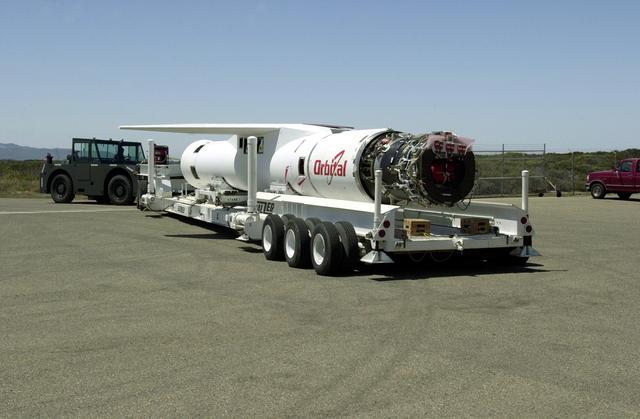
VANDENBERG AIR FORCE BASE, CALIF. - At Vandenberg Air Force Base, Calif., the Pegasus launch vehicle is moved toward its hangar. The Pegasus will carry the SciSat-1 spacecraft in a 400-mile-high polar orbit to investigate processes that control the distribution of ozone in the upper atmosphere. The data from the satellite will provide Canadian and international scientists with improved measurements relating to global ozone processes and help policymakers assess existing environmental policy and develop protective measures for improving the health of our atmosphere, preventing further ozone depletion. The mission is designed to last two years.
KSC-03pd2922
KSC | 2003-06-26
Details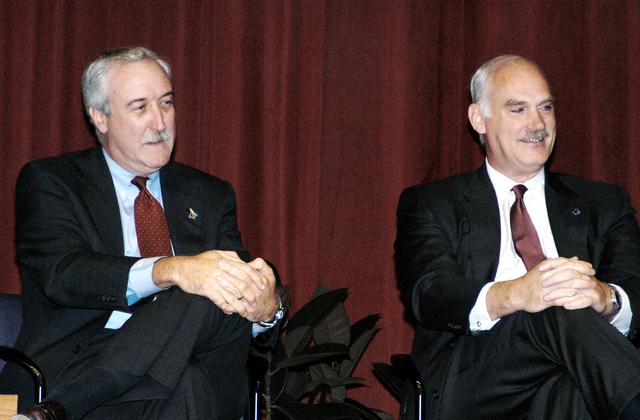
KENNEDY SPACE CENTER, FLA. - NASA Administrator Sean O'Keefe (left) and NASA Associate Administrator of Space Flight William F. Readdy address a group of KSC employees assembled in the KSC Training Auditorium. The occasion is the announcement of James W. Kennedy as the next director of the NASA Kennedy Space Center (KSC) in Florida. Kennedy has served as KSC's deputy director since November 2002. He will succeed KSC Director Roy D. Bridges, who was appointed on June 13 to lead NASA's Langley Research Center, Hampton, Va.
KSC-03pd2044
KSC | 2003-06-26
Details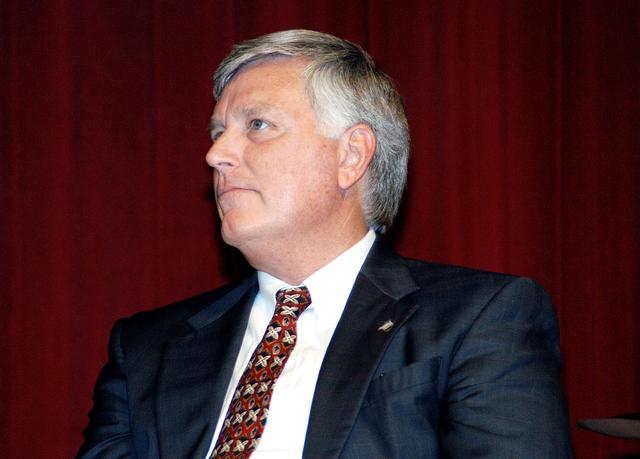
KENNEDY SPACE CENTER, FLA. - KSC Deputy Director James W. Kennedy receives the news of his appointment as the next director of the NASA Kennedy Space Center (KSC) before a group of KSC employees assembled in the KSC Training Auditorium. Kennedy has served as KSC's deputy director since November 2002. He will succeed KSC Director Roy D. Bridges, who was appointed on June 13 to lead NASA's Langley Research Center, Hampton, Va.
KSC-03pd2034
KSC | 2003-06-26
Details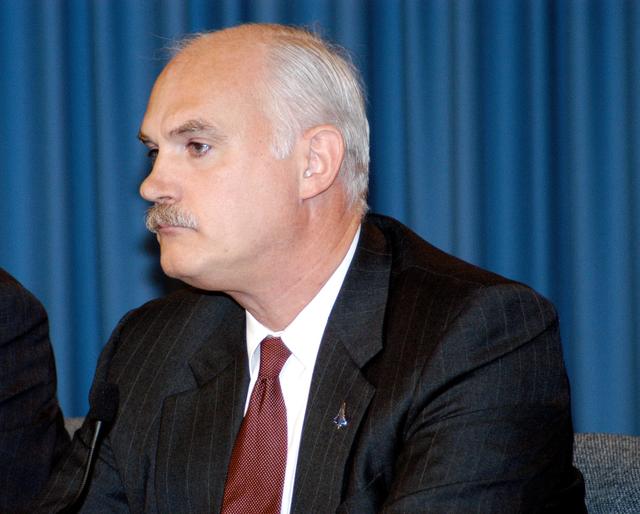
KENNEDY SPACE CENTER, FLA. - NASA Associate Administrator for Space Flight William F. Readdy participates in a press conference in KSC's Press Site Auditorium. The press conference followed the official announcement of James W. Kennedy as the next director of the NASA Kennedy Space Center (KSC) in Florida. Kennedy has served as KSC's deputy director since November 2002. He will succeed KSC Director Roy D. Bridges, who was appointed on June 13 to lead NASA's Langley Research Center, Hampton, Va.
KSC-03pd2052
KSC | 2003-06-26
Details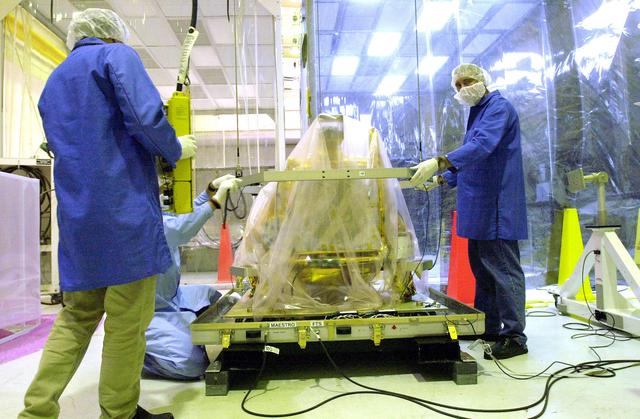
KENNEDY SPACE CENTER, FLA. - Workers at Vandenberg Air Force Base, Calif., prepare to move the SciSat-1 spacecraft. SciSat-1 weighs approximately 330 pounds and will be placed in a 400-mile-high polar orbit to investigate processes that control the distribution of ozone in the upper atmosphere. The scientific mission of SciSat-1 is to measure and understand the chemical processes that control the distribution of ozone in the Earth’s atmosphere, particularly at high altitudes. The data from the satellite will provide Canadian and international scientists with improved measurements relating to global ozone processes and help policymakers assess existing environmental policy and develop protective measures for improving the health of our atmosphere, preventing further ozone depletion. The mission is designed to last two years.
KSC-03pd2111
KSC | 2003-06-26
Details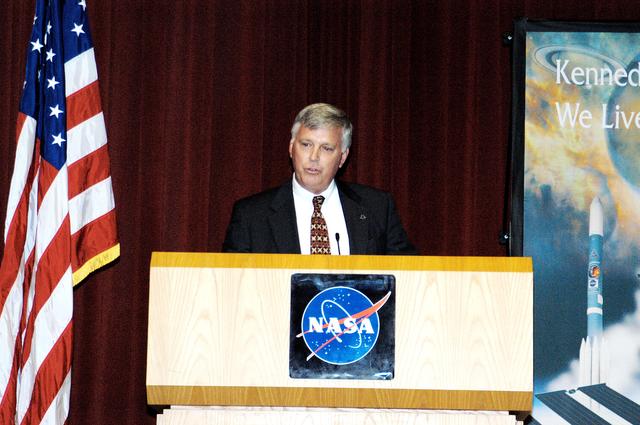
KENNEDY SPACE CENTER, FLA. - KSC Deputy Director James W. Kennedy addresses a group of KSC employees assembled in the KSC Training Auditorium. The occasion is the announcement of Kennedy as the next director of the NASA Kennedy Space Center (KSC) in Florida. He has served as KSC's deputy director since November 2002. He will succeed KSC Director Roy D. Bridges, who was appointed on June 13 to lead NASA's Langley Research Center, Hampton, Va.
KSC-03pd2041
KSC | 2003-06-26
Details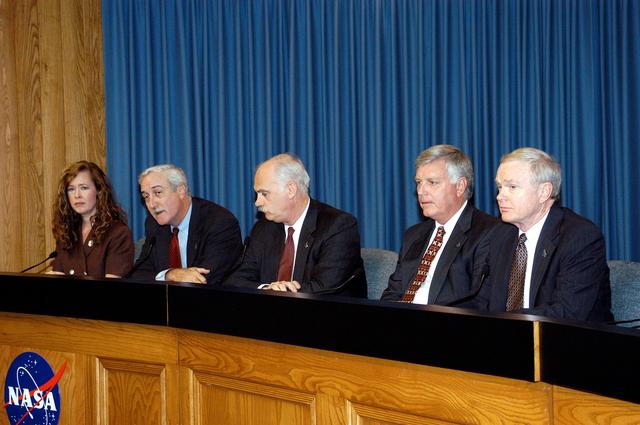
KENNEDY SPACE CENTER, FLA. - NASA officials participate in a press conference in KSC's Press Site Auditorium. From left are KSC Deputy Director of External Relations and Business Development Lisa Malone, NASA Administrator Sean O'Keefe, NASA Associate Administrator for Space Flight William F. Readdy, KSC Deputy Director James W. Kennedy, and KSC Director Roy D. Bridges. The press conference followed the official announcement of James W. Kennedy as the next director of the NASA Kennedy Space Center (KSC) in Florida. Kennedy has served as KSC's deputy director since November 2002. He will succeed Bridges, who was appointed on June 13 to lead NASA's Langley Research Center, Hampton, Va.
KSC-03pd2049
KSC | 2003-06-26
Details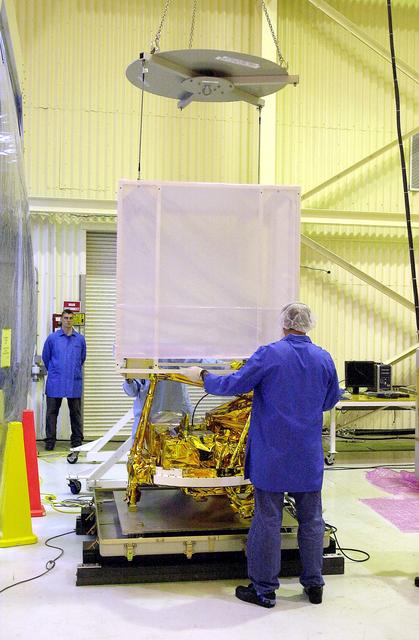
VANDENBERG AIR FORCE BASE, CALIF.- The cover is being lifted off SciSat-1 spacecraft at Vandenberg Air Force Base, Calif. Sci-Sat, which will undergo instrument checkout and spacecraft functional testing, weighs approximately 330 pounds and after launch will be placed in a 400-mile-high polar orbit to investigate processes that control the distribution of ozone in the upper atmosphere. The data from the satellite will provide Canadian and international scientists with improved measurements relating to global ozone processes and help policymakers assess existing environmental policy and develop protective measures for improving the health of our atmosphere, preventing further ozone depletion. The mission is designed to last two years.
KSC-03pd2918
KSC | 2003-06-26
Details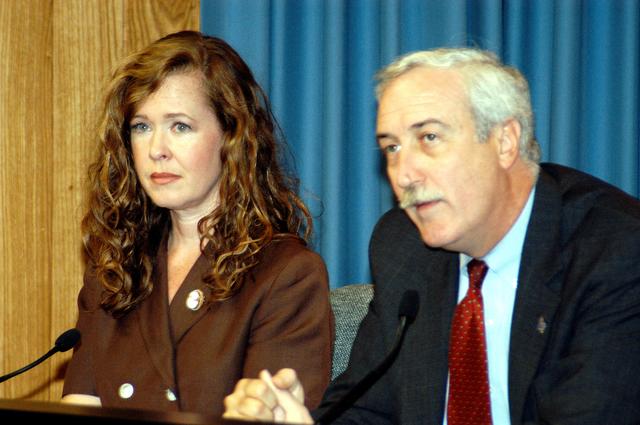
KENNEDY SPACE CENTER, FLA. - KSC Deputy Director of External Relations and Business Development Lisa Malone and NASA Administrator Sean O'Keefe participate in a press conference in KSC's Press Site Auditorium. The press conference followed the official announcement of James W. Kennedy as the next director of the NASA Kennedy Space Center (KSC) in Florida. Kennedy has served as KSC's deputy director since November 2002. He will succeed KSC Director Roy D. Bridges, who was appointed on June 13 to lead NASA's Langley Research Center, Hampton, Va.
KSC-03pd2050
KSC | 2003-06-26
Details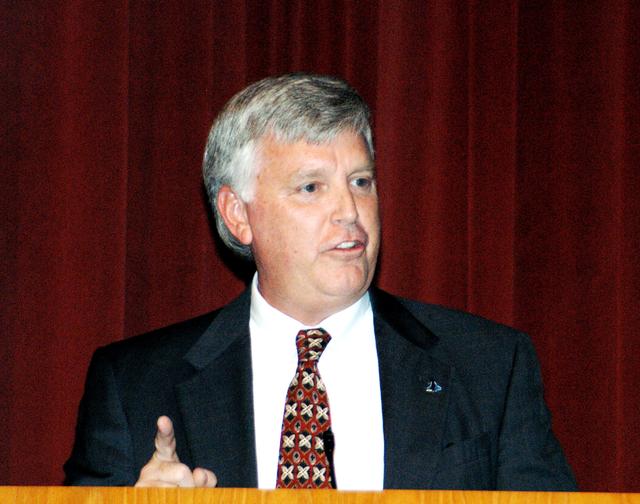
KENNEDY SPACE CENTER, FLA. - KSC Deputy Director James W. Kennedy addresses a group of KSC employees assembled in the KSC Training Auditorium. The occasion is the announcement of Kennedy as the next director of the NASA Kennedy Space Center (KSC) in Florida. He has served as KSC's deputy director since November 2002. He will succeed KSC Director Roy D. Bridges, who was appointed on June 13 to lead NASA's Langley Research Center, Hampton, Va.
KSC-03pd2045
KSC | 2003-06-26
Details