NASA Media Archive
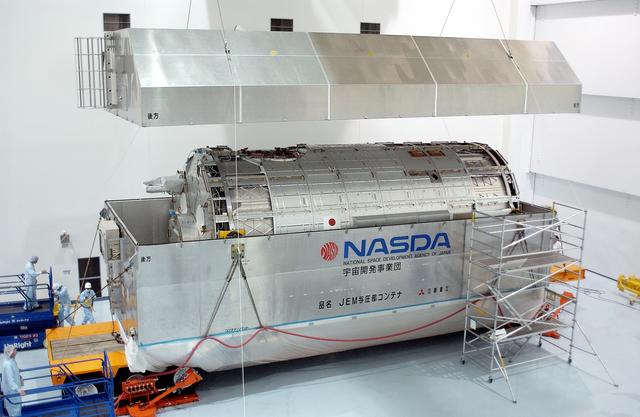
KENNEDY SPACE CENTER, FLA. - In the Space Station Processing Facility, the lid is removed from the container with the Japanese Experiment Module (JEM) pressure module inside. A research laboratory, the pressurized module is the first element of the JEM, named "Kibo" (Hope), to be delivered to KSC. The National Space Development Agency of Japan (NASDA) developed the laboratory at the Tsukuba Space Center near Tokyo and is Japan's primary contribution to the Station. It will enhance the unique research capabilities of the orbiting complex by providing an additional environment for astronauts to conduct science experiments. The JEM also includes an exposed facility (platform) for space environment experiments, a robotic manipulator system, and two logistics modules. The various JEM components will be assembled in space over the course of three Shuttle missions.
KSC-03pd1909
KSC | 2003-06-09
Details
KENNEDY SPACE CENTER, FLA. - On Launch Complex 17-A, Cape Canaveral Air Force Station, the launch tower begins to roll back from the Boeing Delta II rocket and its Mars Exploration Rover (MER-A) payload in preparation for a second attempt at launch. The first attempt on June 8, 2003, was scrubbed due to bad weather in the vicinity. MER-A is the first of two rovers being launched to Mars. When the two rovers arrive at Mars in 2004, they will bounce to airbag-cushioned landings at sites offering a balance of favorable conditions for safe landings and interesting science. The rovers see sharper images, can explore farther and examine rocks better than anything that has ever landed on Mars. The designated site for MER-A mission is Gusev Crater, which appears to have been a crater lake. The second rover, MER-B, is scheduled to launch June 25.
KSC-03pd1860
KSC | 2003-06-09
Details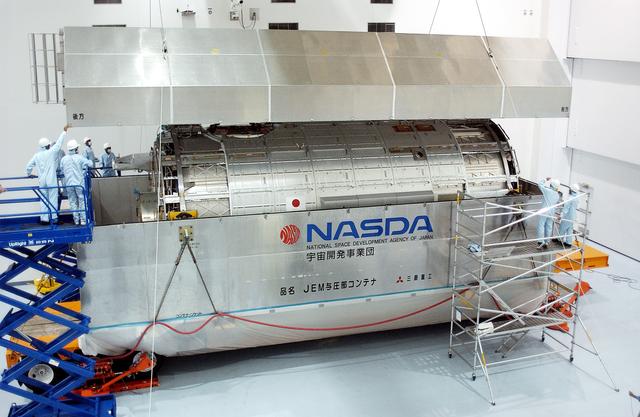
KENNEDY SPACE CENTER, FLA. - In the Space Station Processing Facility, the lid is removed from the container with the Japanese Experiment Module (JEM) pressure module inside. A research laboratory, the pressurized module is the first element of the JEM, named "Kibo" (Hope), to be delivered to KSC. The National Space Development Agency of Japan (NASDA) developed the laboratory at the Tsukuba Space Center near Tokyo and is Japan's primary contribution to the Station. It will enhance the unique research capabilities of the orbiting complex by providing an additional environment for astronauts to conduct science experiments. The JEM also includes an exposed facility (platform) for space environment experiments, a robotic manipulator system, and two logistics modules. The various JEM components will be assembled in space over the course of three Shuttle missions.
KSC-03pd1908
KSC | 2003-06-09
Details
KENNEDY SPACE CENTER, FLA. - On Launch Complex 17-A, Cape Canaveral Air Force Station, the Boeing Delta II rocket and its Mars Exploration Rover (MER-A) payload are in the clear after tower rollback in preparation for a second attempt at launch. The first attempt on June 8, 2003, was scrubbed due to bad weather in the vicinity. MER-A is the first of two rovers being launched to Mars. When the two rovers arrive at Mars in 2004, they will bounce to airbag-cushioned landings at sites offering a balance of favorable conditions for safe landings and interesting science. The rovers see sharper images, can explore farther and examine rocks better than anything that has ever landed on Mars. The designated site for MER-A mission is Gusev Crater, which appears to have been a crater lake. The second rover, MER-B, is scheduled to launch June 25.
KSC-03pd1863
KSC | 2003-06-09
Details
KENNEDY SPACE CENTER, FLA. - The launch tower (right) on Launch Complex 17-A, Cape Canaveral Air Force Station, has been rolled back from the Boeing Delta II rocket and its Mars Exploration Rover (MER-A) payload (left) in preparation for a second attempt at launch. The first attempt on June 8, 2003, was scrubbed due to bad weather in the vicinity. MER-A is the first of two rovers being launched to Mars. When the two rovers arrive at Mars in 2004, they will bounce to airbag-cushioned landings at sites offering a balance of favorable conditions for safe landings and interesting science. The rovers see sharper images, can explore farther and examine rocks better than anything that has ever landed on Mars. The designated site for MER-A mission is Gusev Crater, which appears to have been a crater lake. The second rover, MER-B, is scheduled to launch June 25.
KSC-03pd1864
KSC | 2003-06-09
Details
KENNEDY SPACE CENTER, FLA. - The launch tower on Launch Complex 17-A, Cape Canaveral Air Force Station, clears the Boeing Delta II rocket and its Mars Exploration Rover (MER-A) payload in preparation for a second attempt at launch. The first attempt on June 8, 2003, was scrubbed due to bad weather in the vicinity. MER-A is the first of two rovers being launched to Mars. When the two rovers arrive at Mars in 2004, they will bounce to airbag-cushioned landings at sites offering a balance of favorable conditions for safe landings and interesting science. The rovers see sharper images, can explore farther and examine rocks better than anything that has ever landed on Mars. The designated site for MER-A mission is Gusev Crater, which appears to have been a crater lake. The second rover, MER-B, is scheduled to launch June 25.
KSC-03pd1862
KSC | 2003-06-09
Details
KENNEDY SPACE CENTER, FLA. - On Launch Complex 17-A, Cape Canaveral Air Force Station, the launch tower begins to roll back from the Boeing Delta II rocket and its Mars Exploration Rover (MER-A) payload in preparation for a second attempt at launch. The first attempt on June 8, 2003, was scrubbed due to bad weather in the vicinity. MER-A is the first of two rovers being launched to Mars. When the two rovers arrive at Mars in 2004, they will bounce to airbag-cushioned landings at sites offering a balance of favorable conditions for safe landings and interesting science. The rovers see sharper images, can explore farther and examine rocks better than anything that has ever landed on Mars. The designated site for MER-A mission is Gusev Crater, which appears to have been a crater lake. The second rover, MER-B, is scheduled to launch June 25.
KSC-03pd1859
KSC | 2003-06-09
Details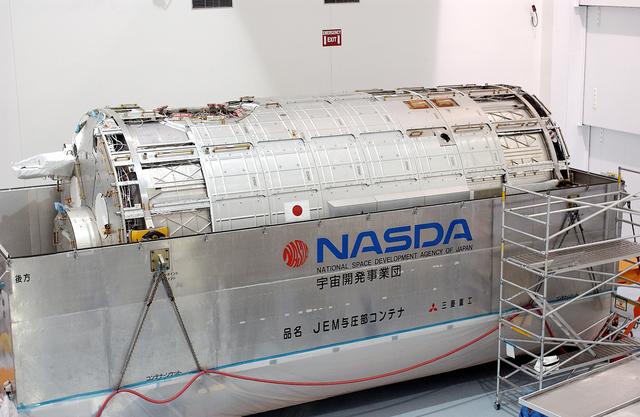
KENNEDY SPACE CENTER, FLA. - In the Space Station Processing Facility, the Japanese Experiment Module (JEM) pressure module is exposed after removal of the lid of its shipping container. A research laboratory, the pressurized module is the first element of the JEM, named "Kibo" (Hope), to be delivered to KSC. The National Space Development Agency of Japan (NASDA) developed the laboratory at the Tsukuba Space Center near Tokyo and is Japan's primary contribution to the Station. It will enhance the unique research capabilities of the orbiting complex by providing an additional environment for astronauts to conduct science experiments. The JEM also includes an exposed facility (platform) for space environment experiments, a robotic manipulator system, and two logistics modules. The various JEM components will be assembled in space over the course of three Shuttle missions.
KSC-03pd1910
KSC | 2003-06-09
Details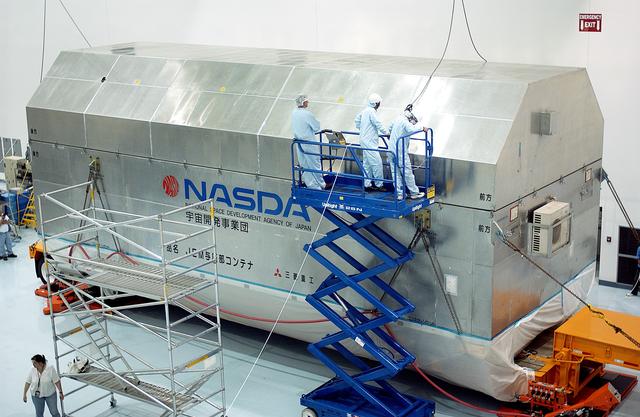
KENNEDY SPACE CENTER, FLA. - Workers in the Space Station Processing Facility prepare to remove the lid of the container with the Japanese Experiment Module (JEM) pressure module inside. A research laboratory, the pressurized module is the first element of the JEM, named "Kibo" (Hope), to be delivered to KSC. The National Space Development Agency of Japan (NASDA) developed the laboratory at the Tsukuba Space Center near Tokyo and is Japan's primary contribution to the Station. It will enhance the unique research capabilities of the orbiting complex by providing an additional environment for astronauts to conduct science experiments. The JEM also includes an exposed facility (platform) for space environment experiments, a robotic manipulator system, and two logistics modules. The various JEM components will be assembled in space over the course of three Shuttle missions.
KSC-03pd1906
KSC | 2003-06-09
Details
KENNEDY SPACE CENTER, FLA. - The Boeing Delta II rocket and its Mars Exploration Rover (MER-A) payload is viewed from under the launch tower as it moves away on Launch Complex 17-A, Cape Canaveral Air Force Station. This will be a second attempt at launch. The first attempt on June 8, 2003, was scrubbed due to bad weather in the vicinity. MER-A is the first of two rovers being launched to Mars. When the two rovers arrive at Mars in 2004, they will bounce to airbag-cushioned landings at sites offering a balance of favorable conditions for safe landings and interesting science. The rovers see sharper images, can explore farther and examine rocks better than anything that has ever landed on Mars. The designated site for MER-A mission is Gusev Crater, which appears to have been a crater lake. The second rover, MER-B, is scheduled to launch June 25.
KSC-03pd1861
KSC | 2003-06-09
Details
KENNEDY SPACE CENTER, FLA. - Members of the STS-114 crew take a look at the Japanese Experiment Module (JEM) pressure module in the Space Station Processing Facility. A research laboratory, the pressurized module is the first element of the JEM, named "Kibo" (Hope), to be delivered to KSC. The National Space Development Agency of Japan (NASDA) developed the laboratory at the Tsukuba Space Center near Tokyo and is Japan's primary contribution to the Station. The JEM also includes an exposed facility (platform) for space environment experiments, a robotic manipulator system, and two logistics modules. The various JEM components will be assembled in space over the course of three Shuttle missions.
KSC-03pd1907
KSC | 2003-06-09
Details
KENNEDY SPACE CENTER, FLA. - On Launch Complex 17-A, Cape Canaveral Air Force Station, the Boeing Delta II rocket and its Mars Exploration Rover (MER-A) payload waits for rollback of the launch tower in preparation for a second attempt at launch. The first attempt on June 8, 2003, was scrubbed due to bad weather in the vicinity. MER-A is the first of two rovers being launched to Mars. When the two rovers arrive at Mars in 2004, they will bounce to airbag-cushioned landings at sites offering a balance of favorable conditions for safe landings and interesting science. The rovers see sharper images, can explore farther and examine rocks better than anything that has ever landed on Mars. The designated site for MER-A mission is Gusev Crater, which appears to have been a crater lake. The second rover, MER-B, is scheduled to launch June 25.
KSC-03pd1858
KSC | 2003-06-09
Details
KENNEDY SPACE CENTER, FLA. - The Mobile Service Tower is rolled back at Launch Complex 17A to reveal a Delta II rocket ready to launch the Mars Exploration Rover-A mission. NASA's twin Mars Exploration Rovers are designed to study the history of water on Mars. These robotic geologists are equipped with a robotic arm, a drilling tool, three spectrometers, and four pairs of cameras that allow them to have a human-like, 3D view of the terrain. Each rover could travel as far as 100 meters in one day to act as Mars scientists' eyes and hands, exploring an environment where humans are not yet able to go. MER-A, with the rover Spirit aboard, is scheduled to launch on June 8 at 2:06 p.m. EDT, with two launch opportunities each day during a launch period that closes on June 24.
KSC-03pd1841
KSC | 2003-06-08
Details
KENNEDY SPACE CENTER, FLA. - Nine-year-old Sofi Collis (left) is congratulated by NASA Administrator Sean O'Keefe for selecting the names of the Mars Exploration Rovers -- "Spirit" and "Opportunity" -- during a press conference. The names Sofi suggested were chosen from more than 10,000 student entries in an essay contest managed for NASA by the LEGO Company. NASA's twin Mars Exploration Rovers are designed to study the history of water on Mars. These robotic geologists are equipped with a robotic arm, a drilling tool, three spectrometers, and four pairs of cameras that allow them to have a human-like, 3D view of the terrain. Each rover could travel as far as 100 meters in one day to act as Mars scientists' eyes and hands, exploring an environment where humans are not yet able to go. MER-A, with the rover Spirit aboard, is scheduled to launch on June 8 at 2:06 p.m. EDT, with two launch opportunities each day during a launch period that closes on June 24.
KSC-03pd1847
KSC | 2003-06-08
Details
KENNEDY SPACE CENTER, FLA. - Nine-year-old Sofi Collis (left) is introduced to the media by NASA Administrator Sean O'Keefe at a press conference. The Siberian-born Arizona resident wrote the winning entry in the Name the Rovers Contest sponsored by NASA and the Lego Co., a Denmark-based toymaker, with collaboration from the Planetary Society, Pasadena, Calif. The names she selected for the Mars Exploration Rovers are "Spirit" and "Opportunity." The third grader's essay was chosen from more than 10,000 American student entries. NASA's twin Mars Exploration Rovers are designed to study the history of water on Mars. These robotic geologists are equipped with a robotic arm, a drilling tool, three spectrometers, and four pairs of cameras that allow them to have a human-like, 3D view of the terrain. Each rover could travel as far as 100 meters in one day to act as Mars scientists' eyes and hands, exploring an environment where humans are not yet able to go. MER-A, with the rover Spirit aboard, is scheduled to launch on June 8 at 2:06 p.m. EDT, with two launch opportunities each day during a launch period that closes on June 24.
KSC-03pd1851
KSC | 2003-06-08
Details
KENNEDY SPACE CENTER, FLA. - Nine-year-old Sofi Collis is introduced to the media at a press conference. The Siberian-born Arizona resident wrote the winning entry in the Name the Rovers Contest sponsored by NASA and the Lego Co., a Denmark-based toymaker, with collaboration from the Planetary Society, Pasadena, Calif. The names she selected for the Mars Exploration Rovers are "Spirit" and "Opportunity." The third grader's essay was chosen from more than 10,000 American student entries. NASA's twin Mars Exploration Rovers are designed to study the history of water on Mars. These robotic geologists are equipped with a robotic arm, a drilling tool, three spectrometers, and four pairs of cameras that allow them to have a human-like, 3D view of the terrain. Each rover could travel as far as 100 meters in one day to act as Mars scientists' eyes and hands, exploring an environment where humans are not yet able to go. MER-A, with the rover Spirit aboard, is scheduled to launch on June 8 at 2:06 p.m. EDT, with two launch opportunities each day during a launch period that closes on June 24.
KSC-03pd1850
KSC | 2003-06-08
Details
KENNEDY SPACE CENTER, FLA. - Nine-year-old Sofi Collis (left) shares a light moment with NASA Administrator Sean O'Keefe at a press conference. The Siberian-born Arizona resident wrote the winning entry in the Name the Rovers Contest sponsored by NASA and the Lego Co., a Denmark-based toymaker, with collaboration from the Planetary Society, Pasadena, Calif. The names she selected for the Mars Exploration Rovers are "Spirit" and "Opportunity." The third grader's essay was chosen from more than 10,000 American student entries. NASA's twin Mars Exploration Rovers are designed to study the history of water on Mars. These robotic geologists are equipped with a robotic arm, a drilling tool, three spectrometers, and four pairs of cameras that allow them to have a human-like, 3D view of the terrain. Each rover could travel as far as 100 meters in one day to act as Mars scientists' eyes and hands, exploring an environment where humans are not yet able to go. MER-A, with the rover Spirit aboard, is scheduled to launch on June 8 at 2:06 p.m. EDT, with two launch opportunities each day during a launch period that closes on June 24.
KSC-03pd1852
KSC | 2003-06-08
Details
KENNEDY SPACE CENTER, FLA. - Nine-year-old Sofi Collis (third from left) and her family pose proudly with a banner displaying the names she selected for the Mars Exploration Rovers -- "Spirit" and "Opportunity" -- following a press conference announcing the names. The names Sofi suggested were chosen from more than 10,000 student entries in an essay contest managed for NASA by the LEGO Company. NASA's twin Mars Exploration Rovers are designed to study the history of water on Mars. These robotic geologists are equipped with a robotic arm, a drilling tool, three spectrometers, and four pairs of cameras that allow them to have a human-like, 3D view of the terrain. Each rover could travel as far as 100 meters in one day to act as Mars scientists' eyes and hands, exploring an environment where humans are not yet able to go. MER-A, with the rover Spirit aboard, is scheduled to launch on June 8 at 2:06 p.m. EDT, with two launch opportunities each day during a launch period that closes on June 24.
KSC-03pd1849
KSC | 2003-06-08
Details
KENNEDY SPACE CENTER, FLA. - The Mobile Service Tower is rolled back at Launch Complex 17A to reveal a Delta II rocket ready to launch the Mars Exploration Rover-A mission. NASA's twin Mars Exploration Rovers are designed to study the history of water on Mars. These robotic geologists are equipped with a robotic arm, a drilling tool, three spectrometers, and four pairs of cameras that allow them to have a human-like, 3D view of the terrain. Each rover could travel as far as 100 meters in one day to act as Mars scientists' eyes and hands, exploring an environment where humans are not yet able to go. MER-A, with the rover Spirit aboard, is scheduled to launch on June 8 at 2:06 p.m. EDT, with two launch opportunities each day during a launch period that closes on June 24.
KSC-03pd1839
KSC | 2003-06-08
Details
KENNEDY SPACE CENTER, FLA. - The Mobile Service Tower is rolled back at Launch Complex 17A to reveal a Delta II rocket ready to launch the Mars Exploration Rover-A mission. NASA's twin Mars Exploration Rovers are designed to study the history of water on Mars. These robotic geologists are equipped with a robotic arm, a drilling tool, three spectrometers, and four pairs of cameras that allow them to have a human-like, 3D view of the terrain. Each rover could travel as far as 100 meters in one day to act as Mars scientists' eyes and hands, exploring an environment where humans are not yet able to go. MER-A, with the rover Spirit aboard, is scheduled to launch on June 8 at 2:06 p.m. EDT, with two launch opportunities each day during a launch period that closes on June 24.
KSC-03pd1840
KSC | 2003-06-08
Details
KENNEDY SPACE CENTER, FLA. - The Mobile Service Tower is rolled back at Launch Complex 17A to reveal a Delta II rocket ready to launch the Mars Exploration Rover-A mission. NASA's twin Mars Exploration Rovers are designed to study the history of water on Mars. These robotic geologists are equipped with a robotic arm, a drilling tool, three spectrometers, and four pairs of cameras that allow them to have a human-like, 3D view of the terrain. Each rover could travel as far as 100 meters in one day to act as Mars scientists' eyes and hands, exploring an environment where humans are not yet able to go. MER-A, with the rover Spirit aboard, is scheduled to launch on June 8 at 2:06 p.m. EDT, with two launch opportunities each day during a launch period that closes on June 24.
KSC-03pd1843
KSC | 2003-06-08
Details
KENNEDY SPACE CENTER, FLA. - The Mobile Service Tower is rolled back at Launch Complex 17A to reveal a Delta II rocket ready to launch the Mars Exploration Rover-A mission. NASA's twin Mars Exploration Rovers are designed to study the history of water on Mars. These robotic geologists are equipped with a robotic arm, a drilling tool, three spectrometers, and four pairs of cameras that allow them to have a human-like, 3D view of the terrain. Each rover could travel as far as 100 meters in one day to act as Mars scientists' eyes and hands, exploring an environment where humans are not yet able to go. MER-A, with the rover Spirit aboard, is scheduled to launch on June 8 at 2:06 p.m. EDT, with two launch opportunities each day during a launch period that closes on June 24.
KSC-03pd1838
KSC | 2003-06-08
Details
KENNEDY SPACE CENTER, FLA. - The Mobile Service Tower is rolled back at Launch Complex 17A to reveal a Delta II rocket ready to launch the Mars Exploration Rover-A mission. NASA's twin Mars Exploration Rovers are designed to study the history of water on Mars. These robotic geologists are equipped with a robotic arm, a drilling tool, three spectrometers, and four pairs of cameras that allow them to have a human-like, 3D view of the terrain. Each rover could travel as far as 100 meters in one day to act as Mars scientists' eyes and hands, exploring an environment where humans are not yet able to go. MER-A, with the rover Spirit aboard, is scheduled to launch on June 8 at 2:06 p.m. EDT, with two launch opportunities each day during a launch period that closes on June 24.
KSC-03pd1842
KSC | 2003-06-08
Details
KENNEDY SPACE CENTER, FLA. - Nine-year-old Sofi Collis proudly presents the names she selected for the Mars Exploration Rovers -- "Spirit" and "Opportunity" -- during a press conference. Also participating in the press conference are NASA Administrator Sean O'Keefe (left) and Brad Justus, LEGO Co. senior vice president (right). The names Sofi suggested were selected from more than 10,000 student entries in an essay contest managed for NASA by the LEGO Company. NASA's twin Mars Exploration Rovers are designed to study the history of water on Mars. These robotic geologists are equipped with a robotic arm, a drilling tool, three spectrometers, and four pairs of cameras that allow them to have a human-like, 3D view of the terrain. Each rover could travel as far as 100 meters in one day to act as Mars scientists' eyes and hands, exploring an environment where humans are not yet able to go. MER-A, with the rover Spirit aboard, is scheduled to launch on June 8 at 2:06 p.m. EDT, with two launch opportunities each day during a launch period that closes on June 24.
KSC-03pd1846
KSC | 2003-06-08
Details
KENNEDY SPACE CENTER, FLA. - Nine-year-old Sofi Collis poses proudly with a banner displaying the names she selected for the Mars Exploration Rovers -- "Spirit" and "Opportunity" -- during a press conference. Participating in the press conference are, from left, Brad Justus, LEGO Co. senior vice president; Sofi Collis, a third grade student from Arizona; Dr. John Marburger, science advisor to the President and director of the Office of Science and Technology Policy; and NASA Administrator Sean O'Keefe. The names Sofi suggested were selected from more than 10,000 student entries in an essay contest managed for NASA by the LEGO Company. NASA's twin Mars Exploration Rovers are designed to study the history of water on Mars. These robotic geologists are equipped with a robotic arm, a drilling tool, three spectrometers, and four pairs of cameras that allow them to have a human-like, 3D view of the terrain. Each rover could travel as far as 100 meters in one day to act as Mars scientists' eyes and hands, exploring an environment where humans are not yet able to go. MER-A, with the rover Spirit aboard, is scheduled to launch on June 8 at 2:06 p.m. EDT, with two launch opportunities each day during a launch period that closes on June 24.
KSC-03pd1848
KSC | 2003-06-08
Details

KENNEDY SPACE CENTER, FLA. - Nine-year-old Sofi Collis unveils the names of the Mars Exploration Rovers -- "Spirit" and "Opportunity" -- during a press conference. Participating in the press conference are, from left, Dr. John Marburger, science advisor to the President and director of the Office of Science and Technology Policy; NASA Administrator Sean O'Keefe; Sofi Collis, a third grade student from Arizona; and Brad Justus, LEGO Co. senior vice president. The names Sofi suggested were selected from more than 10,000 student entries in an essay contest managed for NASA by the LEGO Company. NASA's twin Mars Exploration Rovers are designed to study the history of water on Mars. These robotic geologists are equipped with a robotic arm, a drilling tool, three spectrometers, and four pairs of cameras that allow them to have a human-like, 3D view of the terrain. Each rover could travel as far as 100 meters in one day to act as Mars scientists' eyes and hands, exploring an environment where humans are not yet able to go. MER-A, with the rover Spirit aboard, is scheduled to launch on June 8 at 2:06 p.m. EDT, with two launch opportunities each day during a launch period that closes on June 24.
KSC-03pd1845
KSC | 2003-06-08
Details
KENNEDY SPACE CENTER, FLA. - The Mobile Service Tower is rolled back at Launch Complex 17A to reveal a Delta II rocket ready to launch the Mars Exploration Rover-A mission. NASA's twin Mars Exploration Rovers are designed to study the history of water on Mars. These robotic geologists are equipped with a robotic arm, a drilling tool, three spectrometers, and four pairs of cameras that allow them to have a human-like, 3D view of the terrain. Each rover could travel as far as 100 meters in one day to act as Mars scientists' eyes and hands, exploring an environment where humans are not yet able to go. MER-A, with the rover Spirit aboard, is scheduled to launch on June 8 at 2:06 p.m. EDT, with two launch opportunities each day during a launch period that closes on June 24.
KSC-03pd1844
KSC | 2003-06-08
Details
KENNEDY SPACE CENTER, FLA. - Nine-year-old Sofi Collis poses proudly with a banner displaying the names she selected for the Mars Exploration Rovers -- "Spirit" and "Opportunity" -- during a press conference. Participating in the press conference are, from left, Brad Justus, LEGO Co. senior vice president; Sofi Collis, third grade student from Arizona; Dr. John Marburger, science advisor to the President and director of the Office of Science and Technology Policy; and NASA Administrator Sean O'Keefe. The names Sofi suggested were selected from more than 10,000 student entries in an essay contest managed for NASA by the LEGO Company. NASA's twin Mars Exploration Rovers are designed to study the history of water on Mars. These robotic geologists are equipped with a robotic arm, a drilling tool, three spectrometers, and four pairs of cameras that allow them to have a human-like, 3D view of the terrain. Each rover could travel as far as 100 meters in one day to act as Mars scientists' eyes and hands, exploring an environment where humans are not yet able to go. MER-A, with the rover Spirit aboard, is scheduled to launch on June 8 at 2:06 p.m. EDT, with two launch opportunities each day during a launch period that closes on June 24.
KSC-03pd1853
KSC | 2003-06-08
Details

Expedition Seven CDR Malenchenko and Science Officer Lu share meal in Zvezda
iss007e06446
JSC | 2003-06-07
Details


KENNEDY SPACE CENTER, FLA. - KSC External Relations and Business Development Director JoAnn Morgan speaks to attendees of The Florida Commission on the Status of Women held June 7 at the Debus Conference Facility. Morgan is a member of the group’s Hall of Fame. The commission, through coordinating, researching, communicating, and encouraging legislation, is dedicated to empowering women from all walks of life in achieving their fullest potential, to eliminating barriers to that achievement, and to recognizing women’s accomplishments.
KSC-03pd1865
KSC | 2003-06-07
Details
KENNEDY SPACE CENTER, FLA. - KSC Director of External Relations and Business Development JoAnn Morgan talks with Dr. Adena Williams Loston at a reception and dinner at the Debus Conference Center June 6. Loston is NASA’s new associate administrator of Education and the reception was in her honor. Loston was previously NASA Administrator Sean O’Keefe’s senior advisor of education and assumed her new position in October 2002. KSC Director Roy Bridges Jr. also attended the reception to welcome Loston during her visit to the Center.
KSC-03pd1854
KSC | 2003-06-07
Details

KENNEDY SPACE CENTER, FLA. - Astronaut Pamela Melroy (fourth from right in front) joins other attendees at the Florida Commission on the Status of Women held June 7 at the Debus Conference Facility. Melroy was a speaker. Her accomplishments include serving as pilot on two Shuttle flights (STS-92 in 2000 and STS-112 in 2002), and logging more than 562 hours in space. The commission, through coordinating, researching, communicating, and encouraging legislation, is dedicated to empowering women from all walks of life in achieving their fullest potential, to eliminating barriers to that achievement, and to recognizing women’s accomplishments.
KSC-03pd1870
KSC | 2003-06-07
Details


Expedition Seven CDR Malenchenko and Science Officer Lu share meal in Zvezda
iss007e06460
JSC | 2003-06-07
Details