NASA Media Archive
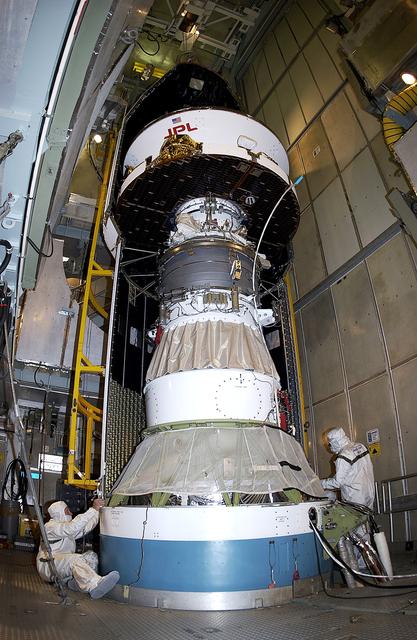
KENNEDY SPACE CENTER, FLA. - At Launch Complex 17-A, Cape Canaveral Air Force Station, the first half of the fairing for the Mars Exploration Rover 2 (MER-2) is installed around the Mars Exploration Rover 2 (MER-2). MER-2 is one of NASA's twin Mars Exploration Rovers designed to study the history of water on Mars. These robotic geologists are equipped with a robotic arm, a drilling tool, three spectrometers, and four pairs of cameras that allow them to have a human-like, 3D view of the terrain. Each rover could travel as far as 100 meters in one day to act as Mars scientists' eyes and hands, exploring an environment where humans can't yet go. MER-2 is scheduled to launch no earlier than June 8 as MER-A, with two launch opportunities each day during the launch period that closes on June 19.
KSC-03pd1765
KSC | 2003-05-31
Details


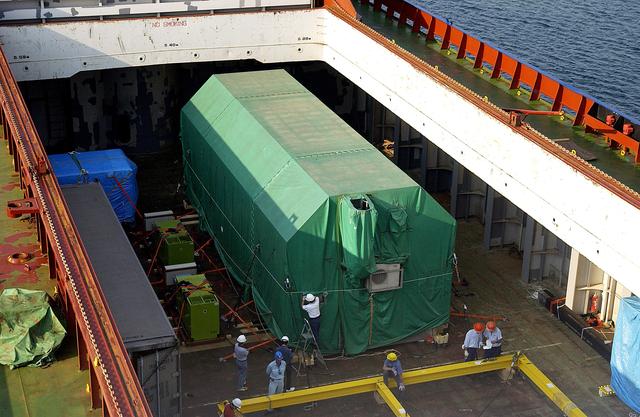
KENNEDY SPACE CENTER, FLA. - The JEM Pressurized Module is seen in the hold of the ship that carried it from Japan. The National Space Development Agency of Japan (NASDA) built the laboratory at the Tsukuba Space Center near Tokyo. The Pressurized Module is the first element of the JEM, Japan’s primary contribution to the space station, to be delivered to KSC. It will enhance the unique research capabilities of the orbiting complex by providing an additional shirt-sleeve environment for astronauts to conduct science experiments. The JEM also includes two logistics modules, an exposed pallet for space environment experiments and a robotic manipulator system that are still under construction in Japan. The various JEM components will be assembled in space over the course of three space shuttle missions.
KSC-03pd1753
KSC | 2003-05-30
Details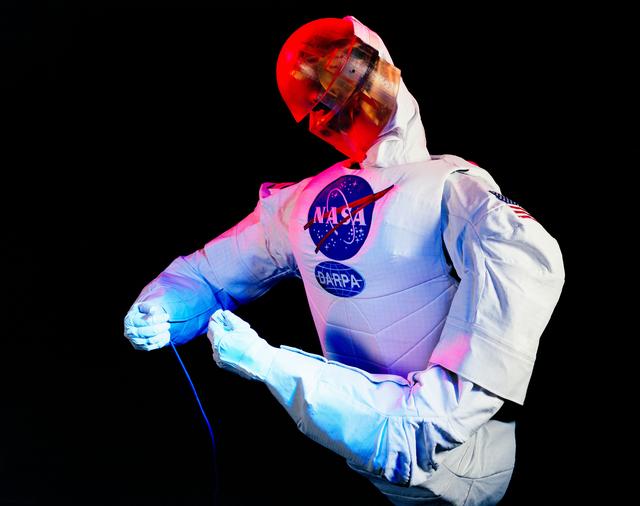
General Howell's Conference Room Photos - Photos of Robonaut.
JSC2003-00263
JSC | 2003-05-30
Details

KENNEDY SPACE CENTER, FLA. - Astronaut Soichi Noguchi, with the National Space Development Agency of Japan (NASDA), stands next to the Japanese Experiment Module after its arrival at Port Canaveral, Fla. Built by the Tsukuba Space Center near Tokyo, the pressurized module is the first element of the JEM, Japan’s primary contribution to the space station, to be delivered to KSC. It will enhance the unique research capabilities of the orbiting complex by providing an additional shirt-sleeve environment for astronauts to conduct science experiments. The JEM also includes two logistics modules, an exposed pallet for space environment experiments and a robotic manipulator system that are still under construction in Japan. The various JEM components will be assembled in space over the course of three space shuttle missions.
KSC-03pd1756
KSC | 2003-05-30
Details
KENNEDY SPACE CENTER, FLA. - Astronaut Soichi Noguchi, with the National Space Development Agency of Japan (NASDA), looks at the Japanese Experiment Module after its arrival at Port Canaveral, Fla. Built by the Tsukuba Space Center near Tokyo, the pressurized module is the first element of the JEM, Japan’s primary contribution to the space station, to be delivered to KSC. It will enhance the unique research capabilities of the orbiting complex by providing an additional shirt-sleeve environment for astronauts to conduct science experiments. The JEM also includes two logistics modules, an exposed pallet for space environment experiments and a robotic manipulator system that are still under construction in Japan. The various JEM components will be assembled in space over the course of three space shuttle missions. .
KSC-03pd1758
KSC | 2003-05-30
Details


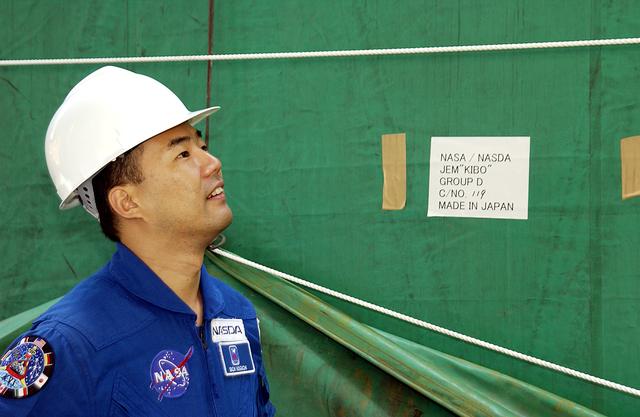
KENNEDY SPACE CENTER, FLA. - Astronaut Soichi Noguchi, with the National Space Development Agency of Japan (NASDA), looks at the Japanese Experiment Module after its arrival at Port Canaveral, Fla. Built by the Tsukuba Space Center near Tokyo, the pressurized module is the first element of the JEM, Japan’s primary contribution to the space station, to be delivered to KSC. It will enhance the unique research capabilities of the orbiting complex by providing an additional shirt-sleeve environment for astronauts to conduct science experiments. The JEM also includes two logistics modules, an exposed pallet for space environment experiments and a robotic manipulator system that are still under construction in Japan. The various JEM components will be assembled in space over the course of three space shuttle missions.
KSC-03pd1757
KSC | 2003-05-30
Details

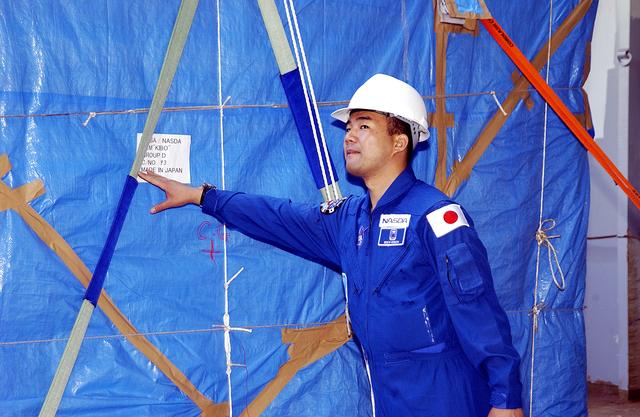
KENNEDY SPACE CENTER, FLA. - Astronaut Soichi Noguchi, with the National Space Development Agency of Japan (NASDA), looks at the Japanese Experiment Module after its arrival at Port Canaveral, Fla. Built by the Tsukuba Space Center near Tokyo, the pressurized module is the first element of the JEM, Japan’s primary contribution to the space station, to be delivered to KSC. It will enhance the unique research capabilities of the orbiting complex by providing an additional shirt-sleeve environment for astronauts to conduct science experiments. The JEM also includes two logistics modules, an exposed pallet for space environment experiments and a robotic manipulator system that are still under construction in Japan. The various JEM components will be assembled in space over the course of three space shuttle missions.
KSC-03pd1755
KSC | 2003-05-30
Details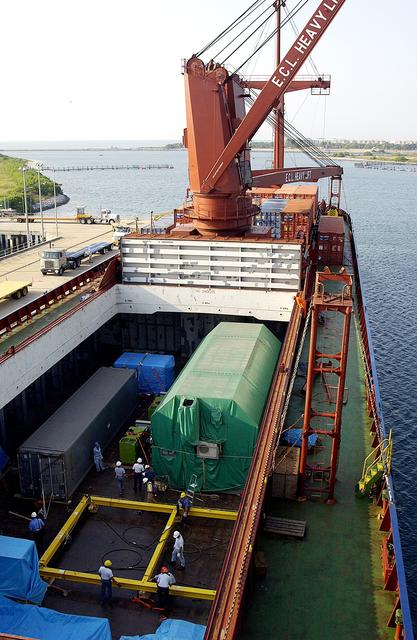
KENNEDY SPACE CENTER, FLA. - The Japanese Experiment Module (JEM) Pressurized Module is ready to be offloaded from the ship that carried it from Japan. The National Space Development Agency of Japan (NASDA) built the laboratory at the Tsukuba Space Center near Tokyo. The Pressurized Module is the first element of the JEM, Japan’s primary contribution to the space station, to be delivered to KSC. It will enhance the unique research capabilities of the orbiting complex by providing an additional shirt-sleeve environment for astronauts to conduct science experiments. The JEM also includes two logistics modules, an exposed pallet for space environment experiments and a robotic manipulator system that are still under construction in Japan. The various JEM components will be assembled in space over the course of three space shuttle missions.
KSC-03pd1754
KSC | 2003-05-30
Details
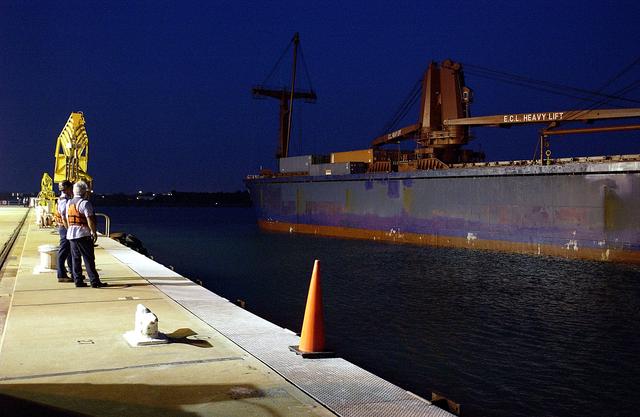
KENNEDY SPACE CENTER, FLA. - The container transport ship carrying the JEM Pressurized Module arrives at Port Canaveral, Fla. The National Space Development Agency of Japan (NASDA) built the laboratory at the Tsukuba Space Center near Tokyo. The Pressurized Module is the first element of the JEM, Japan’s primary contribution to the space station, to be delivered to KSC. It will enhance the unique research capabilities of the orbiting complex by providing an additional shirt-sleeve environment for astronauts to conduct science experiments. The JEM also includes two logistics modules, an exposed pallet for space environment experiments and a robotic manipulator system that are still under construction in Japan. The various JEM components will be assembled in space over the course of three space shuttle missions.
KSC-03pd1751
KSC | 2003-05-30
Details


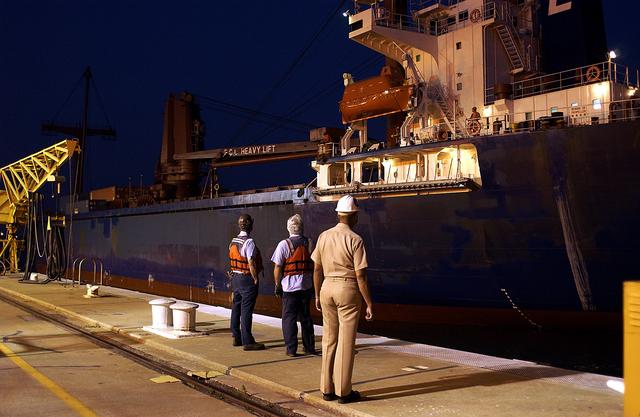
KENNEDY SPACE CENTER, FLA. - The container transport ship carrying the JEM Pressurized Module arrives at Port Canaveral, Fla. The National Space Development Agency of Japan (NASDA) built the laboratory at the Tsukuba Space Center near Tokyo. The Pressurized Module is the first element of the JEM, Japan’s primary contribution to the space station, to be delivered to KSC. It will enhance the unique research capabilities of the orbiting complex by providing an additional shirt-sleeve environment for astronauts to conduct science experiments. The JEM also includes two logistics modules, an exposed pallet for space environment experiments and a robotic manipulator system that are still under construction in Japan. The various JEM components will be assembled in space over the course of three space shuttle missions.
KSC-03pd1752
KSC | 2003-05-30
Details

KENNEDY SPACE CENTER, FLA. - In the Payload Hazardous Servicing Facility, workers prepare to lift the Mars Exploration Rover-1 (MER-B) onto a spin table during preflight processing of the spacecraft. The rover is scheduled to launch aboard a Delta II rocket on June 25. NASA’s twin Mars Exploration Rovers are designed to study the history of water on Mars. These robotic geologists are equipped with a robotic arm, a drilling tool, three spectrometers, and four pairs of cameras that allow them to have a human-like, 3D view of the terrain. Each rover could travel as far as 100 meters in one day to act as Mars scientists' eyes and hands, exploring an environment where humans are not yet able to go. The launch of MER-2 (MER-A) is tentatively set for June 8.
KSC-03pd1730
KSC | 2003-05-29
Details
KENNEDY SPACE CENTER, FLA. - The second stage of a Delta II rocket is prepared for lifting up the launch tower on Pad 17-B, Cape Canaveral Air Force Station. It will be mated to the Delta first stage already at the pad in preparation for the launch of the Mars Exploration Rover-1 (MER-B) on June 25. NASA’s twin Mars Exploration Rovers are designed to study the history of water on Mars. These robotic geologists are equipped with a robotic arm, a drilling tool, three spectrometers, and four pairs of cameras that allow them to have a human-like, 3D view of the terrain. Each rover could travel as far as 100 meters in one day to act as Mars scientists' eyes and hands, exploring an environment where humans are not yet able to go. The launch of MER-2 (MER-A) is tentatively set for June 8.
KSC-03pd1740
KSC | 2003-05-29
Details
KENNEDY SPACE CENTER, FLA. - In the Payload Hazardous Servicing Facility, workers attach a crane to the Mars Exploration Rover-1 (MER-B) as they prepare to lift it onto a spin table during preflight processing of the spacecraft. The rover is scheduled to launch aboard a Delta II rocket on June 25. NASA’s twin Mars Exploration Rovers are designed to study the history of water on Mars. These robotic geologists are equipped with a robotic arm, a drilling tool, three spectrometers, and four pairs of cameras that allow them to have a human-like, 3D view of the terrain. Each rover could travel as far as 100 meters in one day to act as Mars scientists' eyes and hands, exploring an environment where humans are not yet able to go. The launch of MER-2 (MER-A) is tentatively set for June 8.
KSC-03pd1732
KSC | 2003-05-29
Details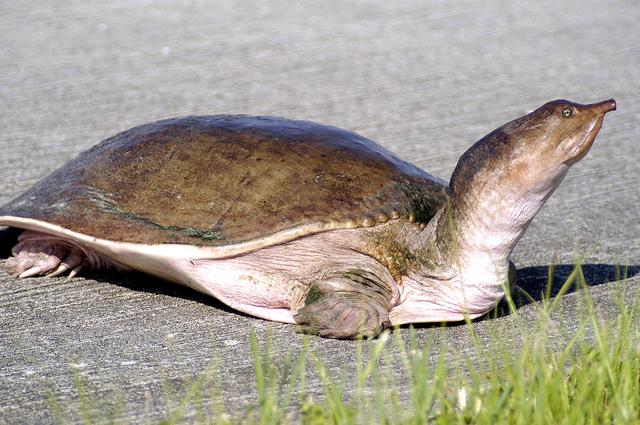
KENNEDY SPACE CENTER, FLA. - A soft-shell turtle with only three legs is seen crossing the tow-way at KSC. The turtle is one of 65 amphibians and reptiles found in the Merritt Island National Wildlife Refuge, which surrounds KSC. The Wildlife Refuge encompasses 92,000 acres that are also a habitat for more than 331 species of birds, 31 mammals and 117 fishes. The marshes and open water of the refuge provide wintering areas for 23 species of migratory waterfowl, as well as a year-round home for great blue herons, great egrets, wood storks, cormorants, brown pelicans and other species of marsh and shore birds, plus a variety of insects.
KSC-03pd1829
KSC | 2003-05-29
Details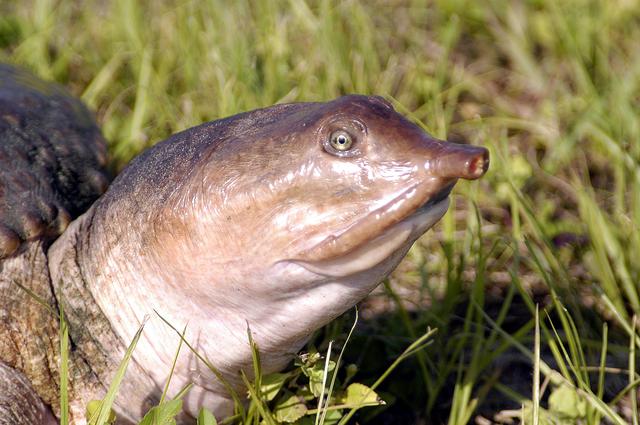
KENNEDY SPACE CENTER, FLA. - A closeup of a soft-shell turtle seen crossing the tow-way at KSC. The turtle is one of 65 amphibians and reptiles found in the Merritt Island National Wildlife Refuge, which surrounds KSC. The Wildlife Refuge encompasses 92,000 acres that are also a habitat for more than 331 species of birds, 31 mammals and 117 fishes. The marshes and open water of the refuge provide wintering areas for 23 species of migratory waterfowl, as well as a year-round home for great blue herons, great egrets, wood storks, cormorants, brown pelicans and other species of marsh and shore birds, plus a variety of insects.
KSC-03pd1830
KSC | 2003-05-29
Details
KENNEDY SPACE CENTER, FLA. - In the Payload Hazardous Servicing Facility, the Mars Exploration Rover-1 (MER-B) awaits further preflight processing atop a spin table. The rover is scheduled to launch aboard a Delta II rocket on June 25. NASA’s twin Mars Exploration Rovers are designed to study the history of water on Mars. These robotic geologists are equipped with a robotic arm, a drilling tool, three spectrometers, and four pairs of cameras that allow them to have a human-like, 3D view of the terrain. Each rover could travel as far as 100 meters in one day to act as Mars scientists' eyes and hands, exploring an environment where humans are not yet able to go. The launch of MER-2 (MER-A) is tentatively set for June 8.
KSC-03pd1734
KSC | 2003-05-29
Details
KENNEDY SPACE CENTER, FLA. - In the Payload Hazardous Servicing Facility, workers prepare to lift the Mars Exploration Rover-1 (MER-B) onto a spin table during preflight processing of the spacecraft. The rover is scheduled to launch aboard a Delta II rocket on June 25. NASA’s twin Mars Exploration Rovers are designed to study the history of water on Mars. These robotic geologists are equipped with a robotic arm, a drilling tool, three spectrometers, and four pairs of cameras that allow them to have a human-like, 3D view of the terrain. Each rover could travel as far as 100 meters in one day to act as Mars scientists' eyes and hands, exploring an environment where humans are not yet able to go. The launch of MER-2 (MER-A) is tentatively set for June 8.
KSC-03pd1726
KSC | 2003-05-29
Details
KENNEDY SPACE CENTER, FLA. - The second stage of a Delta II rocket is lowered into positioned above a first stage at Pad 17-B, Cape Canaveral Air Force Station. Next, it will be mated to the first stage in preparation for the launch of the Mars Exploration Rover-1 (MER-B) on June 25. NASA’s twin Mars Exploration Rovers are designed to study the history of water on Mars. These robotic geologists are equipped with a robotic arm, a drilling tool, three spectrometers, and four pairs of cameras that allow them to have a human-like, 3D view of the terrain. Each rover could travel as far as 100 meters in one day to act as Mars scientists' eyes and hands, exploring an environment where humans are not yet able to go. The launch of MER-2 (MER-A) is tentatively set for June 8.
KSC-03pd1750
KSC | 2003-05-29
Details
KENNEDY SPACE CENTER, FLA. - The second stage of a Delta II rocket is raised to a vertical position for its lift up the launch tower on Pad 17-B, Cape Canaveral Air Force Station. It will be mated to the Delta first stage already at the pad in preparation for the launch of the Mars Exploration Rover-1 (MER-B) on June 25. NASA’s twin Mars Exploration Rovers are designed to study the history of water on Mars. These robotic geologists are equipped with a robotic arm, a drilling tool, three spectrometers, and four pairs of cameras that allow them to have a human-like, 3D view of the terrain. Each rover could travel as far as 100 meters in one day to act as Mars scientists' eyes and hands, exploring an environment where humans are not yet able to go. The launch of MER-2 (MER-A) is tentatively set for June 8.
KSC-03pd1743
KSC | 2003-05-29
Details