NASA Media Archive
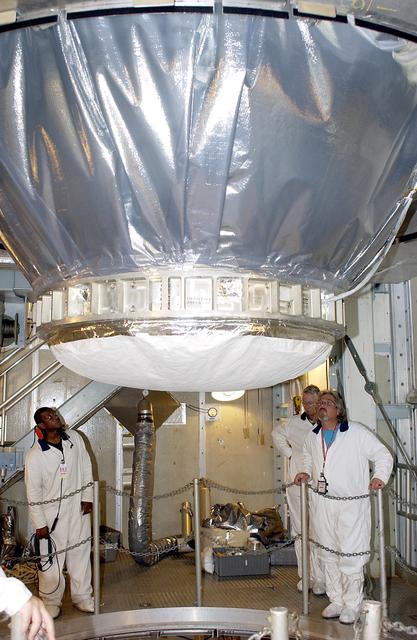
KENNEDY SPACE CENTER, FLA. - On Launch Pad 17-A, Cape Canaveral Air Force Station, workers watch as the Mars Exploration Rover 2 (MER-2), inside the transport canister, is lowered toward the Delta II rocket for mating. MER-2 is one of NASA's twin Mars Exploration Rovers designed to study the history of water on Mars. These robotic geologists are equipped with a robotic arm, a drilling tool, three spectrometers, and four pairs of cameras that allow them to have a human-like, 3D view of the terrain. Each rover could travel as far as 100 meters in one day to act as Mars scientists' eyes and hands, exploring an environment where humans can't yet go. MER-2 is scheduled to launch no earlier than June 8 as MER-A.
KSC-03pd1724
KSC | 2003-05-27
Details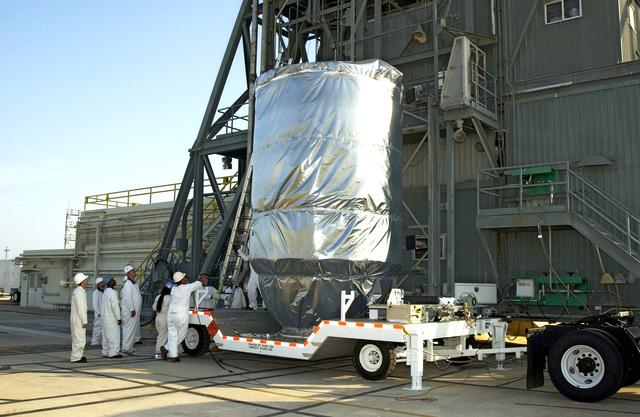
KENNEDY SPACE CENTER, FLA. - The Mars Exploration Rover 2 (MER-2), inside the transport canister, will be lifted up the launch tower on Launch Pad 17-A, Cape Canaveral Air Force Station, where it will be mated to the Delta II rocket for launch. MER-2 is one of NASA's twin Mars Exploration Rovers designed to study the history of water on Mars. These robotic geologists are equipped with a robotic arm, a drilling tool, three spectrometers, and four pairs of cameras that allow them to have a human-like, 3D view of the terrain. Each rover could travel as far as 100 meters in one day to act as Mars scientists' eyes and hands, exploring an environment where humans can't yet go. MER-2 is scheduled to launch no earlier than June 8 as MER-A.
KSC-03pd1714
KSC | 2003-05-27
Details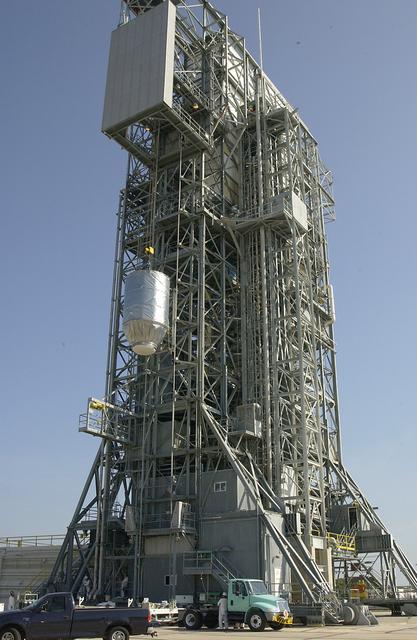
KENNEDY SPACE CENTER, FLA. - On Launch Pad 17-A, Cape Canaveral Air Force Station, the Mars Exploration Rover 2 (MER-2), inside the transport canister, is lifted up the launch tower where it will be mated to the Delta II rocket for launch. MER-2 is one of NASA's twin Mars Exploration Rovers designed to study the history of water on Mars. These robotic geologists are equipped with a robotic arm, a drilling tool, three spectrometers, and four pairs of cameras that allow them to have a human-like, 3D view of the terrain. Each rover could travel as far as 100 meters in one day to act as Mars scientists' eyes and hands, exploring an environment where humans can't yet go. MER-2 is scheduled to launch no earlier than June 8 as MER-A.
KSC-03pd1720
KSC | 2003-05-27
Details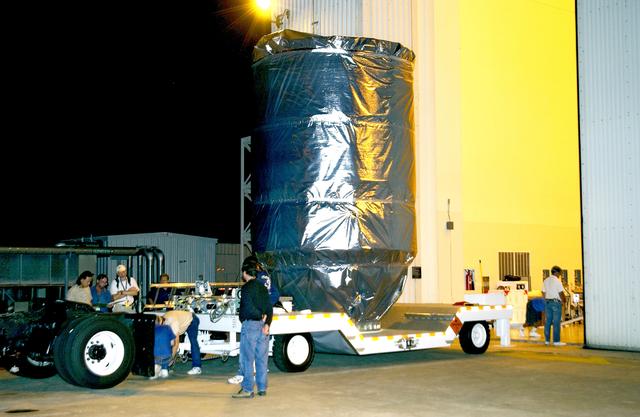
KENNEDY SPACE CENTER, FLA. - The Mars Exploration Rover 2 (MER-2), inside the transport canister, is ready for transfer to Launch Pad 17-A, Cape Canaveral Air Force Station. At the pad it will be mated to the Delta II rocket for launch. MER-2 is one of NASA's twin Mars Exploration Rovers designed to study the history of water on Mars. These robotic geologists are equipped with a robotic arm, a drilling tool, three spectrometers, and four pairs of cameras that allow them to have a human-like, 3D view of the terrain. Each rover could travel as far as 100 meters in one day to act as Mars scientists' eyes and hands, exploring an environment where humans can't yet go. MER-2 is scheduled to launch no earlier than June 8 as MER-A.
KSC-03pd1712
KSC | 2003-05-27
Details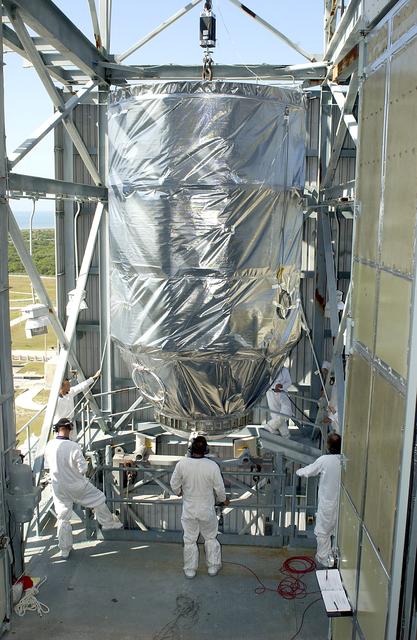
KENNEDY SPACE CENTER, FLA. - On Launch Pad 17-A, Cape Canaveral Air Force Station, the Mars Exploration Rover 2 (MER-2), inside the transport canister, is moved toward the platform in the launch tower. MER-2 will be mated to the Delta II rocket for launch. MER-2 is one of NASA's twin Mars Exploration Rovers designed to study the history of water on Mars. These robotic geologists are equipped with a robotic arm, a drilling tool, three spectrometers, and four pairs of cameras that allow them to have a human-like, 3D view of the terrain. Each rover could travel as far as 100 meters in one day to act as Mars scientists' eyes and hands, exploring an environment where humans can't yet go. MER-2 is scheduled to launch no earlier than June 8 as MER-A.
KSC-03pd1721
KSC | 2003-05-27
Details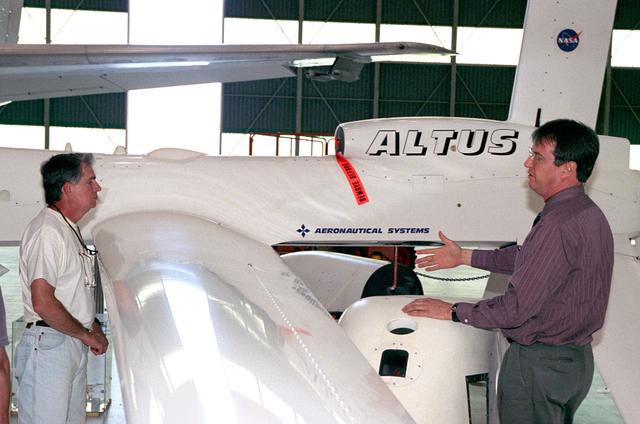
Dryden's David Bushman explains the capabilities of the Altus UAV to NASA Langley's Charles Hudgins
EC03-0148-1
AFRC | 2003-05-27
Details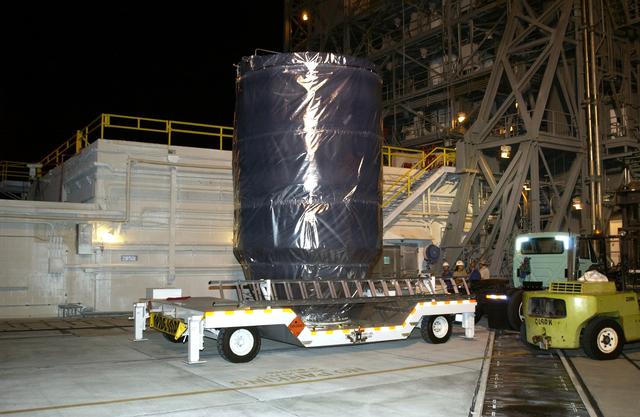
KENNEDY SPACE CENTER, FLA. - The Mars Exploration Rover 2 (MER-2), inside the transport canister, has arrived at Launch Pad 17-A, Cape Canaveral Air Force Station, where it will be mated to the Delta II rocket for launch. MER-2 is one of NASA's twin Mars Exploration Rovers designed to study the history of water on Mars. These robotic geologists are equipped with a robotic arm, a drilling tool, three spectrometers, and four pairs of cameras that allow them to have a human-like, 3D view of the terrain. Each rover could travel as far as 100 meters in one day to act as Mars scientists' eyes and hands, exploring an environment where humans can't yet go. MER-2 is scheduled to launch no earlier than June 8 as MER-A.
KSC-03pd1713
KSC | 2003-05-27
Details
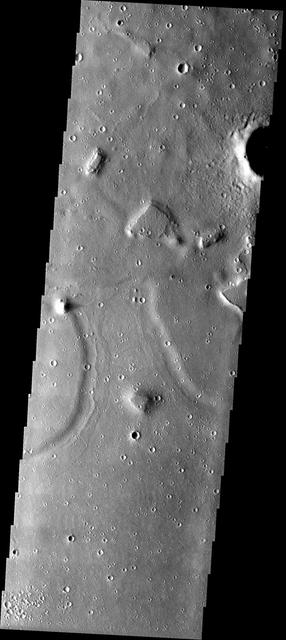


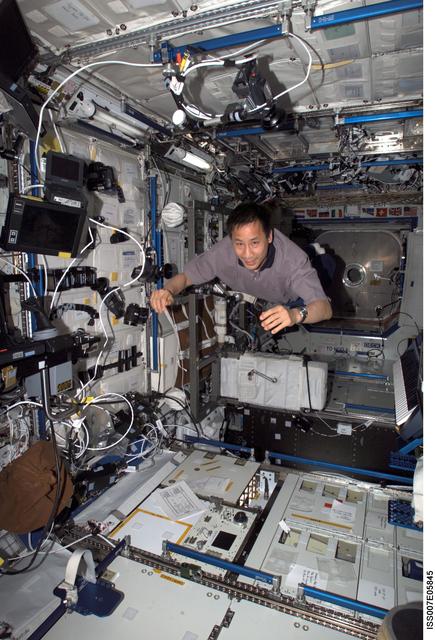
Expedition Seven Science Officer Ed Lu flies throught the Destiny laboratory
iss007e05845
JSC | 2003-05-26
Details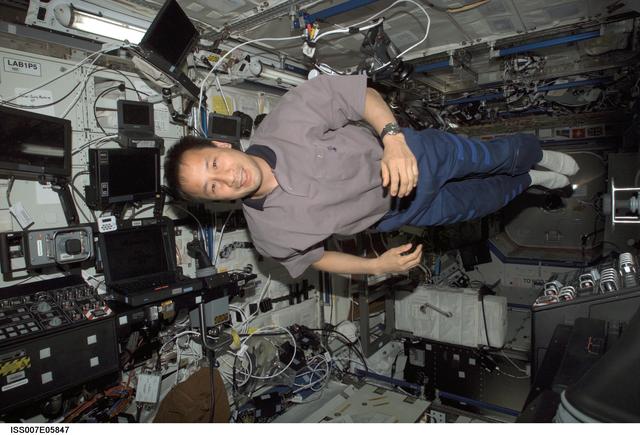
Expedition Seven Science Officer Ed Lu in the Destiny laboratory
iss007e05847
JSC | 2003-05-26
Details
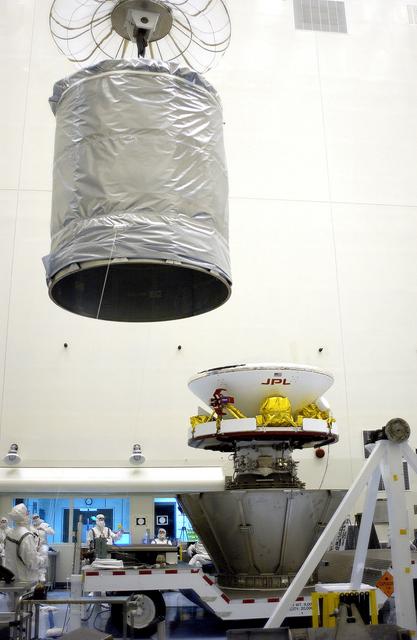
KENNEDY SPACE CENTER, FLA. - In the Payload Hazardous Servicing Facility, an overhead crane moves the canister that will complete encapsulation of the Mars Exploration Rover 2 (MER-2), at right. After encapsulation, MER-2 will be transferred to Launch Complex 17-A, Cape Canaveral Air Force Station. MER-2 is one of NASA's twin Mars Exploration Rovers designed to study the history of water on Mars. These robotic geologists are equipped with a robotic arm, a drilling tool, three spectrometers, and four pairs of cameras that allow them to have a human-like, 3D view of the terrain. Each rover could travel as far as 100 meters in one day to act as Mars scientists' eyes and hands, exploring an environment where humans can't yet go. MER-2 is scheduled to launch no earlier than June 8 as MER-A aboard a Delta II rocket.
KSC-03pd1707
KSC | 2003-05-24
Details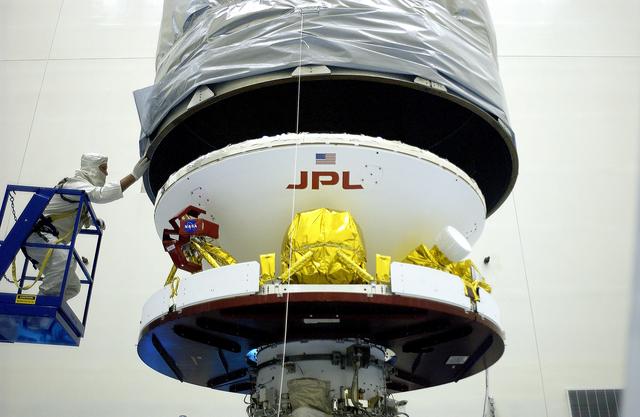
KENNEDY SPACE CENTER, FLA. - In the Payload Hazardous Servicing Facility, the Mars Exploration Rover 2 (MER-2) is being encapsulated for transfer to Launch Complex 17-A, Cape Canaveral Air Force Station. MER-2 is one of NASA's twin Mars Exploration Rovers designed to study the history of water on Mars. These robotic geologists are equipped with a robotic arm, a drilling tool, three spectrometers, and four pairs of cameras that allow them to have a human-like, 3D view of the terrain. Each rover could travel as far as 100 meters in one day to act as Mars scientists' eyes and hands, exploring an environment where humans can't yet go. MER-2 is scheduled to launch no earlier than June 8 as MER-A aboard a Delta II rocket.
KSC-03pd1703
KSC | 2003-05-24
Details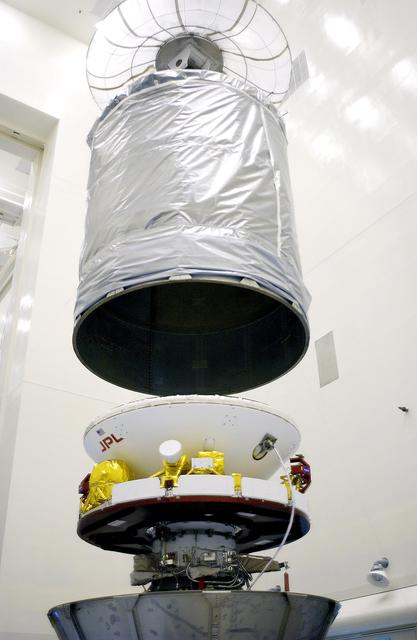
KENNEDY SPACE CENTER, FLA. - In the Payload Hazardous Servicing Facility, an overhead crane lowers the canister that will complete encapsulation of the Mars Exploration Rover 2 (MER-2), at right. After encapsulation, MER-2 will be transferred to Launch Complex 17-A, Cape Canaveral Air Force Station. MER-2 is one of NASA's twin Mars Exploration Rovers designed to study the history of water on Mars. These robotic geologists are equipped with a robotic arm, a drilling tool, three spectrometers, and four pairs of cameras that allow them to have a human-like, 3D view of the terrain. Each rover could travel as far as 100 meters in one day to act as Mars scientists' eyes and hands, exploring an environment where humans can't yet go. MER-2 is scheduled to launch no earlier than June 8 as MER-A aboard a Delta II rocket.
KSC-03pd1708
KSC | 2003-05-24
Details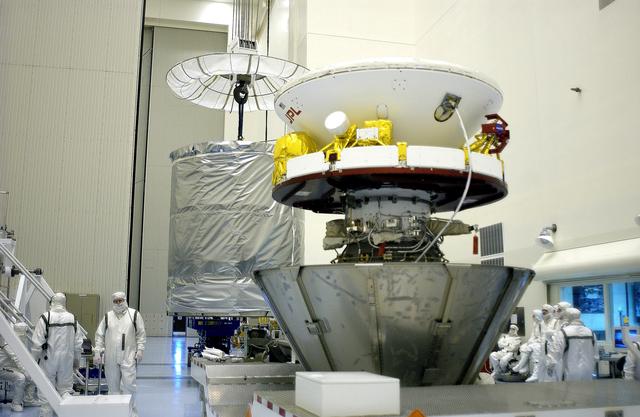
KENNEDY SPACE CENTER, FLA. - In the Payload Hazardous Servicing Facility, an overhead crane (background) begins to lift the canister that will complete encapsulation of the Mars Exploration Rover 2 (MER-2) in the foreground. After encapsulation, MER-2 will be transferred to Launch Complex 17-A, Cape Canaveral Air Force Station. MER-2 is one of NASA's twin Mars Exploration Rovers designed to study the history of water on Mars. These robotic geologists are equipped with a robotic arm, a drilling tool, three spectrometers, and four pairs of cameras that allow them to have a human-like, 3D view of the terrain. Each rover could travel as far as 100 meters in one day to act as Mars scientists' eyes and hands, exploring an environment where humans can't yet go. MER-2 is scheduled to launch no earlier than June 8 as MER-A aboard a Delta II rocket.
KSC-03pd1706
KSC | 2003-05-24
Details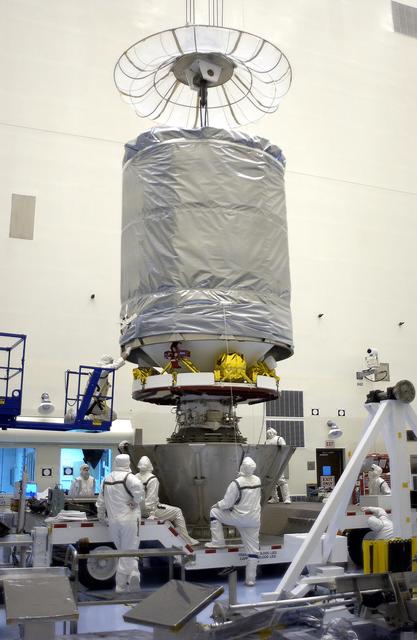
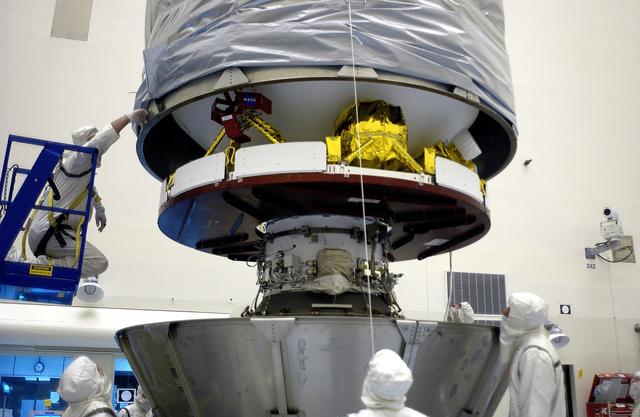
KENNEDY SPACE CENTER, FLA. - In the Payload Hazardous Servicing Facility, workers attach the upper canister to the lower portion to encapsulate the Mars Exploration Rover 2 (MER-2). After encapsulation, MER-2 will be transferred to Launch Complex 17-A, Cape Canaveral Air Force Station. MER-2 is one of NASA's twin Mars Exploration Rovers designed to study the history of water on Mars. These robotic geologists are equipped with a robotic arm, a drilling tool, three spectrometers, and four pairs of cameras that allow them to have a human-like, 3D view of the terrain. Each rover could travel as far as 100 meters in one day to act as Mars scientists' eyes and hands, exploring an environment where humans can't yet go. MER-2 is scheduled to launch no earlier than June 8 as MER-A aboard a Delta II rocket.
KSC-03pd1709
KSC | 2003-05-24
Details
KENNEDY SPACE CENTER, FLA. - In the Payload Hazardous Servicing Facility, an overhead crane lowers the canister that will complete encapsulation of the Mars Exploration Rover 2 (MER-2), at right. After encapsulation, MER-2 will be transferred to Launch Complex 17-A, Cape Canaveral Air Force Station. MER-2 is one of NASA's twin Mars Exploration Rovers designed to study the history of water on Mars. These robotic geologists are equipped with a robotic arm, a drilling tool, three spectrometers, and four pairs of cameras that allow them to have a human-like, 3D view of the terrain. Each rover could travel as far as 100 meters in one day to act as Mars scientists' eyes and hands, exploring an environment where humans can't yet go. MER-2 is scheduled to launch no earlier than June 8 as MER-A aboard a Delta II rocket.
KSC-03pd1710
KSC | 2003-05-24
Details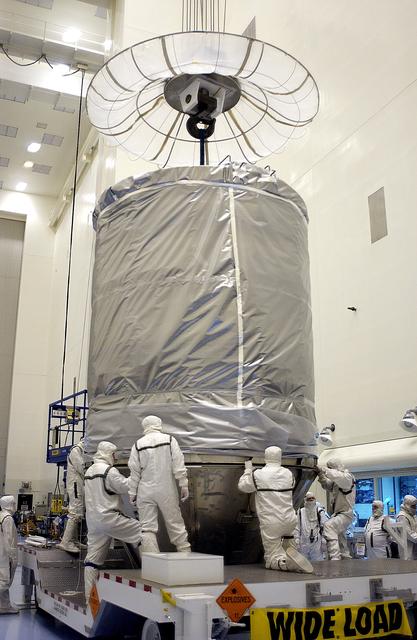
KENNEDY SPACE CENTER, FLA. - In the Payload Hazardous Servicing Facility, an overhead crane lowers the canister that will complete encapsulation of the Mars Exploration Rover 2 (MER-2), at right. After encapsulation, MER-2 will be transferred to Launch Complex 17-A, Cape Canaveral Air Force Station. MER-2 is one of NASA's twin Mars Exploration Rovers designed to study the history of water on Mars. These robotic geologists are equipped with a robotic arm, a drilling tool, three spectrometers, and four pairs of cameras that allow them to have a human-like, 3D view of the terrain. Each rover could travel as far as 100 meters in one day to act as Mars scientists' eyes and hands, exploring an environment where humans can't yet go. MER-2 is scheduled to launch no earlier than June 8 as MER-A aboard a Delta II rocket.
KSC-03pd1711
KSC | 2003-05-24
Details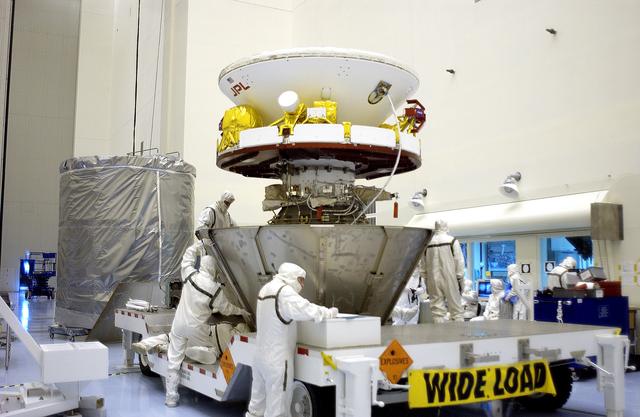
KENNEDY SPACE CENTER, FLA. - Workers in the Payload Hazardous Servicing Facility secure the lower sections of the transport canister around the Mars Exploration Rover 2 (MER-2). The upper portion waits at left. After encapsulation, MER-2 will be transferred to Launch Complex 17-A, Cape Canaveral Air Force Station. MER-2 is one of NASA's twin Mars Exploration Rovers designed to study the history of water on Mars. These robotic geologists are equipped with a robotic arm, a drilling tool, three spectrometers, and four pairs of cameras that allow them to have a human-like, 3D view of the terrain. Each rover could travel as far as 100 meters in one day to act as Mars scientists' eyes and hands, exploring an environment where humans can't yet go. MER-2 is scheduled to launch no earlier than June 8 as MER-A aboard a Delta II rocket.
KSC-03pd1705
KSC | 2003-05-24
Details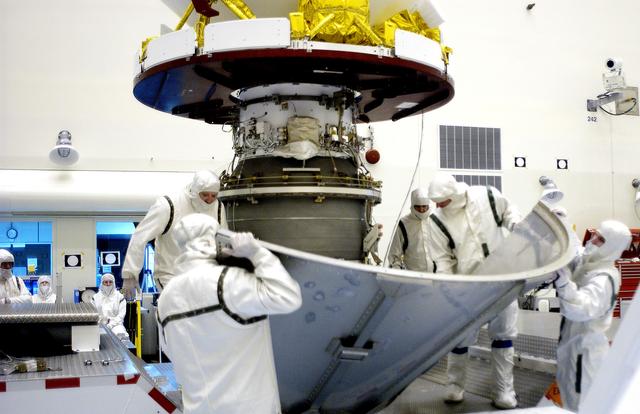
KENNEDY SPACE CENTER, FLA. - Workers in the Payload Hazardous Servicing Facility place the lower sections of the transport canister around the Mars Exploration Rover 2 (MER-2). After encapsulation, it will be transferred to Launch Complex 17-A, Cape Canaveral Air Force Station. MER-2 is one of NASA's twin Mars Exploration Rovers designed to study the history of water on Mars. These robotic geologists are equipped with a robotic arm, a drilling tool, three spectrometers, and four pairs of cameras that allow them to have a human-like, 3D view of the terrain. Each rover could travel as far as 100 meters in one day to act as Mars scientists' eyes and hands, exploring an environment where humans can't yet go. MER-2 is scheduled to launch no earlier than June 8 as MER-A aboard a Delta II rocket.
KSC-03pd1704
KSC | 2003-05-24
Details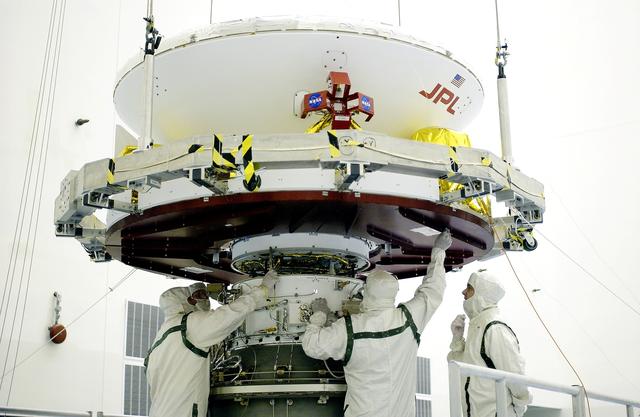
KENNEDY SPACE CENTER, FLA. - In the Payload Hazardous Servicing Facility, workers mate the Mars Exploration Rover-2 (MER-2) to the third stage of a Delta II rocket for launch on June 5. NASA’s twin Mars Exploration Rovers are designed to study the history of water on Mars. These robotic geologists are equipped with a robotic arm, a drilling tool, three spectrometers, and four pairs of cameras that allow them to have a human-like, 3D view of the terrain. Each rover could travel as far as 100 meters in one day to act as Mars scientists' eyes and hands, exploring an environment where humans can’t yet go. MER-1 (MER-B) will launch June 25.
KSC-03pd1701
KSC | 2003-05-23
Details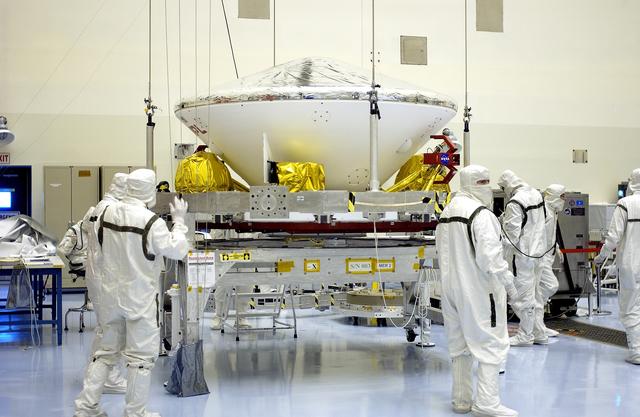
KENNEDY SPACE CENTER, FLA. - In the Payload Hazardous Servicing Facility, workers prepare to mate the Mars Exploration Rover-2 (MER-2) to the third stage of a Delta II rocket for launch on June 5. NASA’s twin Mars Exploration Rovers are designed to study the history of water on Mars. These robotic geologists are equipped with a robotic arm, a drilling tool, three spectrometers, and four pairs of cameras that allow them to have a human-like, 3D view of the terrain. Each rover could travel as far as 100 meters in one day to act as Mars scientists' eyes and hands, exploring an environment where humans can’t yet go. MER-1 (MER-B) will launch June 25.
KSC-03pd1696
KSC | 2003-05-23
Details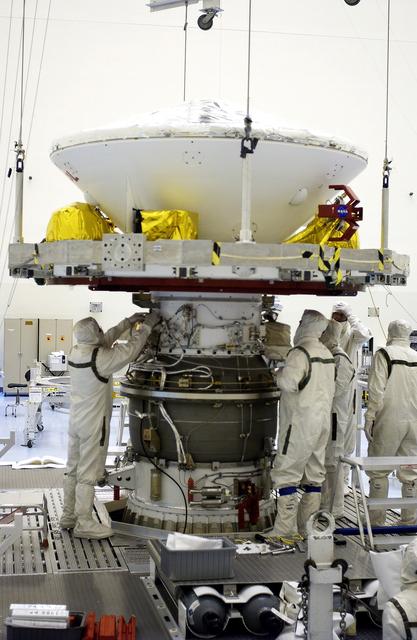
KENNEDY SPACE CENTER, FLA. - In the Payload Hazardous Servicing Facility, workers mate the Mars Exploration Rover-2 (MER-2) to the third stage of a Delta II rocket for launch on June 5. NASA’s twin Mars Exploration Rovers are designed to study the history of water on Mars. These robotic geologists are equipped with a robotic arm, a drilling tool, three spectrometers, and four pairs of cameras that allow them to have a human-like, 3D view of the terrain. Each rover could travel as far as 100 meters in one day to act as Mars scientists' eyes and hands, exploring an environment where humans can’t yet go. MER-1 (MER-B) will launch June 25.
KSC-03pd1702
KSC | 2003-05-23
Details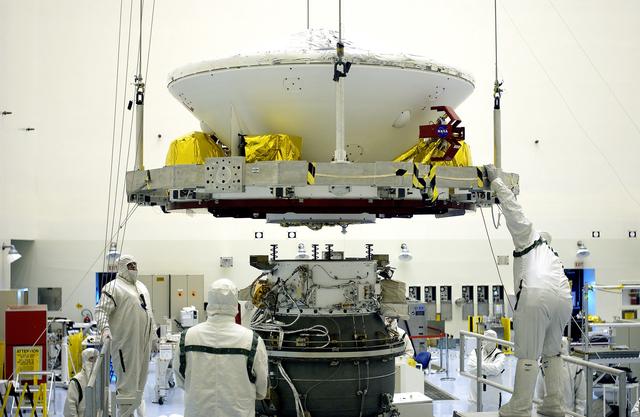
KENNEDY SPACE CENTER, FLA. - In the Payload Hazardous Servicing Facility, workers prepare to mate the Mars Exploration Rover-2 (MER-2) to the third stage of a Delta II rocket for launch on June 5. NASA’s twin Mars Exploration Rovers are designed to study the history of water on Mars. These robotic geologists are equipped with a robotic arm, a drilling tool, three spectrometers, and four pairs of cameras that allow them to have a human-like, 3D view of the terrain. Each rover could travel as far as 100 meters in one day to act as Mars scientists' eyes and hands, exploring an environment where humans can’t yet go. MER-1 (MER-B) will launch June 25.
KSC-03pd1700
KSC | 2003-05-23
Details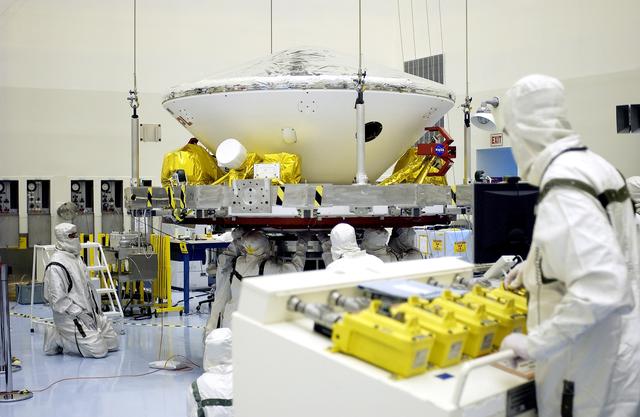
KENNEDY SPACE CENTER, FLA. - In the Payload Hazardous Servicing Facility, workers prepare to mate the Mars Exploration Rover-2 (MER-2) to the third stage of a Delta II rocket for launch on June 5. NASA’s twin Mars Exploration Rovers are designed to study the history of water on Mars. These robotic geologists are equipped with a robotic arm, a drilling tool, three spectrometers, and four pairs of cameras that allow them to have a human-like, 3D view of the terrain. Each rover could travel as far as 100 meters in one day to act as Mars scientists' eyes and hands, exploring an environment where humans can’t yet go. MER-1 (MER-B) will launch June 25.
KSC-03pd1694
KSC | 2003-05-23
Details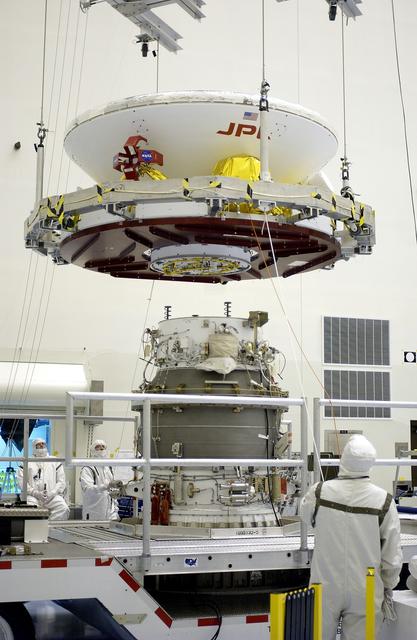
KENNEDY SPACE CENTER, FLA. - In the Payload Hazardous Servicing Facility, workers prepare to mate the Mars Exploration Rover-2 (MER-2) to the third stage of a Delta II rocket for launch on June 5. NASA’s twin Mars Exploration Rovers are designed to study the history of water on Mars. These robotic geologists are equipped with a robotic arm, a drilling tool, three spectrometers, and four pairs of cameras that allow them to have a human-like, 3D view of the terrain. Each rover could travel as far as 100 meters in one day to act as Mars scientists' eyes and hands, exploring an environment where humans can’t yet go. MER-1 (MER-B) will launch June 25.
KSC-03pd1699
KSC | 2003-05-23
Details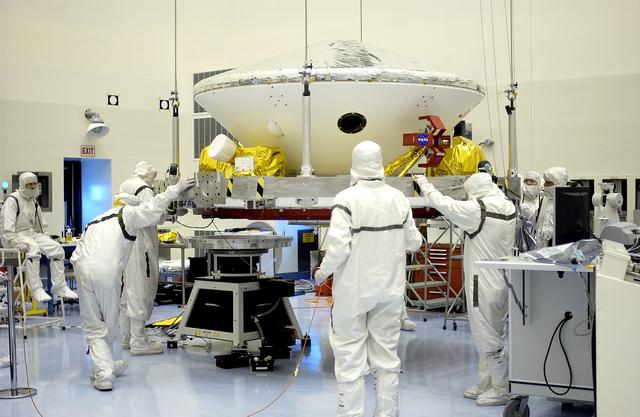
KENNEDY SPACE CENTER, FLA. - In the Payload Hazardous Servicing Facility, workers prepare to mate the Mars Exploration Rover-2 (MER-2) to the third stage of a Delta II rocket for launch on June 5. NASA’s twin Mars Exploration Rovers are designed to study the history of water on Mars. These robotic geologists are equipped with a robotic arm, a drilling tool, three spectrometers, and four pairs of cameras that allow them to have a human-like, 3D view of the terrain. Each rover could travel as far as 100 meters in one day to act as Mars scientists' eyes and hands, exploring an environment where humans can’t yet go. MER-1 (MER-B) will launch June 25.
KSC-03pd1695
KSC | 2003-05-23
Details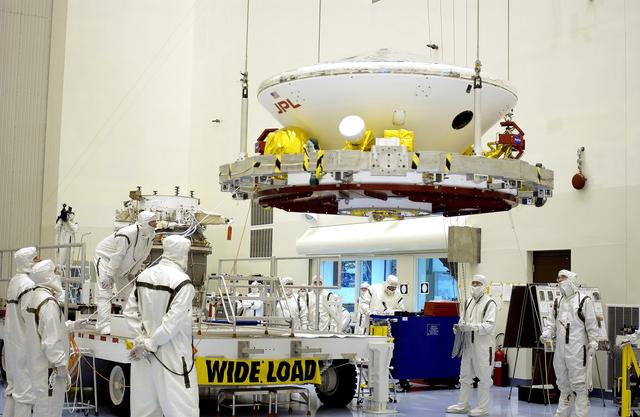
KENNEDY SPACE CENTER, FLA. - In the Payload Hazardous Servicing Facility, workers prepare to mate the Mars Exploration Rover-2 (MER-2) to the third stage of a Delta II rocket for launch on June 5. NASA’s twin Mars Exploration Rovers are designed to study the history of water on Mars. These robotic geologists are equipped with a robotic arm, a drilling tool, three spectrometers, and four pairs of cameras that allow them to have a human-like, 3D view of the terrain. Each rover could travel as far as 100 meters in one day to act as Mars scientists' eyes and hands, exploring an environment where humans can’t yet go. MER-1 (MER-B) will launch June 25.
KSC-03pd1697
KSC | 2003-05-23
Details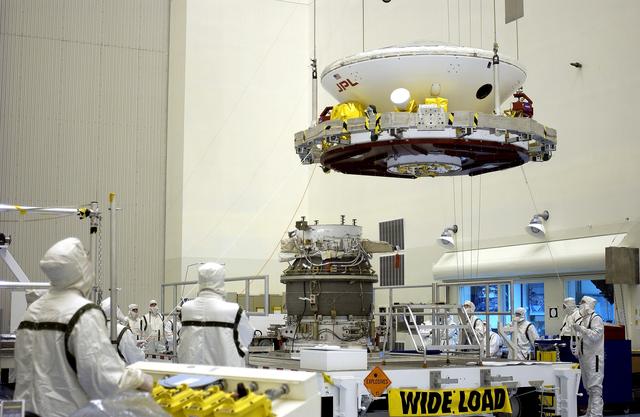
KENNEDY SPACE CENTER, FLA. - In the Payload Hazardous Servicing Facility, workers prepare to mate the Mars Exploration Rover-2 (MER-2) to the third stage of a Delta II rocket for launch on June 5. NASA’s twin Mars Exploration Rovers are designed to study the history of water on Mars. These robotic geologists are equipped with a robotic arm, a drilling tool, three spectrometers, and four pairs of cameras that allow them to have a human-like, 3D view of the terrain. Each rover could travel as far as 100 meters in one day to act as Mars scientists' eyes and hands, exploring an environment where humans can’t yet go. MER-1 (MER-B) will launch June 25.
KSC-03pd1698
KSC | 2003-05-23
Details



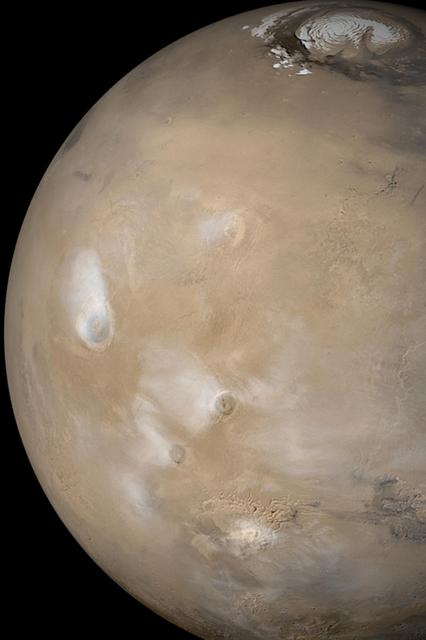

KENNEDY SPACE CENTER, FLA. - Solid rocket boosters are attached to the base of a Delta II rocket for the Mars Exploration Rover 1 (MER-1) launch on June 25 at Launch Complex 17-B, Cape Canaveral Air Force Station. NASA’s twin Mars Exploration Rovers are designed to study the history of water on Mars. These robotic geologists are equipped with a robotic arm, a drilling tool, three spectrometers, and four pairs of cameras that allow them to have a human-like, 3D view of the terrain. Each rover could travel as far as 100 meters in one day to act as Mars scientists' eyes and hands, exploring an environment where humans can’t yet go. MER-2 (MER-A) will launch June 5.
KSC-03pd1692
KSC | 2003-05-22
Details