NASA Media Archive

KENNEDY SPACE CENTER, FLA. - On Launch Complex 17-B, Cape Canaveral Air Force Station, a solid rocket booster is lifted to vertical. It will be mated to the Delta II rocket (in the background) for the Mars Exploration Rover 1 (MER-1) launch June 25. NASA’s twin Mars Exploration Rovers are designed to study the history of water on Mars. These robotic geologists are equipped with a robotic arm, a drilling tool, three spectrometers, and four pairs of cameras that allow them to have a human-like, 3D view of the terrain. Each rover could travel as far as 100 meters in one day to act as Mars scientists' eyes and hands, exploring an environment where humans can’t yet go. MER-2 (MER-A) will launch June 5.
KSC-03pd1688
KSC | 2003-05-22
Details
KENNEDY SPACE CENTER, FLA. - Solid rocket boosters are positioned around the base of a Delta II rocket for the Mars Exploration Rover 1 (MER-1) launch on June 25 at Launch Complex 17-B, Cape Canaveral Air Force Station. NASA’s twin Mars Exploration Rovers are designed to study the history of water on Mars. These robotic geologists are equipped with a robotic arm, a drilling tool, three spectrometers, and four pairs of cameras that allow them to have a human-like, 3D view of the terrain. Each rover could travel as far as 100 meters in one day to act as Mars scientists' eyes and hands, exploring an environment where humans can’t yet go. MER-2 (MER-A) will launch June 5.
KSC-03pd1690
KSC | 2003-05-22
Details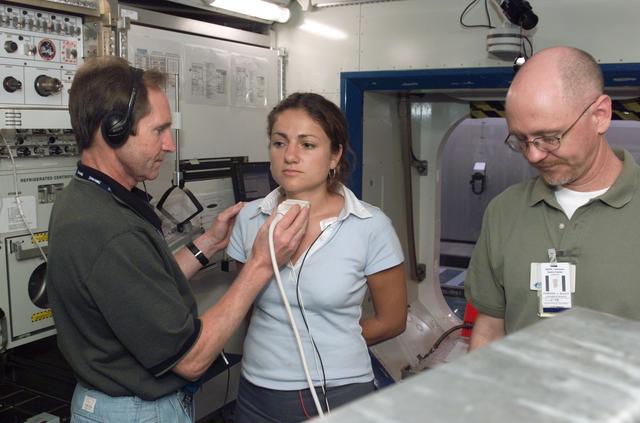
Tokarev HRF training in Destiny mockup at JSC for Expedition 8
jsc2003e37776
JSC | 2003-05-22
Details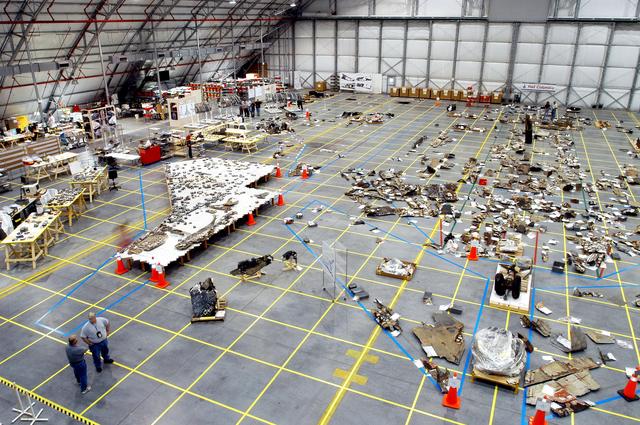
KENNEDY SPACE CENTER, FLA. - An overview of the Columbia debris hangar shows the orbiter outline on the floor with some of the 78,760 pieces identified to date, as well as tables on the left that hold tiles. More than 82,500 pieces of shuttle debris have been rcovered.
KSC-03pd1674
KSC | 2003-05-22
Details
KENNEDY SPACE CENTER, FLA. - Solid rocket boosters are positioned around the base of a Delta II rocket for the Mars Exploration Rover 1 (MER-1) launch on June 25 at Launch Complex 17-B, Cape Canaveral Air Force Station. NASA’s twin Mars Exploration Rovers are designed to study the history of water on Mars. These robotic geologists are equipped with a robotic arm, a drilling tool, three spectrometers, and four pairs of cameras that allow them to have a human-like, 3D view of the terrain. Each rover could travel as far as 100 meters in one day to act as Mars scientists' eyes and hands, exploring an environment where humans can’t yet go. MER-2 (MER-A) will launch June 5.
KSC-03pd1691
KSC | 2003-05-22
Details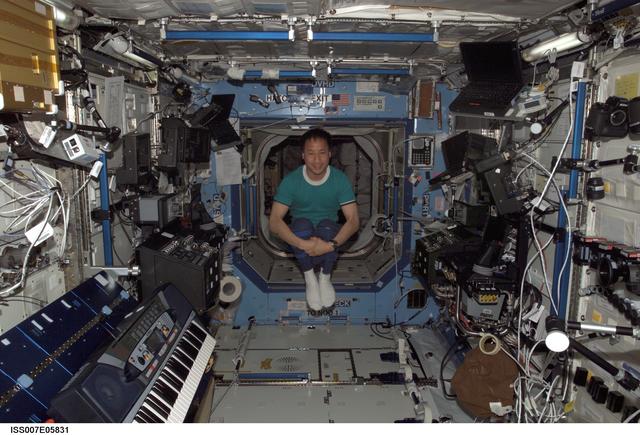
Expedition Seven Science Officer Ed Lu tumbles through the Destiny laboratory
iss007e05831
JSC | 2003-05-22
Details
KENNEDY SPACE CENTER, FLA. - On Launch Complex 17-B, Cape Canaveral Air Force Station, a solid rocket booster is raised off its transporter to lift it to vertical. It will be mated to the Delta II rocket for the Mars Exploration Rover 1 (MER-1) launch June 25. NASA’s twin Mars Exploration Rovers are designed to study the history of water on Mars. These robotic geologists are equipped with a robotic arm, a drilling tool, three spectrometers, and four pairs of cameras that allow them to have a human-like, 3D view of the terrain. Each rover could travel as far as 100 meters in one day to act as Mars scientists' eyes and hands, exploring an environment where humans can’t yet go. MER-2 (MER-A) will launch June 5.
KSC-03pd1687
KSC | 2003-05-22
Details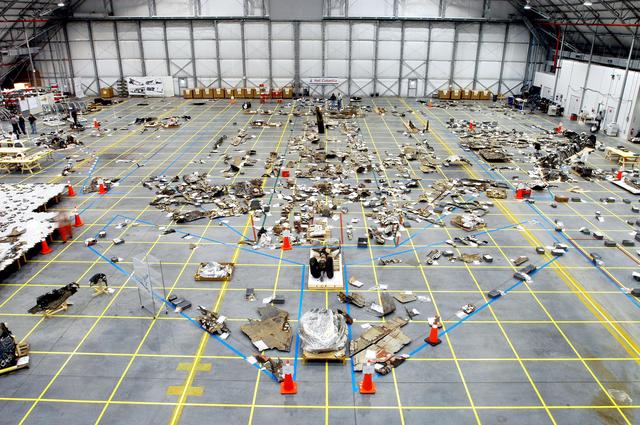
KENNEDY SPACE CENTER, FLA. - An overview of the Columbia debris hangar shows the orbiter outline on the floor with some of the 78,760 pieces identified to date. More than 82,500 pieces of shuttle debris have been rcovered.
KSC-03pd1673
KSC | 2003-05-22
Details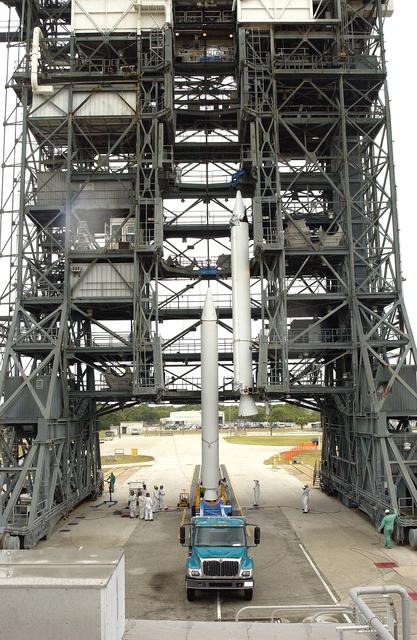
KENNEDY SPACE CENTER, FLA. - Another solid rocket booster is lifted up the launch tower on Launch Complex 17-B, Cape Canaveral Air Force Station. It will be mated to the Delta II rocket for the Mars Exploration Rover 1 (MER-1) launch June 25. NASA’s twin Mars Exploration Rovers are designed to study the history of water on Mars. These robotic geologists are equipped with a robotic arm, a drilling tool, three spectrometers, and four pairs of cameras that allow them to have a human-like, 3D view of the terrain. Each rover could travel as far as 100 meters in one day to act as Mars scientists' eyes and hands, exploring an environment where humans can’t yet go. MER-2 (MER-A) will launch June 5.
KSC-03pd1689
KSC | 2003-05-22
Details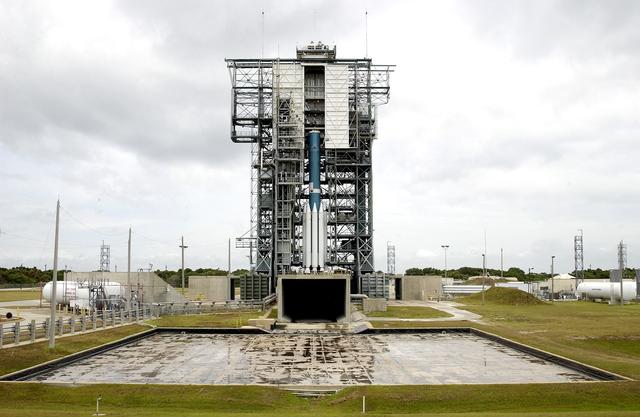
KENNEDY SPACE CENTER, FLA. - Erection of the Delta II rocket for the Mars Exploration Rover 1 (MER-1) launch on June 25 at Launch Complex 17-B, Cape Canaveral Air Force Station, is under way. NASA’s twin Mars Exploration Rovers are designed to study the history of water on Mars. These robotic geologists are equipped with a robotic arm, a drilling tool, three spectrometers, and four pairs of cameras that allow them to have a human-like, 3D view of the terrain. Each rover could travel as far as 100 meters in one day to act as Mars scientists' eyes and hands, exploring an environment where humans can’t yet go. MER-2 (MER-A) will launch June 5.
KSC-03pd1693
KSC | 2003-05-22
Details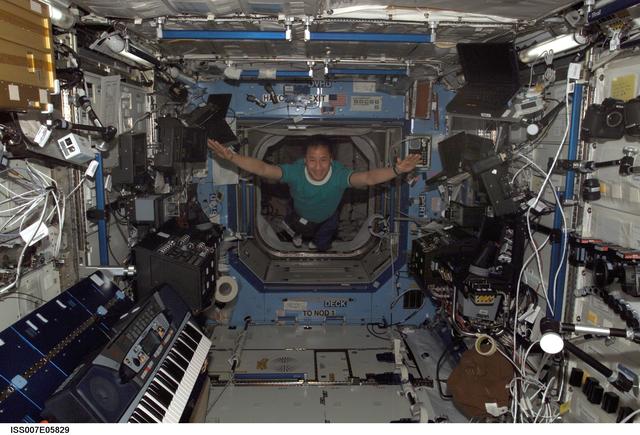
Expedition Seven Science Officer Ed Lu flies through the Destiny laboratory
iss007e05829
JSC | 2003-05-22
Details

International Space Station Expedition 6 crew arrival at Ellington Field for crew return to JSC.
jsc2003e37639
JSC | 2003-05-21
Details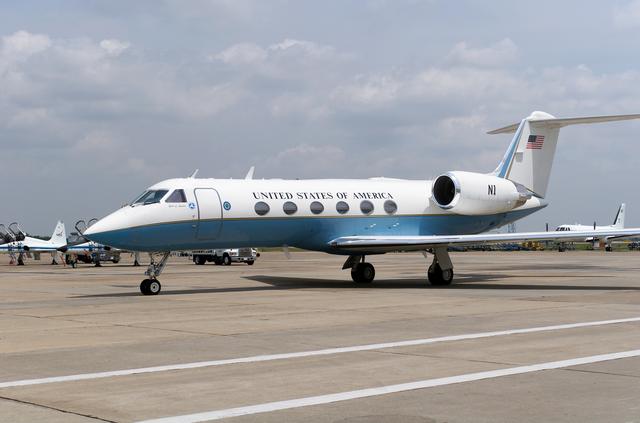
International Space Station Expedition 6 crew arrival at Ellington Field for crew return to JSC.
jsc2003e37449
JSC | 2003-05-21
Details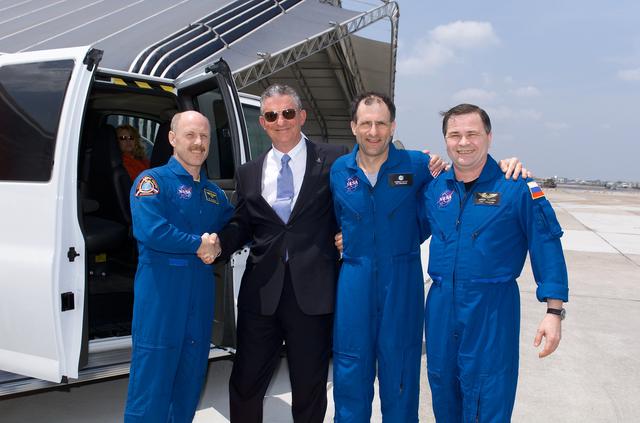
International Space Station Expedition 6 crew arrival at Ellington Field for crew return to JSC.
jsc2003e37463
JSC | 2003-05-21
Details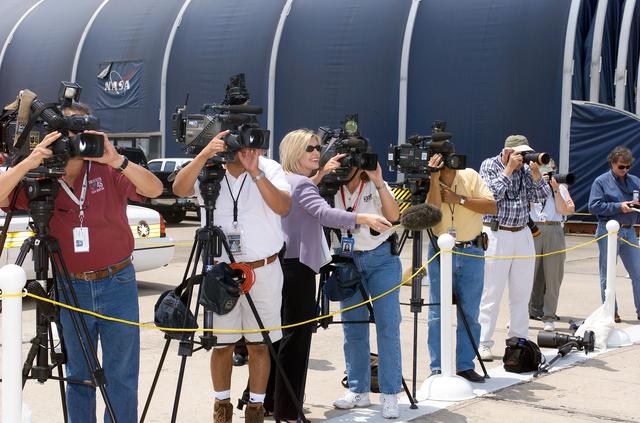
International Space Station Expedition 6 crew arrival at Ellington Field for crew return to JSC.
jsc2003e37465
JSC | 2003-05-21
Details
KENNEDY SPACE CENTER, FLA. - William (Bill) W. Parsons, named Space Shuttle Program Manager, Johnson Space Center, Houston, in May 2003.
KSC-03pd1672
KSC | 2003-05-20
Details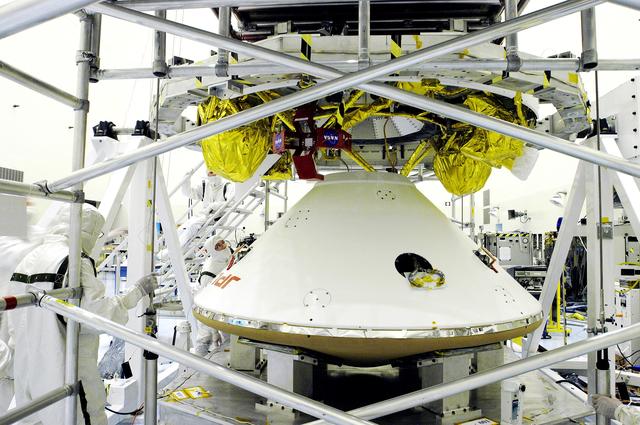
KENNEDY SPACE CENTER, FLA. - The Mars Exploration Rover 1 (MER-1) lander (below) is mated to the cruise stage, seen above the lander. NASA's twin Mars Exploration Rovers are designed to study the history of water on Mars. These robotic geologists are equipped with a robotic arm, a drilling tool, three spectrometers, and four pairs of cameras that allow them to have a human-like, 3D view of the terrain. Each rover could travel as far as 100 meters in one day to act as Mars scientists' eyes and hands, exploring an environment where humans can't yet go. MER-1 is scheduled to launch June 25 as MER-B aboard a Delta II rocket from Cape Canaveral Air Force Station.
KSC-03pd1665
KSC | 2003-05-20
Details
KENNEDY SPACE CENTER, FLA. - A solid rocket booster arrives at Launch Complex 17-B, Cape Canaveral Air Force Station, to be mated to the Delta II rocket for the Mars Exploration Rover 1 (MER-1) launch June 25. NASA’s twin Mars Exploration Rovers are designed to study the history of water on Mars. These robotic geologists are equipped with a robotic arm, a drilling tool, three spectrometers, and four pairs of cameras that allow them to have a human-like, 3D view of the terrain. Each rover could travel as far as 100 meters in one day to act as Mars scientists' eyes and hands, exploring an environment where humans can’t yet go. MER-2 (MER-A) will launch June 5.
KSC-03pd1675
KSC | 2003-05-20
Details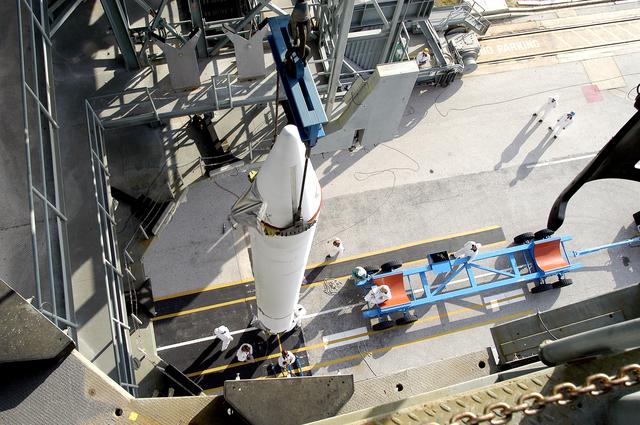
KENNEDY SPACE CENTER, FLA. - On Launch Complex 17-B, Cape Canaveral Air Force Station, a solid rocket booster is viewed from above after being lifted to vertical. It will be mated to the Delta II rocket for the Mars Exploration Rover 1 (MER-1) launch June 25. NASA’s twin Mars Exploration Rovers are designed to study the history of water on Mars. These robotic geologists are equipped with a robotic arm, a drilling tool, three spectrometers, and four pairs of cameras that allow them to have a human-like, 3D view of the terrain. Each rover could travel as far as 100 meters in one day to act as Mars scientists' eyes and hands, exploring an environment where humans can’t yet go. MER-2 (MER-A) will launch June 5.
KSC-03pd1679
KSC | 2003-05-20
Details
KENNEDY SPACE CENTER, FLA. - The Mars Exploration Rover 1 (MER-1) lander (below) is mated to the cruise stage, seen above the lander. NASA's twin Mars Exploration Rovers are designed to study the history of water on Mars. These robotic geologists are equipped with a robotic arm, a drilling tool, three spectrometers, and four pairs of cameras that allow them to have a human-like, 3D view of the terrain. Each rover could travel as far as 100 meters in one day to act as Mars scientists' eyes and hands, exploring an environment where humans can't yet go. MER-1 is scheduled to launch June 25 as MER-B aboard a Delta II rocket from Cape Canaveral Air Force Station.
KSC-03pd1666
KSC | 2003-05-20
Details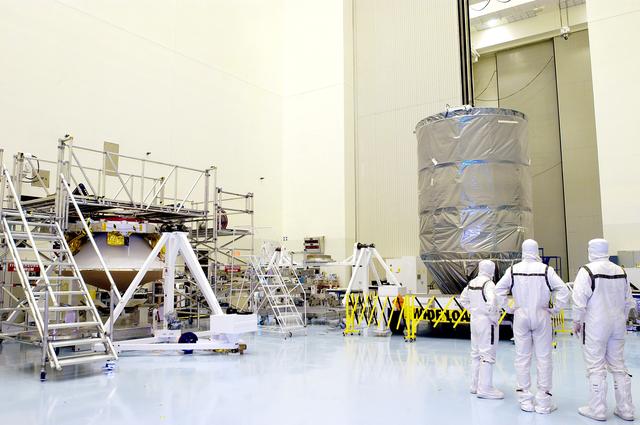
KENNEDY SPACE CENTER, FLA. - The Delta II rocket’s third stage waits in the Payload Hazardous Servicing Facility for mating with the Mars Exploration Rover 2 (MER-2). They will then be installed into the transportation canister for transfer to the launch pad. NASA's twin Mars Exploration Rovers are designed to study the history of water on Mars. These robotic geologists are equipped with a robotic arm, a drilling tool, three spectrometers, and four pairs of cameras that allow them to have a human-like, 3D view of the terrain. Each rover could travel as far as 100 meters in one day to act as Mars scientists' eyes and hands, exploring an environment where humans can't yet go. MER-2 is scheduled to launch June 5 as MER-A aboard a Delta II rocket from Cape Canaveral Air Force Station.
KSC-03pd1671
KSC | 2003-05-20
Details
KENNEDY SPACE CENTER, FLA. - Three solid rocket boosters are suspended in the launch tower of Launch Complex 17-B, Cape Canaveral Air Force Station. They will be mated to the Delta II rocket for the Mars Exploration Rover 1 (MER-1) launch June 25. NASA’s twin Mars Exploration Rovers are designed to study the history of water on Mars. These robotic geologists are equipped with a robotic arm, a drilling tool, three spectrometers, and four pairs of cameras that allow them to have a human-like, 3D view of the terrain. Each rover could travel as far as 100 meters in one day to act as Mars scientists' eyes and hands, exploring an environment where humans can’t yet go. MER-2 (MER-A) will launch June 5.
KSC-03pd1683
KSC | 2003-05-20
Details
KENNEDY SPACE CENTER, FLA. - On Launch Complex 17-B, Cape Canaveral Air Force Station, workers make adjustments on the solid rocket booster after its lift to vertical. It is one of nine SRBs that will be mated to the Delta II rocket for the Mars Exploration Rover 1 (MER-1) launch June 25. NASA’s twin Mars Exploration Rovers are designed to study the history of water on Mars. These robotic geologists are equipped with a robotic arm, a drilling tool, three spectrometers, and four pairs of cameras that allow them to have a human-like, 3D view of the terrain. Each rover could travel as far as 100 meters in one day to act as Mars scientists' eyes and hands, exploring an environment where humans can’t yet go. MER-2 (MER-A) will launch June 5.
KSC-03pd1682
KSC | 2003-05-20
Details
KENNEDY SPACE CENTER, FLA. - On Launch Complex 17-B, Cape Canaveral Air Force Station, a solid rocket booster if lifted up the launch tower. It will be mated to the Delta II rocket for the Mars Exploration Rover 1 (MER-1) launch June 25. NASA’s twin Mars Exploration Rovers are designed to study the history of water on Mars. These robotic geologists are equipped with a robotic arm, a drilling tool, three spectrometers, and four pairs of cameras that allow them to have a human-like, 3D view of the terrain. Each rover could travel as far as 100 meters in one day to act as Mars scientists' eyes and hands, exploring an environment where humans can’t yet go. MER-2 (MER-A) will launch June 5.
KSC-03pd1680
KSC | 2003-05-20
Details

KENNEDY SPACE CENTER, FLA. - Workers in the Payload Hazardous Servicing Facility check the mating of the Mars Exploration Rover 1 (MER-1) cruise stage to the lander below it. NASA's twin Mars Exploration Rovers are designed to study the history of water on Mars. These robotic geologists are equipped with a robotic arm, a drilling tool, three spectrometers, and four pairs of cameras that allow them to have a human-like, 3D view of the terrain. Each rover could travel as far as 100 meters in one day to act as Mars scientists' eyes and hands, exploring an environment where humans can't yet go. MER-1 is scheduled to launch June 25 as MER-B aboard a Delta II rocket from Cape Canaveral Air Force Station.
KSC-03pd1667
KSC | 2003-05-20
Details
KENNEDY SPACE CENTER, FLA. - Another solid rocket booster is raised to vertical on Launch Complex 17-B, Cape Canaveral Air Force Station. It is the second of nine SRBs that will be mated to the Delta II rocket for the Mars Exploration Rover 1 (MER-1) launch June 25. NASA’s twin Mars Exploration Rovers are designed to study the history of water on Mars. These robotic geologists are equipped with a robotic arm, a drilling tool, three spectrometers, and four pairs of cameras that allow them to have a human-like, 3D view of the terrain. Each rover could travel as far as 100 meters in one day to act as Mars scientists' eyes and hands, exploring an environment where humans can’t yet go. MER-2 (MER-A) will launch June 5.
KSC-03pd1681
KSC | 2003-05-20
Details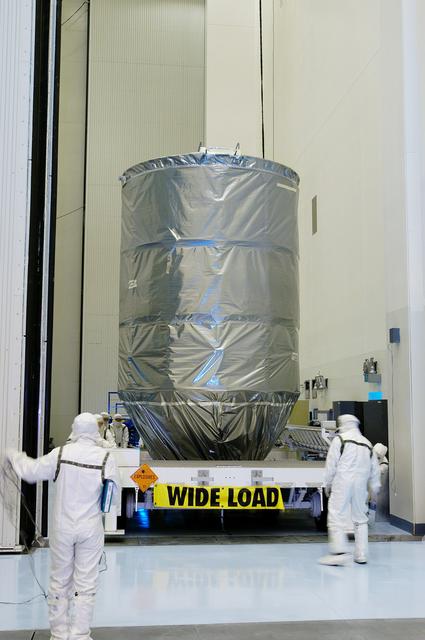
KENNEDY SPACE CENTER, FLA. - The Delta II rocket’s third stage arrives at the Payload Hazardous Servicing Facility. It will be mated with the Mars Exploration Rover 2 (MER-2) and then installed into the transportation canister for transfer to the launch pad. NASA's twin Mars Exploration Rovers are designed to study the history of water on Mars. These robotic geologists are equipped with a robotic arm, a drilling tool, three spectrometers, and four pairs of cameras that allow them to have a human-like, 3D view of the terrain. Each rover could travel as far as 100 meters in one day to act as Mars scientists' eyes and hands, exploring an environment where humans can't yet go. MER-2 is scheduled to launch June 5 as MER-A aboard a Delta II rocket from Cape Canaveral Air Force Station.
KSC-03pd1669
KSC | 2003-05-20
Details
KENNEDY SPACE CENTER, FLA. - On the launch tower of Launch Complex 17-B, Cape Canaveral Air Force Station, solid rocket boosters are mated to the Delta II rocket for the Mars Exploration Rover 1 (MER-1) launch June 25. NASA’s twin Mars Exploration Rovers are designed to study the history of water on Mars. These robotic geologists are equipped with a robotic arm, a drilling tool, three spectrometers, and four pairs of cameras that allow them to have a human-like, 3D view of the terrain. Each rover could travel as far as 100 meters in one day to act as Mars scientists' eyes and hands, exploring an environment where humans can’t yet go. MER-2 (MER-A) will launch June 5.
KSC-03pd1684
KSC | 2003-05-20
Details
KENNEDY SPACE CENTER, FLA. - Workers in the Payload Hazardous Servicing Facility check the mating of the Mars Exploration Rover 1 (MER-1) cruise stage to the lander below it. NASA's twin Mars Exploration Rovers are designed to study the history of water on Mars. These robotic geologists are equipped with a robotic arm, a drilling tool, three spectrometers, and four pairs of cameras that allow them to have a human-like, 3D view of the terrain. Each rover could travel as far as 100 meters in one day to act as Mars scientists' eyes and hands, exploring an environment where humans can't yet go. MER-1 is scheduled to launch June 25 as MER-B aboard a Delta II rocket from Cape Canaveral Air Force Station.
KSC-03pd1668
KSC | 2003-05-20
Details
KENNEDY SPACE CENTER, FLA. - On Launch Complex 17-B, Cape Canaveral Air Force Station, a solid rocket booster is raised off its transporter to lift it to vertical. It will be mated to the Delta II rocket for the Mars Exploration Rover 1 (MER-1) launch June 25. NASA’s twin Mars Exploration Rovers are designed to study the history of water on Mars. These robotic geologists are equipped with a robotic arm, a drilling tool, three spectrometers, and four pairs of cameras that allow them to have a human-like, 3D view of the terrain. Each rover could travel as far as 100 meters in one day to act as Mars scientists' eyes and hands, exploring an environment where humans can’t yet go. MER-2 (MER-A) will launch June 5.
KSC-03pd1677
KSC | 2003-05-20
Details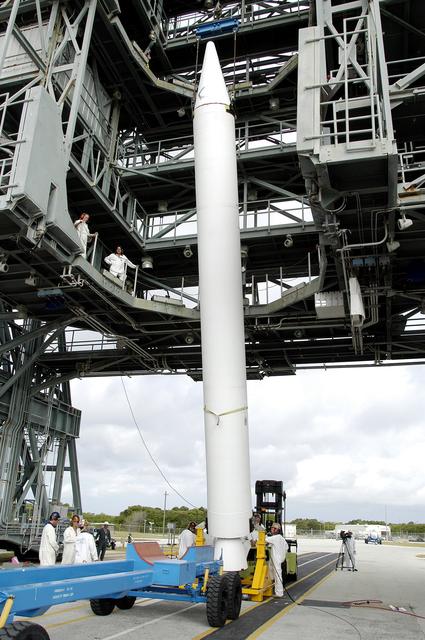
KENNEDY SPACE CENTER, FLA. - On Launch Complex 17-B, Cape Canaveral Air Force Station, a solid rocket booster is lifted to vertical. It will be mated to the Delta II rocket for the Mars Exploration Rover 1 (MER-1) launch June 25. NASA’s twin Mars Exploration Rovers are designed to study the history of water on Mars. These robotic geologists are equipped with a robotic arm, a drilling tool, three spectrometers, and four pairs of cameras that allow them to have a human-like, 3D view of the terrain. Each rover could travel as far as 100 meters in one day to act as Mars scientists' eyes and hands, exploring an environment where humans can’t yet go. MER-2 (MER-A) will launch June 5.
KSC-03pd1678
KSC | 2003-05-20
Details
KENNEDY SPACE CENTER, FLA. - The Delta II rocket’s third stage rolls into the Payload Hazardous Servicing Facility. It will be mated with the Mars Exploration Rover 2 (MER-2) and then installed into the transportation canister for transfer to the launch pad. NASA's twin Mars Exploration Rovers are designed to study the history of water on Mars. These robotic geologists are equipped with a robotic arm, a drilling tool, three spectrometers, and four pairs of cameras that allow them to have a human-like, 3D view of the terrain. Each rover could travel as far as 100 meters in one day to act as Mars scientists' eyes and hands, exploring an environment where humans can't yet go. MER-2 is scheduled to launch June 5 as MER-A aboard a Delta II rocket from Cape Canaveral Air Force Station.
KSC-03pd1670
KSC | 2003-05-20
Details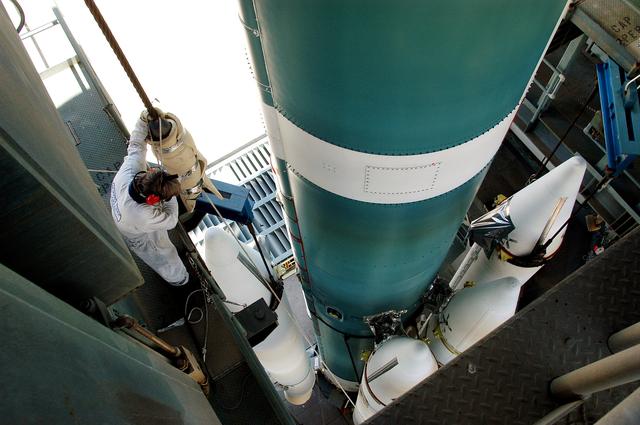
KENNEDY SPACE CENTER, FLA. - On the launch tower of Launch Complex 17-B, Cape Canaveral Air Force Station, solid rocket boosters are mated to the Delta II rocket for the Mars Exploration Rover 1 (MER-1) launch June 25. NASA’s twin Mars Exploration Rovers are designed to study the history of water on Mars. These robotic geologists are equipped with a robotic arm, a drilling tool, three spectrometers, and four pairs of cameras that allow them to have a human-like, 3D view of the terrain. Each rover could travel as far as 100 meters in one day to act as Mars scientists' eyes and hands, exploring an environment where humans can’t yet go. MER-2 (MER-A) will launch June 5.
KSC-03pd1685
KSC | 2003-05-20
Details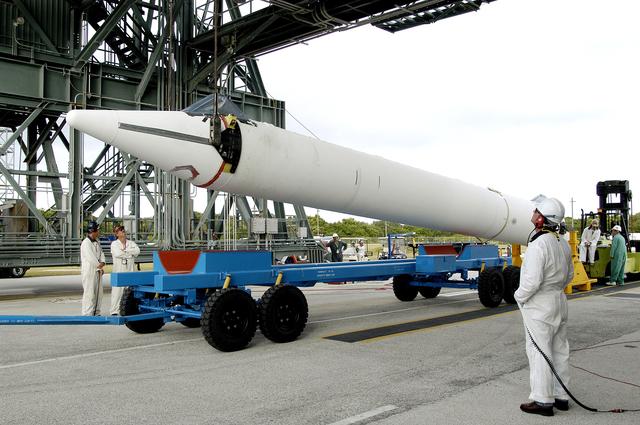
KENNEDY SPACE CENTER, FLA. - On Launch Complex 17-B, Cape Canaveral Air Force Station, a solid rocket booster is raised off its transporter to lift it to vertical. It will be mated to the Delta II rocket for the Mars Exploration Rover 1 (MER-1) launch June 25. NASA’s twin Mars Exploration Rovers are designed to study the history of water on Mars. These robotic geologists are equipped with a robotic arm, a drilling tool, three spectrometers, and four pairs of cameras that allow them to have a human-like, 3D view of the terrain. Each rover could travel as far as 100 meters in one day to act as Mars scientists' eyes and hands, exploring an environment where humans can’t yet go. MER-2 (MER-A) will launch June 5.
KSC-03pd1676
KSC | 2003-05-20
Details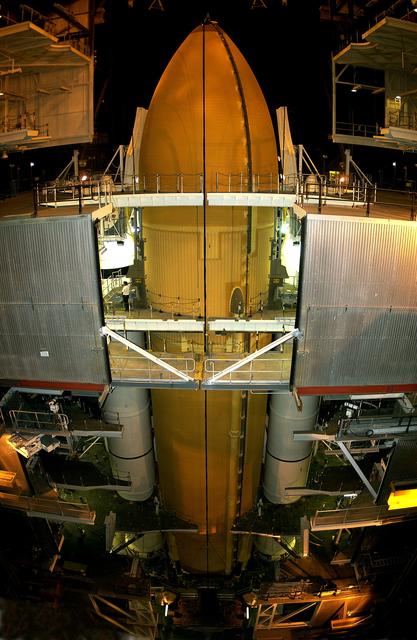
KENNEDY SPACE CENTER, FLA. - The external tank in the Vehicle Assembly Building (VAB) is destacked from the solid rocket boosters. The tank and SRBs were configured for Atlantis and mission STS-114. The tank will remain in the VAB.
KSC-03pd1686
KSC | 2003-05-20
Details