NASA Media Archive

KENNEDY SPACE CENTER, FLA. - The Mars Exploration Rover 2 (MER-2) is ready for a second spin test in the Payload Hazardous Servicing Facility. After mating to the third stage of the Delta II rocket, MER-2 will be transported to the launch pad. NASA’s twin Mars Exploration Rovers are designed to study the history of water on Mars. These robotic geologists are equipped with a robotic arm, a drilling tool, three spectrometers, and four pairs of cameras that allow them to have a human-like, 3D view of the terrain. Each rover could travel as far as 100 meters in one day to act as Mars scientists' eyes and hands, exploring an environment where humans can’t yet go. The MER-2 is scheduled to launch June 5 from Launch Pad 17-A, Cape Canaveral Air Force Station.
KSC-03pd1664
KSC | 2003-05-19
Details
KENNEDY SPACE CENTER, FLA. - The Mars Exploration Rover 2 (MER-2) is ready for a second spin test in the Payload Hazardous Servicing Facility. After mating to the third stage of the Delta II rocket, MER-2 will be transported to the launch pad. NASA’s twin Mars Exploration Rovers are designed to study the history of water on Mars. These robotic geologists are equipped with a robotic arm, a drilling tool, three spectrometers, and four pairs of cameras that allow them to have a human-like, 3D view of the terrain. Each rover could travel as far as 100 meters in one day to act as Mars scientists' eyes and hands, exploring an environment where humans can’t yet go. The MER-2 is scheduled to launch June 5 from Launch Pad 17-A, Cape Canaveral Air Force Station.
KSC-03pd1662
KSC | 2003-05-19
Details
KENNEDY SPACE CENTER, FLA. - In the Payload Hazardous Servicing Facility, workers secure the Mars Exploration Rover 2 (MER-2) on the spin table. NASA’s twin Mars Exploration Rovers are designed to study the history of water on Mars. These robotic geologists are equipped with a robotic arm, a drilling tool, three spectrometers, and four pairs of cameras that allow them to have a human-like, 3D view of the terrain. Each rover could travel as far as 100 meters in one day to act as Mars scientists' eyes and hands, exploring an environment where humans can’t yet go. The MER-2 is scheduled to launch June 5 from Launch Pad 17-A, Cape Canaveral Air Force Station.
KSC-03pd1661
KSC | 2003-05-19
Details
KENNEDY SPACE CENTER, FLA. - In the Payload Hazardous Servicing Facility, an overhead crane lifts the Mars Exploration Rover 2 (MER-2) to move it to a spin table. NASA’s twin Mars Exploration Rovers are designed to study the history of water on Mars. These robotic geologists are equipped with a robotic arm, a drilling tool, three spectrometers, and four pairs of cameras that allow them to have a human-like, 3D view of the terrain. Each rover could travel as far as 100 meters in one day to act as Mars scientists' eyes and hands, exploring an environment where humans can’t yet go. The MER-2 is scheduled to launch June 5 from Launch Pad 17-A, Cape Canaveral Air Force Station.
KSC-03pd1657
KSC | 2003-05-19
Details
KENNEDY SPACE CENTER, FLA. - In the Payload Hazardous Servicing Facility, the Mars Exploration Rover 2 (MER-2) is lowered toward the spin table. NASA’s twin Mars Exploration Rovers are designed to study the history of water on Mars. These robotic geologists are equipped with a robotic arm, a drilling tool, three spectrometers, and four pairs of cameras that allow them to have a human-like, 3D view of the terrain. Each rover could travel as far as 100 meters in one day to act as Mars scientists' eyes and hands, exploring an environment where humans can’t yet go. The MER-2 is scheduled to launch June 5 from Launch Pad 17-A, Cape Canaveral Air Force Station.
KSC-03pd1660
KSC | 2003-05-19
Details
KENNEDY SPACE CENTER, FLA. - In the Payload Hazardous Servicing Facility, an overhead crane lifts the Mars Exploration Rover 2 (MER-2) to move it to a spin table. NASA’s twin Mars Exploration Rovers are designed to study the history of water on Mars. These robotic geologists are equipped with a robotic arm, a drilling tool, three spectrometers, and four pairs of cameras that allow them to have a human-like, 3D view of the terrain. Each rover could travel as far as 100 meters in one day to act as Mars scientists' eyes and hands, exploring an environment where humans can’t yet go. The MER-2 is scheduled to launch June 5 from Launch Pad 17-A, Cape Canaveral Air Force Station.
KSC-03pd1658
KSC | 2003-05-19
Details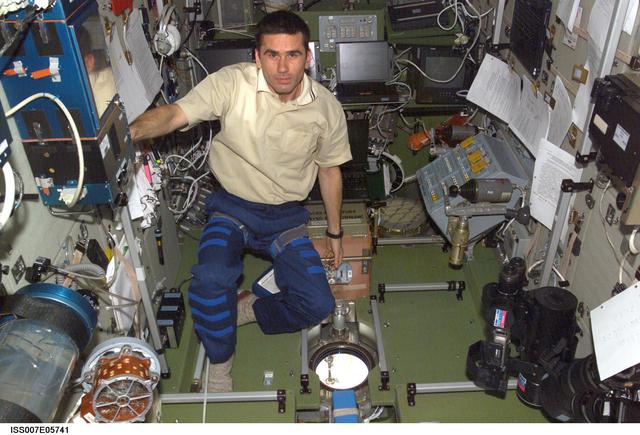

KENNEDY SPACE CENTER, FLA. - The Mars Exploration Rover 2 (MER-2) is ready for a second spin test in the Payload Hazardous Servicing Facility. After mating to the third stage of the Delta II rocket, MER-2 will be transported to the launch pad. NASA’s twin Mars Exploration Rovers are designed to study the history of water on Mars. These robotic geologists are equipped with a robotic arm, a drilling tool, three spectrometers, and four pairs of cameras that allow them to have a human-like, 3D view of the terrain. Each rover could travel as far as 100 meters in one day to act as Mars scientists' eyes and hands, exploring an environment where humans can’t yet go. The MER-2 is scheduled to launch June 5 from Launch Pad 17-A, Cape Canaveral Air Force Station.
KSC-03pd1663
KSC | 2003-05-19
Details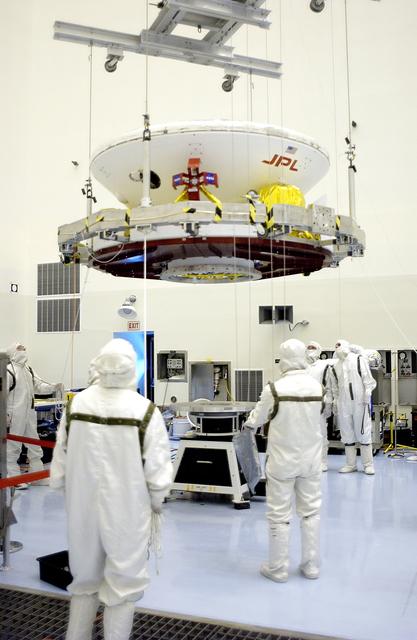
KENNEDY SPACE CENTER, FLA. - In the Payload Hazardous Servicing Facility, the Mars Exploration Rover 2 (MER-2) is moved to a spin table. NASA’s twin Mars Exploration Rovers are designed to study the history of water on Mars. These robotic geologists are equipped with a robotic arm, a drilling tool, three spectrometers, and four pairs of cameras that allow them to have a human-like, 3D view of the terrain. Each rover could travel as far as 100 meters in one day to act as Mars scientists' eyes and hands, exploring an environment where humans can’t yet go. The MER-2 is scheduled to launch June 5 from Launch Pad 17-A, Cape Canaveral Air Force Station.
KSC-03pd1659
KSC | 2003-05-19
Details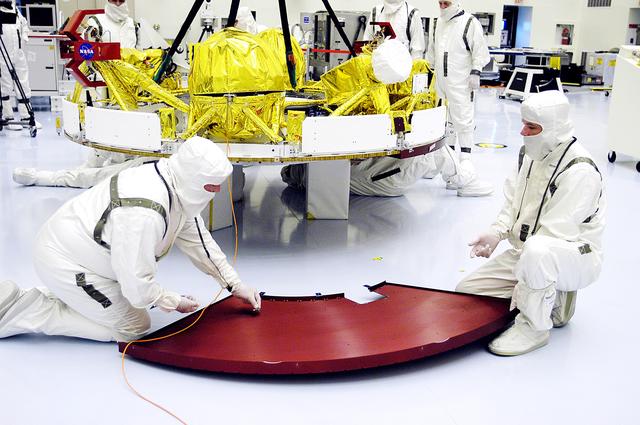
KENNEDY SPACE CENTER, FLA. - In the Payload Hazardous Servicing Facility, workers check one of the cruise stage solar panel protective covers on Mars Exploration Rover 1 (MER-1). The cruise stage will be integrated with the aeroshell, the entry vehicle. NASA’s twin Mars Exploration Rovers are designed to study the history of water on Mars. These robotic geologists are equipped with a robotic arm, a drilling tool, three spectrometers, and four pairs of cameras that allow them to have a human-like, 3D view of the terrain. Each rover could travel as far as 100 meters in one day to act as Mars scientists' eyes and hands, exploring an environment where humans can’t yet go. The MER-1 is scheduled to launch June 25 from Launch Pad 17-A, Cape Canaveral Air Force Station.
KSC-03pd1652
KSC | 2003-05-19
Details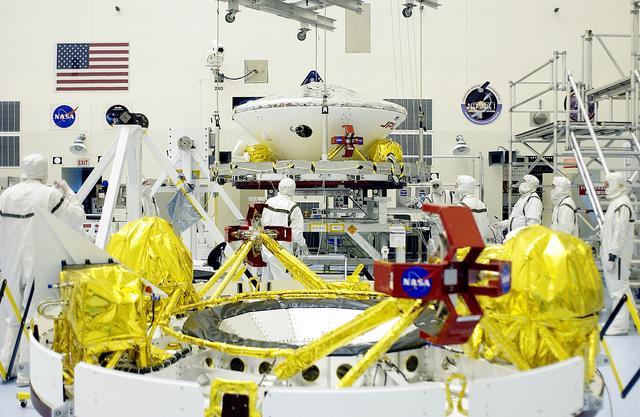
KENNEDY SPACE CENTER, FLA. - In the Payload Hazardous Servicing Facility, an overhead crane (background) is lifting the Mars Exploration Rover 2 (MER-2) to move it to a spin table. In the foreground is the cruise stage for MER-1. NASA’s twin Mars Exploration Rovers are designed to study the history of water on Mars. These robotic geologists are equipped with a robotic arm, a drilling tool, three spectrometers, and four pairs of cameras that allow them to have a human-like, 3D view of the terrain. Each rover could travel as far as 100 meters in one day to act as Mars scientists' eyes and hands, exploring an environment where humans can’t yet go. The MER-2 is scheduled to launch June 5 from Launch Pad 17-A, Cape Canaveral Air Force Station.
KSC-03pd1656
KSC | 2003-05-19
Details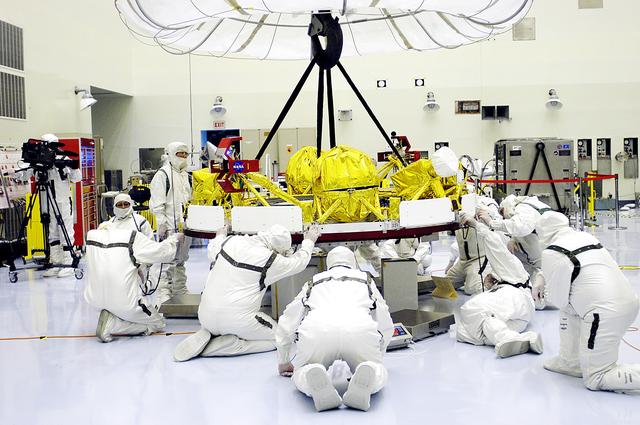
KENNEDY SPACE CENTER, FLA. - In the Payload Hazardous Servicing Facility, workers help guide the cruise stage of Mars Exploration Rover 1 (MER-1) as it is lowered onto blocks. The cruise stage will be integrated with the aeroshell, the entry vehicle. NASA’s twin Mars Exploration Rovers are designed to study the history of water on Mars. These robotic geologists are equipped with a robotic arm, a drilling tool, three spectrometers, and four pairs of cameras that allow them to have a human-like, 3D view of the terrain. Each rover could travel as far as 100 meters in one day to act as Mars scientists' eyes and hands, exploring an environment where humans can’t yet go. The MER-1 is scheduled to launch June 25 from Launch Pad 17-A, Cape Canaveral Air Force Station.
KSC-03pd1647
KSC | 2003-05-18
Details
KENNEDY SPACE CENTER, FLA. - Workers in the Payload Hazardous Servicing Facility prepare an overhead crane (background) that will lift the cruise stage, in the foreground, for Mars Exploration Rover 1 (MER-1). The cruise stage will be moved and integrated with the aeroshell, the entry vehicle. NASA’s twin Mars Exploration Rovers are designed to study the history of water on Mars. These robotic geologists are equipped with a robotic arm, a drilling tool, three spectrometers, and four pairs of cameras that allow them to have a human-like, 3D view of the terrain. Each rover could travel as far as 100 meters in one day to act as Mars scientists' eyes and hands, exploring an environment where humans can’t yet go. The MER-1 is scheduled to launch June 25 from Launch Pad 17-A, Cape Canaveral Air Force Station.
KSC-03pd1644
KSC | 2003-05-18
Details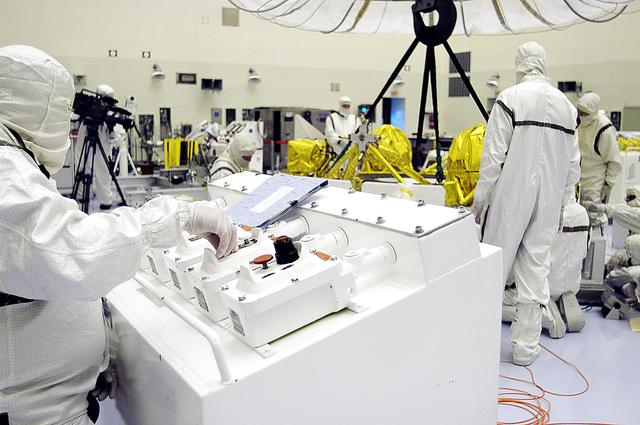
KENNEDY SPACE CENTER, FLA. - In the Payload Hazardous Servicing Facility, workers check the status of the cruise stage of Mars Exploration Rover 1 (MER-1) after being lowered onto blocks. The cruise stage will be integrated with the aeroshell, the entry vehicle. NASA’s twin Mars Exploration Rovers are designed to study the history of water on Mars. These robotic geologists are equipped with a robotic arm, a drilling tool, three spectrometers, and four pairs of cameras that allow them to have a human-like, 3D view of the terrain. Each rover could travel as far as 100 meters in one day to act as Mars scientists' eyes and hands, exploring an environment where humans can’t yet go. The MER-1 is scheduled to launch June 25 from Launch Pad 17-A, Cape Canaveral Air Force Station.
KSC-03pd1651
KSC | 2003-05-18
Details
KENNEDY SPACE CENTER, FLA. - Workers in the Payload Hazardous Servicing Facility check the cruise stage of Mars Exploration Rover 1 (MER-1) that will be lifted and moved by the overhead crane for integration with the aeroshell, the entry vehicle. NASA’s twin Mars Exploration Rovers are designed to study the history of water on Mars. These robotic geologists are equipped with a robotic arm, a drilling tool, three spectrometers, and four pairs of cameras that allow them to have a human-like, 3D view of the terrain. Each rover could travel as far as 100 meters in one day to act as Mars scientists' eyes and hands, exploring an environment where humans can’t yet go. The MER-1 is scheduled to launch June 25 from Launch Pad 17-A, Cape Canaveral Air Force Station.
KSC-03pd1645
KSC | 2003-05-18
Details
KENNEDY SPACE CENTER, FLA. - In the Payload Hazardous Servicing Facility, an overhead crane is lifting the Mars Exploration Rover 2 (MER-2) to move it to a spin table. NASA’s twin Mars Exploration Rovers are designed to study the history of water on Mars. These robotic geologists are equipped with a robotic arm, a drilling tool, three spectrometers, and four pairs of cameras that allow them to have a human-like, 3D view of the terrain. Each rover could travel as far as 100 meters in one day to act as Mars scientists' eyes and hands, exploring an environment where humans can’t yet go. The MER-2 is scheduled to launch June 5 from Launch Pad 17-A, Cape Canaveral Air Force Station.
KSC-03pd1655
KSC | 2003-05-18
Details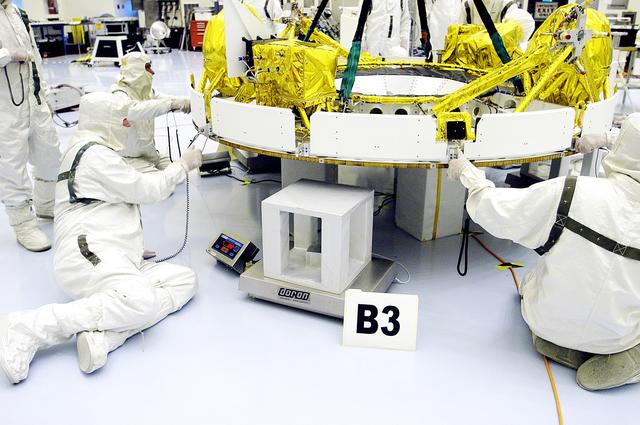
KENNEDY SPACE CENTER, FLA. - In the Payload Hazardous Servicing Facility, workers help guide the cruise stage of Mars Exploration Rover 1 (MER-1) as it is lowered onto blocks. The cruise stage will be integrated with the aeroshell, the entry vehicle. NASA’s twin Mars Exploration Rovers are designed to study the history of water on Mars. These robotic geologists are equipped with a robotic arm, a drilling tool, three spectrometers, and four pairs of cameras that allow them to have a human-like, 3D view of the terrain. Each rover could travel as far as 100 meters in one day to act as Mars scientists' eyes and hands, exploring an environment where humans can’t yet go. The MER-1 is scheduled to launch June 25 from Launch Pad 17-A, Cape Canaveral Air Force Station.
KSC-03pd1648
KSC | 2003-05-18
Details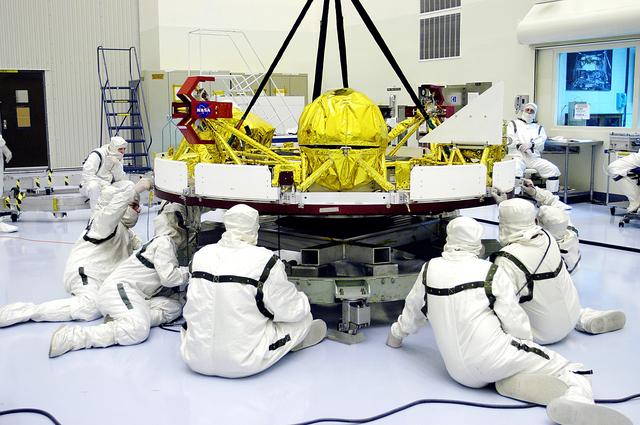
KENNEDY SPACE CENTER, FLA. - In the Payload Hazardous Servicing Facility, workers check the cruise stage of Mars Exploration Rover 1 (MER-1) being lifted off a stand. The cruise stage will be integrated with the aeroshell, the entry vehicle. NASA’s twin Mars Exploration Rovers are designed to study the history of water on Mars. These robotic geologists are equipped with a robotic arm, a drilling tool, three spectrometers, and four pairs of cameras that allow them to have a human-like, 3D view of the terrain. Each rover could travel as far as 100 meters in one day to act as Mars scientists' eyes and hands, exploring an environment where humans can’t yet go. The MER-1 is scheduled to launch June 25 from Launch Pad 17-A, Cape Canaveral Air Force Station.
KSC-03pd1654
KSC | 2003-05-18
Details
KENNEDY SPACE CENTER, FLA. - Technicians in the Payload Hazardous Servicing Facility prepare the cruise stage for Mars Exploration Rover 1 (MER-1) for integration with the aeroshell, the entry vehicle. NASA’s twin Mars Exploration Rovers are designed to study the history of water on Mars. These robotic geologists are equipped with a robotic arm, a drilling tool, three spectrometers, and four pairs of cameras that allow them to have a human-like, 3D view of the terrain. Each rover could travel as far as 100 meters in one day to act as Mars scientists' eyes and hands, exploring an environment where humans can’t yet go. The MER-1 is scheduled to launch June 25 from Launch Pad 17-A, Cape Canaveral Air Force Station.
KSC-03pd1642
KSC | 2003-05-18
Details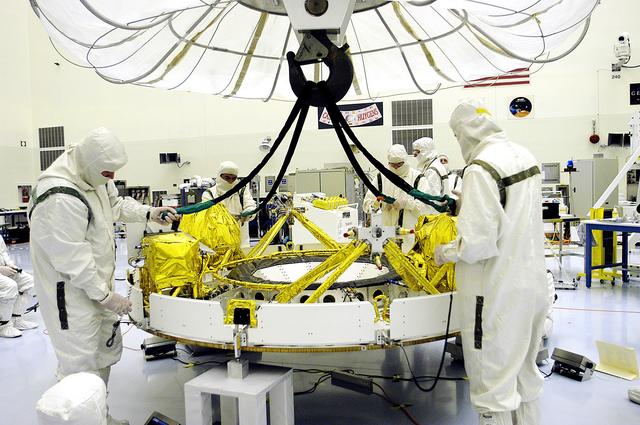
KENNEDY SPACE CENTER, FLA. - In the Payload Hazardous Servicing Facility, workers reattach the tethers of the overhead crane that lowered the cruise stage of Mars Exploration Rover 1 (MER-1) onto blocks. The cruise stage will be lifted and integrated with the aeroshell, the entry vehicle. NASA’s twin Mars Exploration Rovers are designed to study the history of water on Mars. These robotic geologists are equipped with a robotic arm, a drilling tool, three spectrometers, and four pairs of cameras that allow them to have a human-like, 3D view of the terrain. Each rover could travel as far as 100 meters in one day to act as Mars scientists' eyes and hands, exploring an environment where humans can’t yet go. The MER-1 is scheduled to launch June 25 from Launch Pad 17-A, Cape Canaveral Air Force Station.
KSC-03pd1649
KSC | 2003-05-18
Details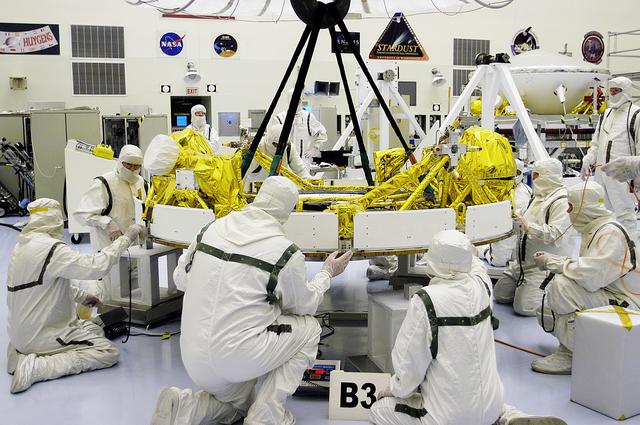
KENNEDY SPACE CENTER, FLA. - In the Payload Hazardous Servicing Facility, workers check the status of the cruise stage of Mars Exploration Rover 1 (MER-1) after being lowered onto blocks. The cruise stage will be integrated with the aeroshell, the entry vehicle. NASA’s twin Mars Exploration Rovers are designed to study the history of water on Mars. These robotic geologists are equipped with a robotic arm, a drilling tool, three spectrometers, and four pairs of cameras that allow them to have a human-like, 3D view of the terrain. Each rover could travel as far as 100 meters in one day to act as Mars scientists' eyes and hands, exploring an environment where humans can’t yet go. The MER-1 is scheduled to launch June 25 from Launch Pad 17-A, Cape Canaveral Air Force Station.
KSC-03pd1650
KSC | 2003-05-18
Details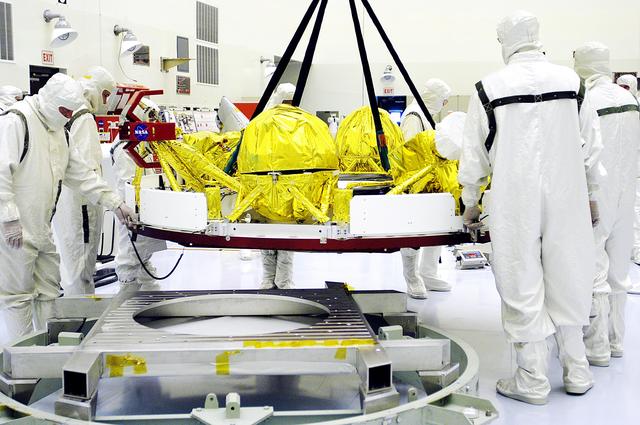
KENNEDY SPACE CENTER, FLA. - In the Payload Hazardous Servicing Facility, workers oversee the movement of the cruise stage of Mars Exploration Rover 1 (MER-1). The cruise stage will be integrated with the aeroshell, the entry vehicle. NASA’s twin Mars Exploration Rovers are designed to study the history of water on Mars. These robotic geologists are equipped with a robotic arm, a drilling tool, three spectrometers, and four pairs of cameras that allow them to have a human-like, 3D view of the terrain. Each rover could travel as far as 100 meters in one day to act as Mars scientists' eyes and hands, exploring an environment where humans can’t yet go. The MER-1 is scheduled to launch June 25 from Launch Pad 17-A, Cape Canaveral Air Force Station.
KSC-03pd1646
KSC | 2003-05-18
Details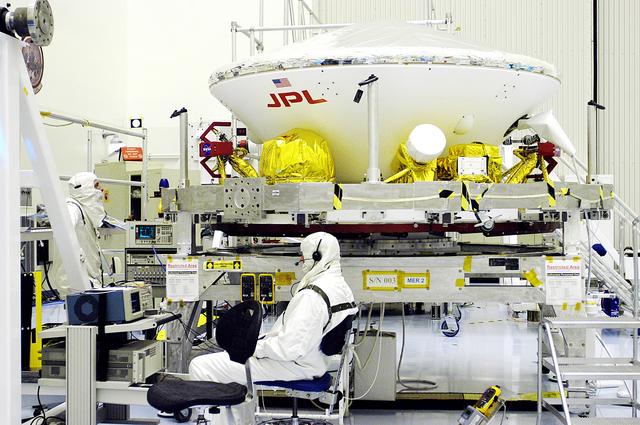
KENNEDY SPACE CENTER, FLA. - The aeroshell, the entry vehicle for Mars Exploration Rover 1 (MER-1), is ready for integration with its cruise stage, seen here below the backshell. What appears to be the top half of the aeroshell is the heat shield. NASA’s twin Mars Exploration Rovers are designed to study the history of water on Mars. These robotic geologists are equipped with a robotic arm, a drilling tool, three spectrometers, and four pairs of cameras that allow them to have a human-like, 3D view of the terrain. Each rover could travel as far as 100 meters in one day to act as Mars scientists' eyes and hands, exploring an environment where humans can’t yet go. The MER-1 is scheduled to launch June 25 from Launch Pad 17-A, Cape Canaveral Air Force Station.
KSC-03pd1643
KSC | 2003-05-18
Details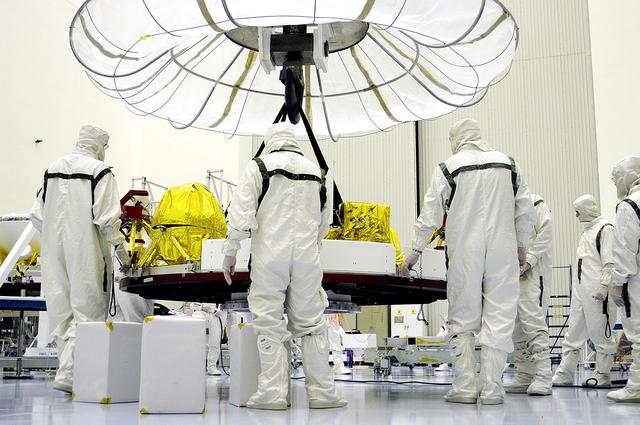
KENNEDY SPACE CENTER, FLA. - In the Payload Hazardous Servicing Facility, workers stand by while an overhead crane again lifts the cruise stage of Mars Exploration Rover 1 (MER-1). The cruise stage will be integrated with the aeroshell, the entry vehicle. NASA’s twin Mars Exploration Rovers are designed to study the history of water on Mars. These robotic geologists are equipped with a robotic arm, a drilling tool, three spectrometers, and four pairs of cameras that allow them to have a human-like, 3D view of the terrain. Each rover could travel as far as 100 meters in one day to act as Mars scientists' eyes and hands, exploring an environment where humans can’t yet go. The MER-1 is scheduled to launch June 25 from Launch Pad 17-A, Cape Canaveral Air Force Station.
KSC-03pd1653
KSC | 2003-05-18
Details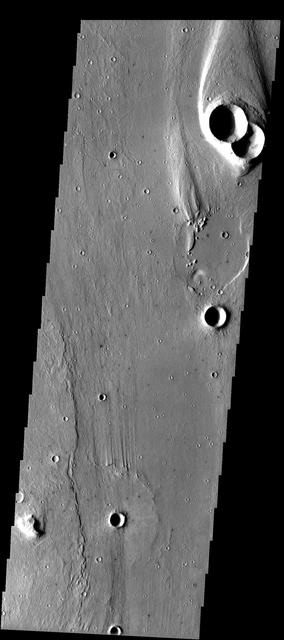

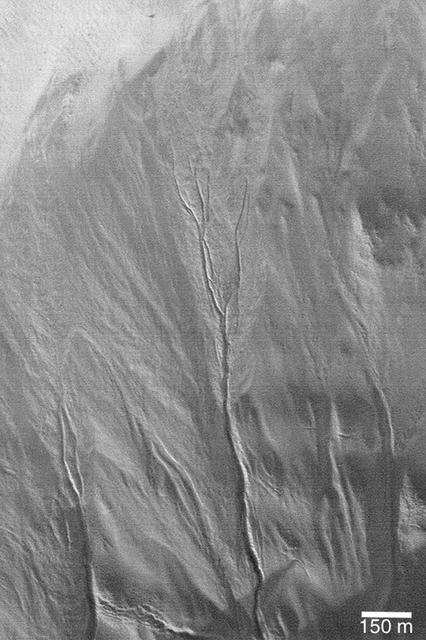
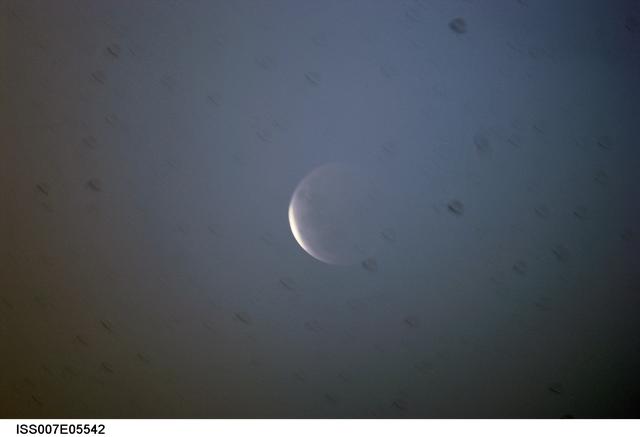
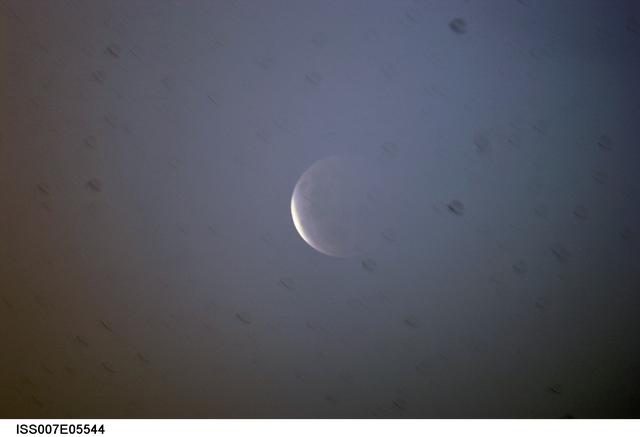
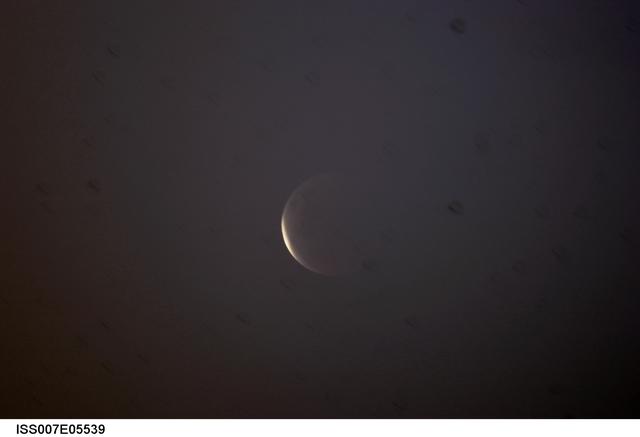
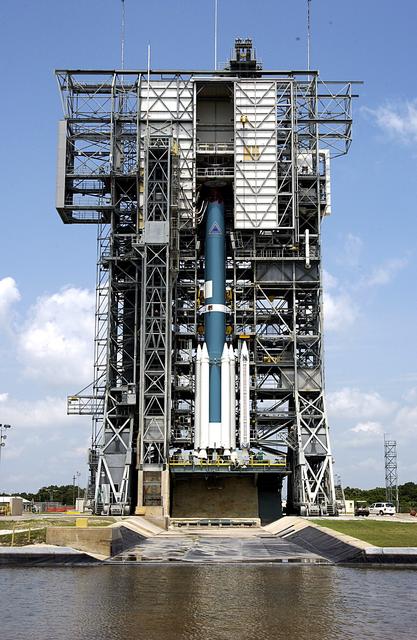
KENNEDY SPACE CENTER, FLA. - The Delta II rocket on Launch Complex 17-A, Cape Canaveral Air Force Station, is having solid rocket boosters (SRBs) installed that will help launch Mars Exploration Rover 2 (MER-2) on June 5. In the center are three more solid rocket boosters that will be added to the Delta, which will carry nine in all. NASA’s twin Mars Exploration Rovers are designed to study the history of water on Mars. These robotic geologists are equipped with a robotic arm, a drilling tool, three spectrometers, and four pairs of cameras that allow them to have a human-like, 3D view of the terrain. Each rover could travel as far as 100 meters in one day to act as Mars scientists' eyes and hands, exploring an environment where humans can’t yet go. MER-2 is scheduled to launch as MER-A. MER-1 (MER-B) will launch June 25.
KSC-03pd1617
KSC | 2003-05-15
Details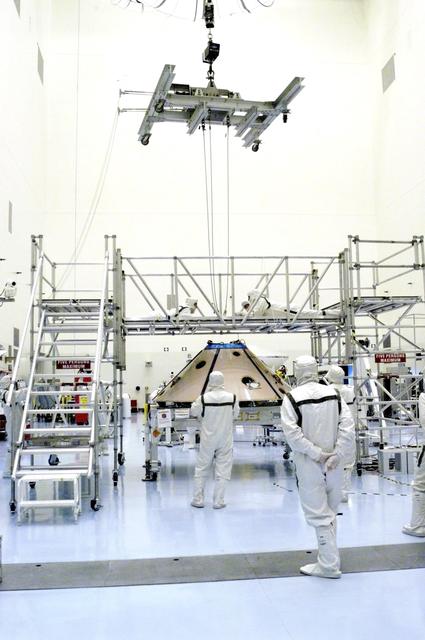
KENNEDY SPACE CENTER, FLA. - An overhead crane is attached to the Mars Exploration Rover 1 (MER-1) inside the upper backshell. The backshell will be moved and attached to the lower heat shield. NASA's twin Mars Exploration Rovers are designed to study the history of water on Mars. These robotic geologists are equipped with a robotic arm, a drilling tool, three spectrometers, and four pairs of cameras that allow them to have a human-like, 3D view of the terrain. Each rover could travel as far as 100 meters in one day to act as Mars scientists' eyes and hands, exploring an environment where humans can't yet go. MER-1 is scheduled to launch June 25 as MER-B aboard a Delta II rocket from Cape Canaveral Air Force Station.
KSC-03pd1600
KSC | 2003-05-15
Details
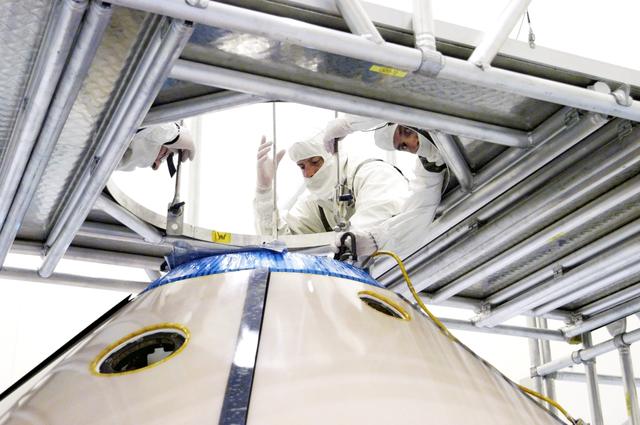
KENNEDY SPACE CENTER, FLA. - Workers attach an overhead crane to the Mars Exploration Rover 1 (MER-1) inside the upper backshell. The backshell will be moved and attached to the lower heat shield. NASA's twin Mars Exploration Rovers are designed to study the history of water on Mars. These robotic geologists are equipped with a robotic arm, a drilling tool, three spectrometers, and four pairs of cameras that allow them to have a human-like, 3D view of the terrain. Each rover could travel as far as 100 meters in one day to act as Mars scientists' eyes and hands, exploring an environment where humans can't yet go. MER-1 is scheduled to launch June 25 as MER-B aboard a Delta II rocket from Cape Canaveral Air Force Station.
KSC-03pd1601
KSC | 2003-05-15
Details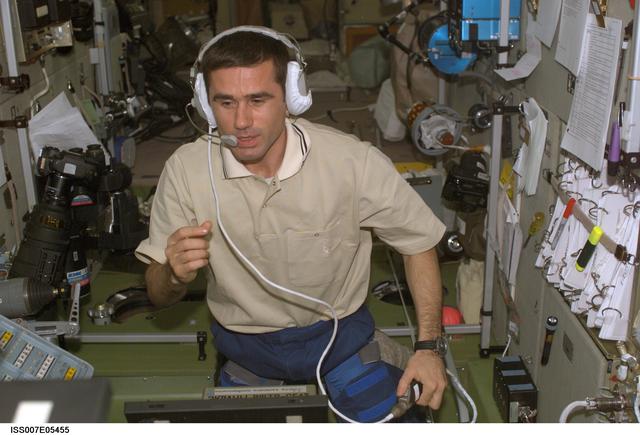
Expedition Seven CDR Malenchenko uses radio in Zvezda Service module
iss007e05455
JSC | 2003-05-15
Details