NASA Media Archive
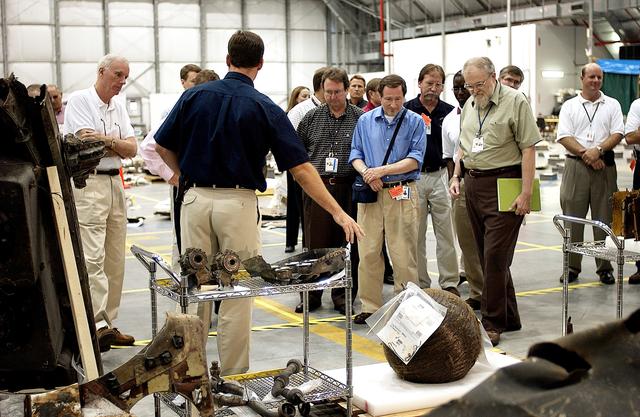
KENNEDY SPACE CENTER, FLA. - Adm. Harold Gehman, far left, chairman of the Columbia Investigation Accident Board, looks at pieces of Columbia debris collected in the KSC RLV Hangar. Other members of the board accompanied him as part of the ongoing investigation. Recovery efforts as of May 5 included 82,500 pieces of debris weighing 84,800 pounds, almost 40 percent of the total dry weight of the shuttle. About 25,000 personnel took part, utilizing almost 1.5 million total man-hours in the recovery effort and involving more than 130 federal, state and local agencies. The operation was also supported by more than 270 organizations that included businesses and volunteer groups.
KSC-03pd1618
KSC | 2003-05-15
Details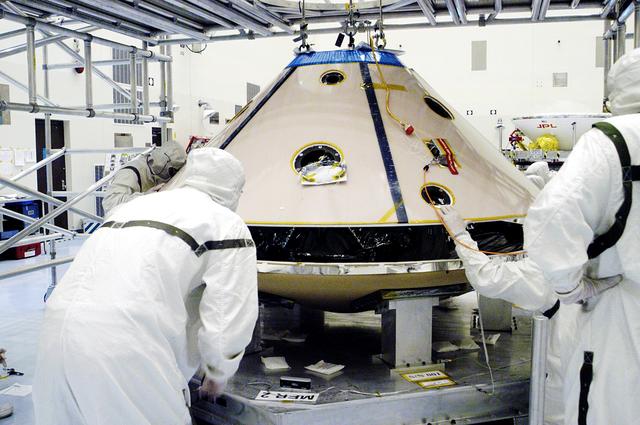
KENNEDY SPACE CENTER, FLA. - In the Payload Hazardous Servicing Facility, workers lower the backshell with the Mars Exploration Rover 1 (MER-1) onto the heat shield. The two components form the aeroshell that will protect the rover on its journey to Mars. NASA's twin Mars Exploration Rovers are designed to study the history of water on Mars. These robotic geologists are equipped with a robotic arm, a drilling tool, three spectrometers, and four pairs of cameras that allow them to have a human-like, 3D view of the terrain. Each rover could travel as far as 100 meters in one day to act as Mars scientists' eyes and hands, exploring an environment where humans can't yet go. MER-1 is scheduled to launch June 25 as MER-B aboard a Delta II rocket from Cape Canaveral Air Force Station.
KSC-03pd1607
KSC | 2003-05-15
Details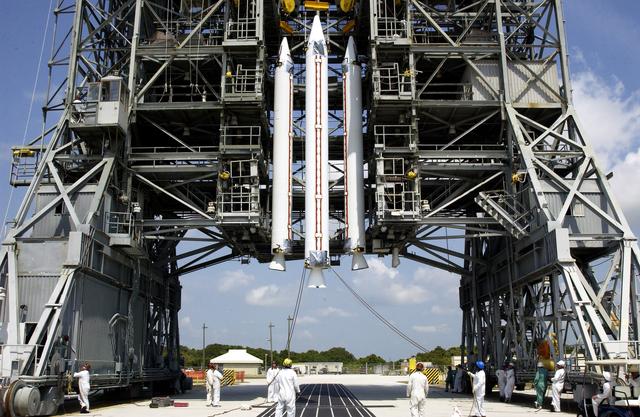
KENNEDY SPACE CENTER, FLA. - Three solid rocket boosters (SRBs) are suspended in the launch tower on Launch Complex 17-A, Cape Canaveral Air Force Station, prior to mating with the Delta II rocket for launch of Mars Exploration Rover 2 (MER-2). NASA’s twin Mars Exploration Rovers are designed to study the history of water on Mars. These robotic geologists are equipped with a robotic arm, a drilling tool, three spectrometers, and four pairs of cameras that allow them to have a human-like, 3D view of the terrain. Each rover could travel as far as 100 meters in one day to act as Mars scientists' eyes and hands, exploring an environment where humans can’t yet go. MER-2 is scheduled to launch June 5 as MER-A. MER-1 (MER-B) will launch June 25.
KSC-03pd1611
KSC | 2003-05-15
Details

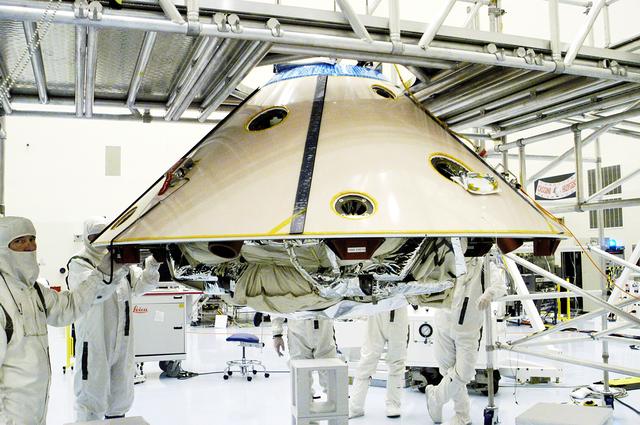
KENNEDY SPACE CENTER, FLA. - Workers walk with the suspended backshell/ Mars Exploration Rover 1 (MER-1) as it travels across the floor of the Payload Hazardous Servicing Facility. The backshell will be attached to the lower heat shield. NASA's twin Mars Exploration Rovers are designed to study the history of water on Mars. These robotic geologists are equipped with a robotic arm, a drilling tool, three spectrometers, and four pairs of cameras that allow them to have a human-like, 3D view of the terrain. Each rover could travel as far as 100 meters in one day to act as Mars scientists' eyes and hands, exploring an environment where humans can't yet go. MER-1 is scheduled to launch June 25 as MER-B aboard a Delta II rocket from Cape Canaveral Air Force Station.
KSC-03pd1603
KSC | 2003-05-15
Details
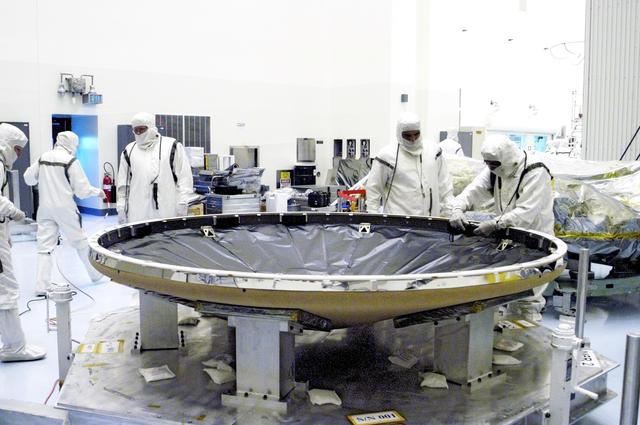
KENNEDY SPACE CENTER, FLA. - Workers in the Payload Hazardous Servicing Facility prepare the heat shield that will be attached to the backshell, surrounding Mars Exploration Rover 1 (MER-1). NASA's twin Mars Exploration Rovers are designed to study the history of water on Mars. These robotic geologists are equipped with a robotic arm, a drilling tool, three spectrometers, and four pairs of cameras that allow them to have a human-like, 3D view of the terrain. Each rover could travel as far as 100 meters in one day to act as Mars scientists' eyes and hands, exploring an environment where humans can't yet go. MER-1 is scheduled to launch June 25 as MER-B aboard a Delta II rocket from Cape Canaveral Air Force Station.
KSC-03pd1598
KSC | 2003-05-15
Details


KENNEDY SPACE CENTER, FLA. - A third solid rocket booster (SRB) joins the first two in the launch tower on Launch Complex 17-A, Cape Canaveral Air Force Station. They are three of nine SRBs that will be mated to the Delta rocket to launch Mars Exploration Rover 2. NASA’s twin Mars Exploration Rovers are designed to study the history of water on Mars. These robotic geologists are equipped with a robotic arm, a drilling tool, three spectrometers, and four pairs of cameras that allow them to have a human-like, 3D view of the terrain. Each rover could travel as far as 100 meters in one day to act as Mars scientists' eyes and hands, exploring an environment where humans can’t yet go. MER-2 is scheduled to launch June 5 as MER-A. MER-1 (MER-B) will launch June 25.
KSC-03pd1597
KSC | 2003-05-14
Details
KENNEDY SPACE CENTER, FLA. - Large items of Columbia debris fill a long table in the RLV Hangar. The items shipped to KSC number more than 82,000 and weigh 84,800 pounds or 38 percent of the total dry weight of Columbia. Of those items, 78,760 have been identified, with 753 placed on the left wing grid in the Hangar.
KSC-03pd1552
KSC | 2003-05-14
Details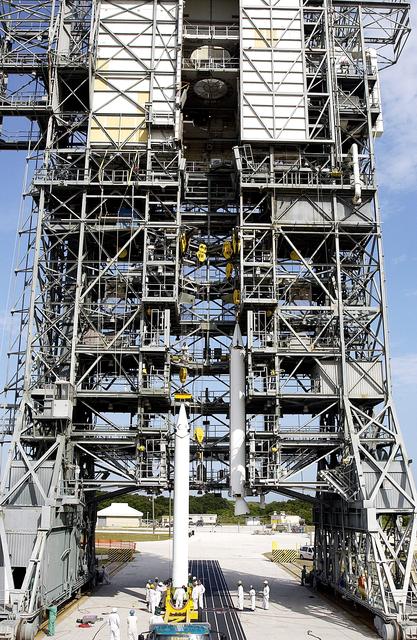
KENNEDY SPACE CENTER, FLA. - A second solid rocket booster (SRB) is ready to be lifted up the launch tower on Launch Complex 17-A, Cape Canaveral Air Force Station. They are two of nine SRBs that will be mated to the Delta rocket to launch Mars Exploration Rover 2. NASA’s twin Mars Exploration Rovers are designed to study the history of water on Mars. These robotic geologists are equipped with a robotic arm, a drilling tool, three spectrometers, and four pairs of cameras that allow them to have a human-like, 3D view of the terrain. Each rover could travel as far as 100 meters in one day to act as Mars scientists' eyes and hands, exploring an environment where humans can’t yet go. MER-2 is scheduled to launch June 5 as MER-A. MER-1 (MER-B) will launch June 25.
KSC-03pd1594
KSC | 2003-05-14
Details
KENNEDY SPACE CENTER, FLA. - On Launch Complex 17-A, Cape Canaveral Air Force Station, a solid rocket booster is moved into position to raise to vertical and lift up the launch tower. It is one of nine that will be mated to the Delta rocket to launch Mars Exploration Rover 2. NASA’s twin Mars Exploration Rovers are designed to study the history of water on Mars. These robotic geologists are equipped with a robotic arm, a drilling tool, three spectrometers, and four pairs of cameras that allow them to have a human-like, 3D view of the terrain. Each rover could travel as far as 100 meters in one day to act as Mars scientists' eyes and hands, exploring an environment where humans can’t yet go. MER-2 is scheduled to launch June 5 as MER-A. MER-1 (MER-B) will launch June 25.
KSC-03pd1588
KSC | 2003-05-14
Details
KENNEDY SPACE CENTER, FLA. - Members of the Columbia Reconstruction Project Team place pieces of debris on a table in the RLV Hangar. The items shipped to KSC number more than 82,000 and weigh 84,800 pounds or 38 percent of the total dry weight of Columbia. Of those items, 78,760 have been identified, with 753 placed on the left wing grid in the Hangar.
KSC-03pd1551
KSC | 2003-05-14
Details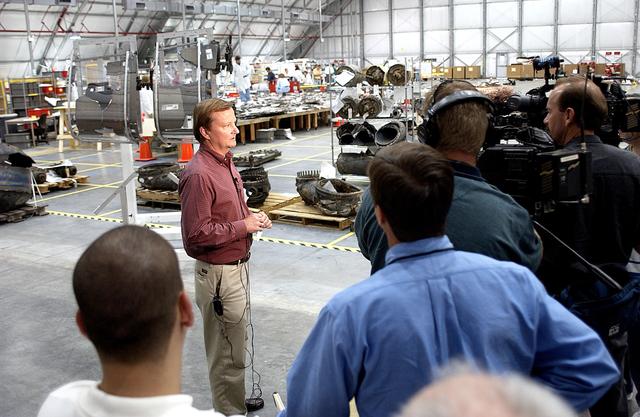
KENNEDY SPACE CENTER, FLA. - Shuttle Launch Director Mike Leinbach talks to the media in the RLV Hangar, site of the collection of Columbia debris undergoing examination. The items shipped to KSC number more than 82,000 and weigh 84,800 pounds or 38 percent of the total dry weight of Columbia. Of those items, 78,760 have been identified, with 753 placed on the left wing grid in the Hangar.
KSC-03pd1554
KSC | 2003-05-14
Details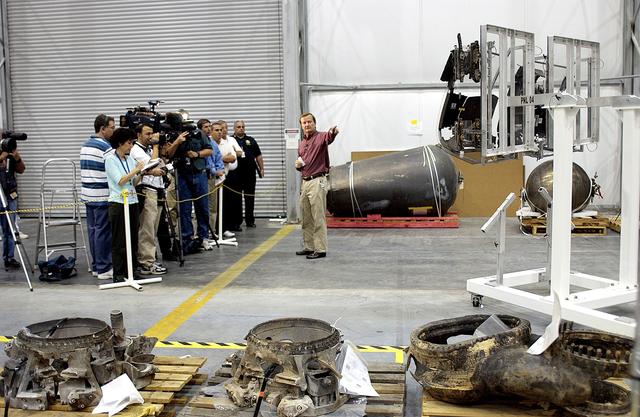
KENNEDY SPACE CENTER, FLA. - While talking to the media, Shuttle Launch Director Mike Leinbach points to some of the investigative tools in the RLV Hangar, where Columbia debris is being examined. The items shipped to KSC number more than 82,000 and weigh 84,800 pounds or 38 percent of the total dry weight of Columbia. Of those items, 78,760 have been identified, with 753 placed on the left wing grid in the Hangar.
KSC-03pd1555
KSC | 2003-05-14
Details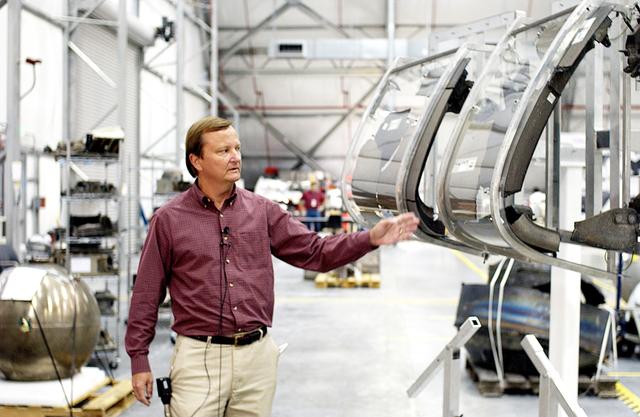
KENNEDY SPACE CENTER, FLA. - While talking to the media in the RLV Hangar, Shuttle Launch Director Mike Leinbach points to the model of the leading edge of an orbiter’s left wing that is being used to reconstruct Columbia’s wing with the recovered debris. The items shipped to KSC number more than 82,000 and weigh 84,800 pounds or 38 percent of the total dry weight of Columbia. Of those items, 78,760 have been identified, with 753 placed on the left wing grid in the Hangar.
KSC-03pd1556
KSC | 2003-05-14
Details
KENNEDY SPACE CENTER, FLA. - On Launch Complex 17-A, Cape Canaveral Air Force Station, a solid rocket booster is prepared to raise it to vertical and lift up the launch tower. It is one of nine that will be mated to the Delta rocket (in the background) to launch Mars Exploration Rover 2. NASA’s twin Mars Exploration Rovers are designed to study the history of water on Mars. These robotic geologists are equipped with a robotic arm, a drilling tool, three spectrometers, and four pairs of cameras that allow them to have a human-like, 3D view of the terrain. Each rover could travel as far as 100 meters in one day to act as Mars scientists' eyes and hands, exploring an environment where humans can’t yet go. MER-2 is scheduled to launch June 5 as MER-A. MER-1 (MER-B) will launch June 25.
KSC-03pd1589
KSC | 2003-05-14
Details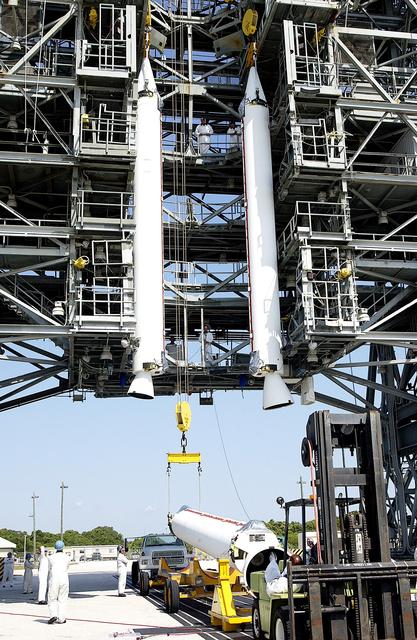
KENNEDY SPACE CENTER, FLA. - While two solid rocket boosters (SRBs) are suspended in the launch tower on Launch Complex 17-A, Cape Canaveral Air Force Station, another is being raised from its transporter for a similar lift. They are three of nine SRBs that will be mated to the Delta rocket to launch Mars Exploration Rover 2. NASA’s twin Mars Exploration Rovers are designed to study the history of water on Mars. These robotic geologists are equipped with a robotic arm, a drilling tool, three spectrometers, and four pairs of cameras that allow them to have a human-like, 3D view of the terrain. Each rover could travel as far as 100 meters in one day to act as Mars scientists' eyes and hands, exploring an environment where humans can’t yet go. MER-2 is scheduled to launch June 5 as MER-A. MER-1 (MER-B) will launch June 25.
KSC-03pd1595
KSC | 2003-05-14
Details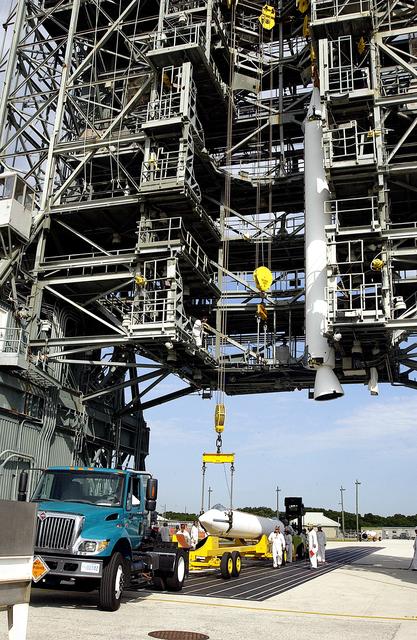
KENNEDY SPACE CENTER, FLA. - While one solid rocket booster (SRB) is suspended in the launch tower on Launch Complex 17-A, Cape Canaveral Air Force Station, another is raised from its transporter for a similar lift. They are two of nine SRBs that will be mated to the Delta rocket to launch Mars Exploration Rover 2. NASA’s twin Mars Exploration Rovers are designed to study the history of water on Mars. These robotic geologists are equipped with a robotic arm, a drilling tool, three spectrometers, and four pairs of cameras that allow them to have a human-like, 3D view of the terrain. Each rover could travel as far as 100 meters in one day to act as Mars scientists' eyes and hands, exploring an environment where humans can’t yet go. MER-2 is scheduled to launch June 5 as MER-A. MER-1 (MER-B) will launch June 25.
KSC-03pd1593
KSC | 2003-05-14
Details
KENNEDY SPACE CENTER, FLA. - On Launch Complex 17-A, Cape Canaveral Air Force Station, a solid rocket booster is raised off the transporter. When vertical, it will be lifted up the launch tower and mated to the Delta rocket (in the background) to launch Mars Exploration Rover 2. NASA’s twin Mars Exploration Rovers are designed to study the history of water on Mars. These robotic geologists are equipped with a robotic arm, a drilling tool, three spectrometers, and four pairs of cameras that allow them to have a human-like, 3D view of the terrain. Each rover could travel as far as 100 meters in one day to act as Mars scientists' eyes and hands, exploring an environment where humans can’t yet go. MER-2 is scheduled to launch June 5 as MER-A. MER-1 (MER-B) will launch June 25.
KSC-03pd1590
KSC | 2003-05-14
Details
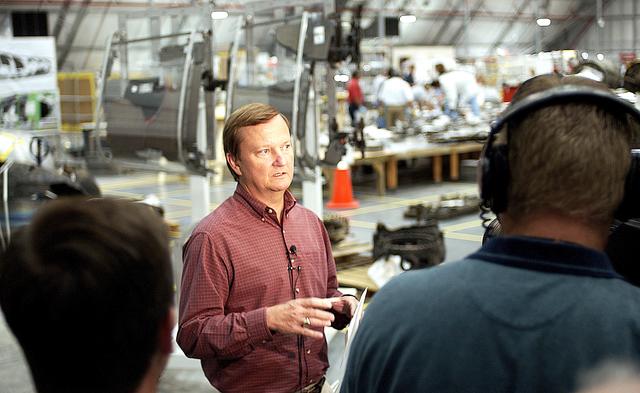
KENNEDY SPACE CENTER, FLA. - Shuttle Launch Director Mike Leinbach talks to the media in the RLV Hangar, site of the collection of Columbia debris undergoing examination. The items shipped to KSC number more than 82,000 and weigh 84,800 pounds or 38 percent of the total dry weight of Columbia. Of those items, 78,760 have been identified, with 753 placed on the left wing grid in the Hangar.
KSC-03pd1553
KSC | 2003-05-14
Details

KENNEDY SPACE CENTER, FLA. - On Launch Complex 17-A, Cape Canaveral Air Force Station, a solid rocket booster is raised off the transporter. When vertical, it will be lifted up the launch tower and mated to the Delta rocket (in the background) to launch Mars Exploration Rover 2. NASA’s twin Mars Exploration Rovers are designed to study the history of water on Mars. These robotic geologists are equipped with a robotic arm, a drilling tool, three spectrometers, and four pairs of cameras that allow them to have a human-like, 3D view of the terrain. Each rover could travel as far as 100 meters in one day to act as Mars scientists' eyes and hands, exploring an environment where humans can’t yet go. MER-2 is scheduled to launch June 5 as MER-A. MER-1 (MER-B) will launch June 25.
KSC-03pd1591
KSC | 2003-05-14
Details
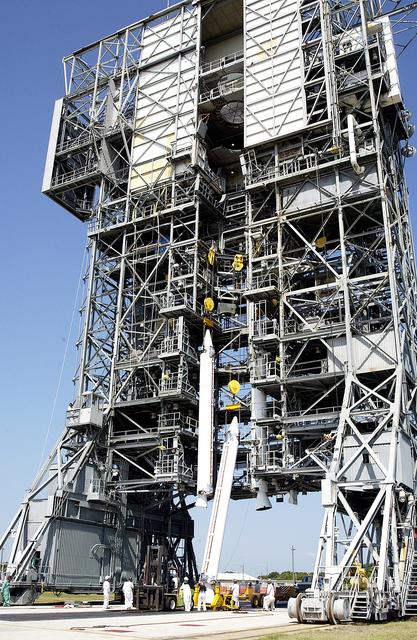
KENNEDY SPACE CENTER, FLA. - A third solid rocket booster (SRB) is lifted up the launch tower on Launch Complex 17-A, Cape Canaveral Air Force Station. They are three of nine SRBs that will be mated to the Delta rocket to launch Mars Exploration Rover 2. NASA’s twin Mars Exploration Rovers are designed to study the history of water on Mars. These robotic geologists are equipped with a robotic arm, a drilling tool, three spectrometers, and four pairs of cameras that allow them to have a human-like, 3D view of the terrain. Each rover could travel as far as 100 meters in one day to act as Mars scientists' eyes and hands, exploring an environment where humans can’t yet go. MER-2 is scheduled to launch June 5 as MER-A. MER-1 (MER-B) will launch June 25.
KSC-03pd1596
KSC | 2003-05-14
Details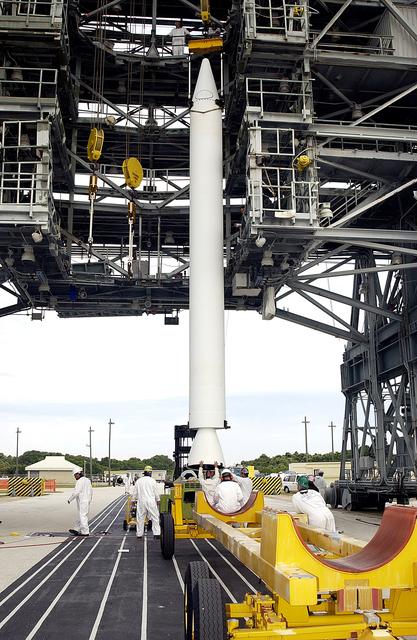
KENNEDY SPACE CENTER, FLA. - On Launch Complex 17-A, Cape Canaveral Air Force Station, workers complete raising a solid rocket booster to a vertical position. It will be lifted up the launch tower and mated to the Delta rocket to launch Mars Exploration Rover 2. NASA’s twin Mars Exploration Rovers are designed to study the history of water on Mars. These robotic geologists are equipped with a robotic arm, a drilling tool, three spectrometers, and four pairs of cameras that allow them to have a human-like, 3D view of the terrain. Each rover could travel as far as 100 meters in one day to act as Mars scientists' eyes and hands, exploring an environment where humans can’t yet go. MER-2 is scheduled to launch June 5 as MER-A. MER-1 (MER-B) will launch June 25.
KSC-03pd1592
KSC | 2003-05-14
Details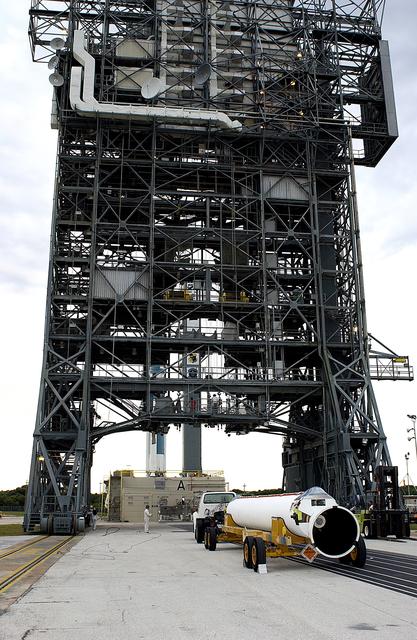
KENNEDY SPACE CENTER, FLA. - A solid rocket booster arrives at Launch Complex 17-A, Cape Canaveral Air Force Station. It is one of nine that will be mated to the Delta rocket to launch Mars Exploration Rover 2. NASA’s twin Mars Exploration Rovers are designed to study the history of water on Mars. These robotic geologists are equipped with a robotic arm, a drilling tool, three spectrometers, and four pairs of cameras that allow them to have a human-like, 3D view of the terrain. Each rover could travel as far as 100 meters in one day to act as Mars scientists' eyes and hands, exploring an environment where humans can’t yet go. MER-2 is scheduled to launch June 5 as MER-A. MER-1 (MER-B) will launch June 25.
KSC-03pd1587
KSC | 2003-05-14
Details