NASA Media Archive





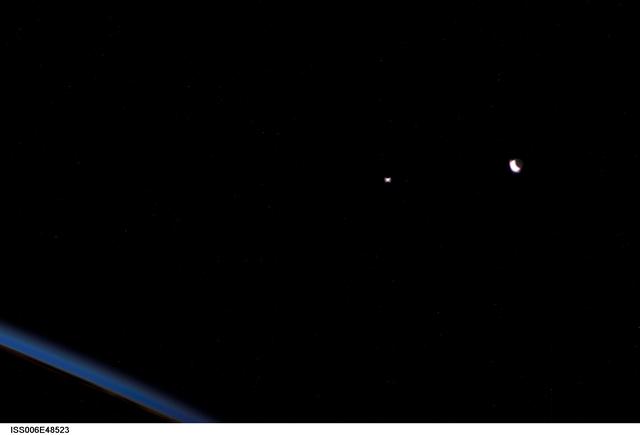
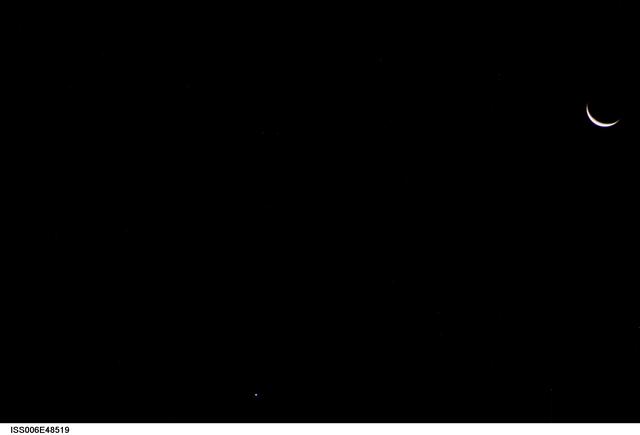
View of crescent moon and the planet Venus during Expedition Six
iss006e48523
JSC | 2003-04-28
Details
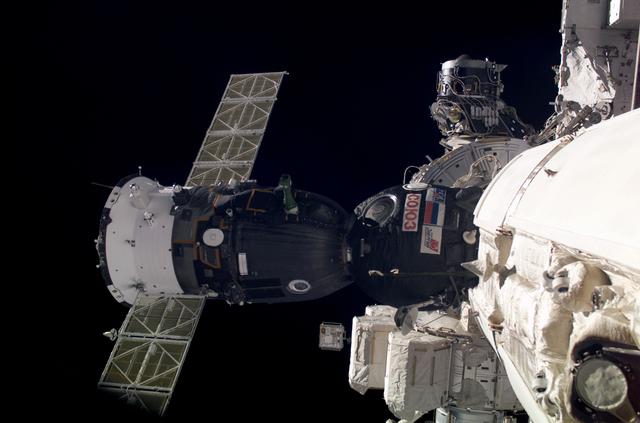
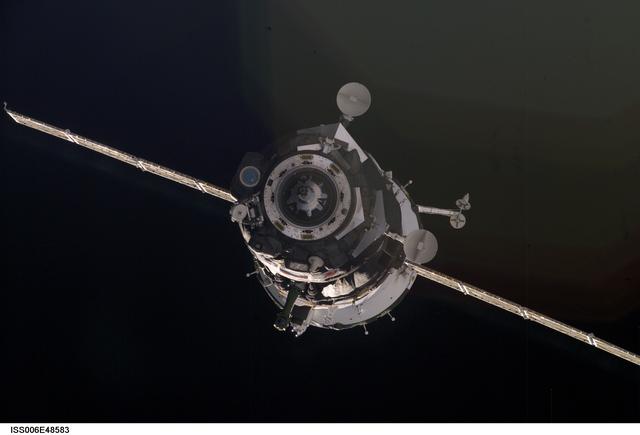
View of Soyuz TMA-2 is docked to the FGB nadir port on the ISS during Expedition Six
iss006e48631
JSC | 2003-04-28
Details



KENNEDY SPACE CENTER, FLA. - Orbital Sciences’ L-1011 aircraft takes off from Cape Canaveral Air Force Station carrying the Pegasus XL rocket/Galaxy Evolution Explorer (GALEX) under its belly. Release of the Pegasus was scheduled for about 8 a.m. over the Atlantic Ocean at an altitude of 39,000 feet at a location approximately 100 nautical miles offshore east-northeast of Cape Canaveral. Spacecraft separation from the Pegasus occurs 11 minutes later. At that time the satellite will be in a circular orbit of 431 statute miles (690 km) at a 29-degree inclination. The GALEX will carry into space an orbiting telescope that will observe a million galaxies across 10 billion years of cosmic history to help astronomers determine when the stars and elements we see today had their origins. The spacecraft will sweep the skies for 28 months using state-of-the-art ultraviolet detectors to single out galaxies dominated by young, hot, short-lived stars that give off a great deal of energy at that wavelength. These galaxies are actively creating stars, and therefore provide a window into the history and causes of star formation in galaxies.
KSC-03pd1288
KSC | 2003-04-28
Details


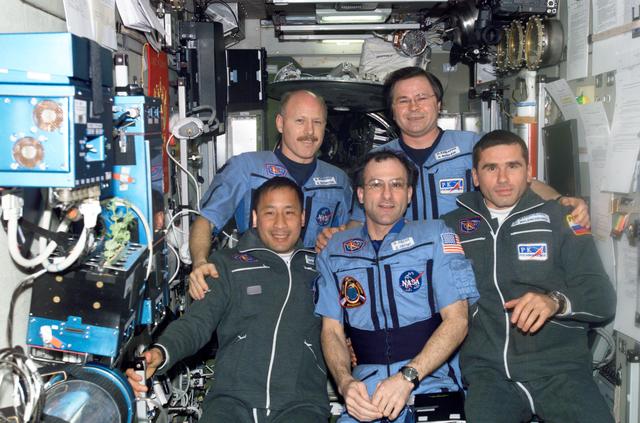
Expedition Six and Seven crews pose for a group photo in the SM
iss006e50609
JSC | 2003-04-28
Details


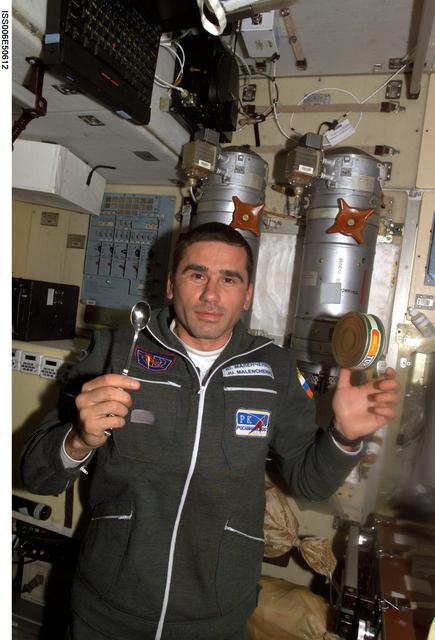
Yuri I. Malenchenko is holding a spoon while a can of food floats nearby in the SM
iss006e50612
JSC | 2003-04-28
Details


KENNEDY SPACE CENTER, FLA. - The second stage of the Delta II rocket is raised off the transporter for its lift up the launch tower on Pad 17-A, Cape Canaveral Air Force Station. It will be mated to the first stage in preparation for the launch of the Mars Exploration Rover 2 (MER-A). The MER Mission consists of two identical rovers designed to cover roughly 110 yards each Martian day over various terrain. Each rover will carry five scientific instruments that will allow it to search for evidence of liquid water that may have been present in the planet’s past. Identical to each other, the rovers will land at different regions of Mars. Launch date for this first of NASA’s two Mars Exploration Rover missions is scheduled June 5.
KSC-03pd1322
KSC | 2003-04-28
Details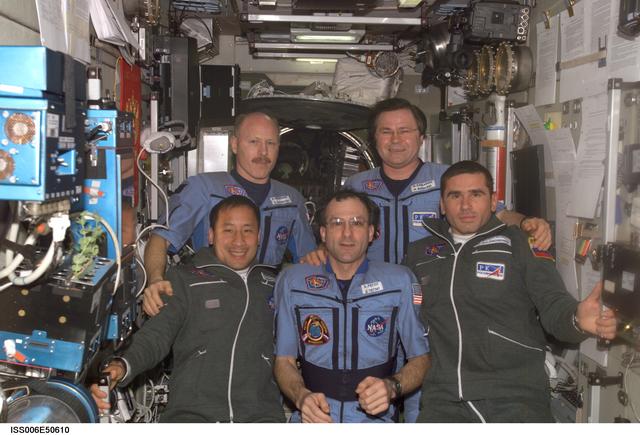
Expedition Six and Seven crews pose for a group photo in the SM
iss006e50610
JSC | 2003-04-28
Details